
Wild silkworm
Bombyx mandarina
Description
How to identify
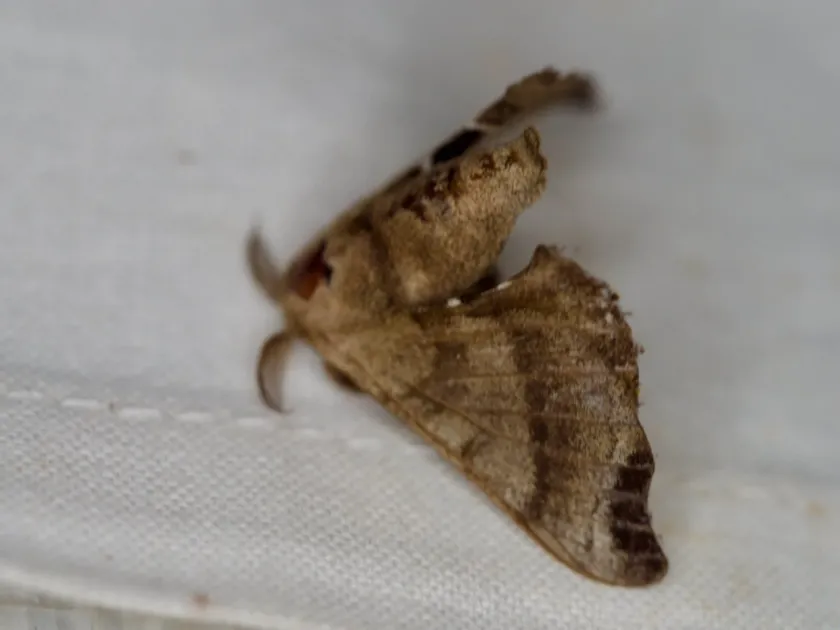
The wild silkworm (Bombyx mandarina) is a moth belonging to the family Bombycidae. As the wild ancestor of the domesticated silkworm, it shares similar morphological characteristics but with distinct coloration adapted for camouflage.
Adult moths typically have a wingspan of 40–50 mm. Their wing coloration ranges from greyish-brown to dark brown, featuring cryptic patterns that allow them to blend seamlessly with tree bark and foliage.
The larvae progress through five instars. Early instars are darker in color, while later stages exhibit a mix of light and dark patterns, aiding in camouflage among the branches of host trees.
A distinctive feature of the larvae is the presence of a horn-like protrusion at the posterior end of the abdomen. They are generally more active and agile compared to the larvae of the domesticated Bombyx mori.
Native to East Asia, this species is well-adapted to local climates and is considered a primary pest for wild and cultivated mulberry plants in countries like China, Japan, and Korea.
What it damages
The wild silkworm primarily feeds on the leaves of mulberry trees (Morus species). Larval feeding can be quite aggressive, leading to significant defoliation of the host plant.
During the initial stages of development, the larvae create small holes in the leaf surface. As they mature, they consume the entire leaf lamina, leaving behind only the primary veins, which severely stresses the tree.
Heavy defoliation interferes with the tree's ability to undergo photosynthesis, directly impacting the plant's health, energy storage, and subsequent growth cycles for the following seasons.
Young mulberry trees are particularly vulnerable to infestation. Persistent feeding can lead to stunted development, dieback of the main branches, and, in severe cases, the mortality of the plant.
While the pest is host-specific to mulberry, in areas where these trees are grown for commercial fruit production or sericulture, the presence of the wild silkworm can cause significant economic losses.
When it appears
The life cycle of the wild silkworm is synchronized with the phenology of the mulberry tree. Typically, the species overwinters in the egg stage, attached to branches or bark.
Egg hatching is triggered by rising spring temperatures, occurring simultaneously with the budding and initial leaf development of the mulberry trees. This ensures an immediate food supply for the emerging larvae.
The larval feeding stage lasts for several weeks, depending on ambient temperatures and food quality. This is the period when damage to the foliage is most visible and severe.
Pupation occurs within a silk cocoon, often spun between folded leaves or within a webbed cluster of branches. The pupal stage is relatively short before the adult moth emerges.
Adult moths emerge, mate, and lay eggs on the bark of host trees. Depending on the latitude and climate, the population may complete one or several generations per year before entering winter diapause.
Control measures
Effective management of the wild silkworm requires a strategic approach focusing on both physical removal and chemical or biological intervention.
- Sanitary pruning of infested branches during the dormant season to eliminate overwintering egg clusters.
- Manual collection and destruction of larvae during early infestation stages to prevent population buildup.
- Application of biological control agents, such as Bacillus thuringiensis, which target larvae while preserving beneficial insects.
- Use of targeted insecticides if the infestation threshold is exceeded, ensuring application coincides with the most vulnerable larval stages.
- Enhancing habitat diversity to support natural predators, including predatory wasps and birds that prey on silkworm larvae.
Early season scouting is critical. Regular monitoring of trees for egg masses and early-instar larvae is the most effective way to manage the pest and prevent major outbreaks.
Taxonomy
- Latin name
- Bombyx mandarina
- Order
- Lepidoptera (butterflies)
- Family
- Bombycidae
- EPPO code
- THEPMA
Discussion
No discussions yet — be the first.