
Blethisa multipunctata
Blethisa multipunctata
Description
How to identify
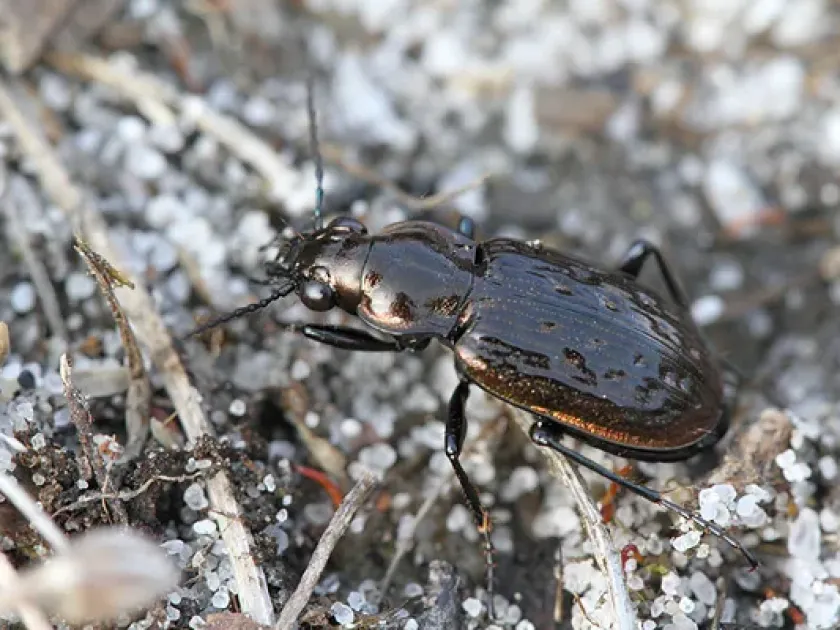
Blethisa multipunctata is a member of the Carabidae family (ground beetles) within the order Coleoptera. These beetles typically grow to 10–13 mm in length and possess a distinct metallic sheen on their elytra.
The beetle’s body exhibits a bronze-black coloration. A key diagnostic feature is the presence of deep, punctate depressions on the elytra arranged in regular rows, which gives the species its common scientific name.
The larvae of Blethisa multipunctata have the typical appearance of ground beetle larvae: they are mobile, with well-developed legs and strong mandibles. They lead a secretive lifestyle, inhabiting the topsoil layer or staying under plant debris.
Adult beetles are highly active during the night. During the day, they prefer to hide under soil clumps, stones, or within the dense root zone of plants.
This species is a typical representative of the entomo-fauna of humid biotopes and is frequently found in fields with high groundwater levels or areas with excessive moisture.
What it damages
Although most carabid beetles are predatory, Blethisa multipunctata can exhibit signs of damage to young crop shoots under specific agro-ecological conditions.
The primary damage occurs during the early growth stages of plants, where adults or larvae may gnaw on tender stems or damage the root system of seedlings.
Cereal crops like wheat and barley are most susceptible to the activity of this beetle, especially during the initial stages of seed germination and seedling establishment.
Damage is often localized, occurring primarily in waterlogged areas of the field where conditions are most favorable for the reproduction and feeding of this species.
When population densities are high, this pest can cause thinning of crops, leading to uneven plant development and a subsequent reduction in overall yield.
When it appears
Activity of Blethisa multipunctata begins in early spring, immediately after the snow melts, when soil temperatures reach the threshold required for insect metabolism.
The most intensive feeding period for adult beetles occurs during the spring months, coinciding with the active growth of winter crops and the germination of spring crops.
The summer period is characterized by a slight decrease in activity as the beetles transition to reproduction and egg-laying in moisture-rich soil substrates.
In autumn, a second wave of activity from the new generation of adults may be observed before the insects move into deeper soil layers for overwintering.
The life cycle of the species is closely tied to the hydrothermal regime of the soil, meaning any fluctuations in humidity significantly impact the population dynamics of this pest.
Signs of infestation
The first visual sign of Blethisa multipunctata presence is characteristic damage to young stems at the soil level, which is often confused with damage caused by wireworms.
Pest presence can be detected using Barber soil traps, which allow for an accurate assessment of beetle population density within a specific area of the field.
When inspecting crops, one should pay attention to areas with stagnant moisture, where beetles congregate during daylight hours under soil clods or plant debris.
An indirect sign is the presence of numerous tunnels on the soil surface created by larvae or adult beetles while searching for food.
- Yellowing or wilting of individual plants during the seedling stage.
- Presence of deep gouges on the lower part of the stem.
- Discovery of imago beetles under straw or weed residues.
- Uneven patchy gaps in crop rows in damp areas.
Control measures
The primary method for controlling Blethisa multipunctata is the implementation of proper agronomic practices aimed at regulating soil water balance and improving field drainage.
High-quality soil cultivation, including deep plowing, plays an important role by destroying beetle shelters and disrupting their breeding conditions.
Eliminating weed vegetation in fields and surrounding areas significantly limits the pest’s food supply and removes its natural habitats.
Chemical control is rarely used and should only be applied if the economic threshold is exceeded, using contact-stomach insecticides.
Crop rotation serves as an effective preventive tool, helping to reduce the accumulation of pests in the soil by alternating crops with different agro-technical requirements.
Taxonomy
- Latin name
- Blethisa multipunctata
- Order
- Coleoptera (beetles)
- Family
- Carabidae
- EPPO code
- BLETMU
Discussion
No discussions yet — be the first.