
Blemus
Blemus
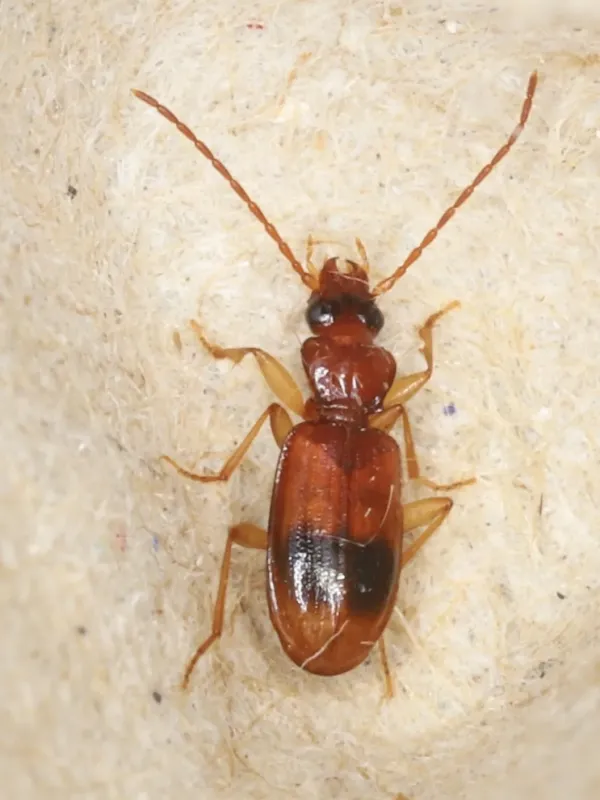
Description
How to identify
The genus Blemus belongs to the family Carabidae (ground beetles) in the order Coleoptera. These are small beetles frequently found in the soil layer and plant debris.
Physically, members of the genus feature elongated bodies typical of many soil-dwelling predators. Their coloration is usually dark, brown, or black, often with a metallic sheen, aiding in camouflage.
The agronomic significance of this genus is mixed. While most Carabidae are predators, some species may exhibit mixophagy, occasionally causing damage to young crop seedlings.
Identification of specific Blemus species requires microscopic analysis of genitalia and elytra structures, as external morphological traits are often subtle and difficult to distinguish in field conditions.
The beetles possess developed limbs adapted for rapid movement within the upper soil horizon and under leaf litter in search of food sources.
What it damages
The primary damage from Blemus occurs during the early developmental stages of agricultural crops, when beetles may feed on tender seedlings of cereals and technical crops.
Crops such as wheat, barley, and maize are particularly sensitive during the germination period and the emergence of the first true leaves.
Damage manifests as nibbling on cotyledons, young stems, and rootlets, which can lead to plant death or significant growth retardation.
Under high humidity and delayed crop growth due to unfavorable weather, the pest's harmfulness increases significantly as the vulnerability period for seedlings is extended.
Beyond direct damage, beetles can contribute to weakening the plant's immunity, creating entry points for secondary fungal and bacterial infections.
When it appears
Activity of Blemus beetles begins early in the spring, immediately after snowmelt and the warming of the topsoil layer to optimal temperatures.
Peak population density usually coincides with the sowing season when the soil contains abundant food resources for adults and their larvae.
During the summer, activity may decrease as pests move to deeper, more humid soil layers, though they remain active in irrigated fields.
A second wave of activity is observed in early autumn, when egg-laying occurs in the soil, making autumn plowing a crucial factor for population control.
The life cycle includes complete metamorphosis: egg, larva, pupa, and imago, with overwintering most often occurring at the adult stage in the soil or under plant remains.
Signs of infestation
The first sign of the pest's presence is thinning of the crop stand, with visible gaps in the fields appearing shortly after seedling emergence.
Detailed inspection of the root zone reveals characteristic bite marks on the stems, which appear jagged or partially consumed.
During evening and night hours, adult beetles can be observed conducting active life cycles on the soil surface or near the base of the stems.
The presence of beetles under soil clods or near plant debris surrounding damaged plants is direct evidence of their presence in the plot.
Indirect signs include the discovery of damaged seeds consumed before germination, often incorrectly attributed to poor seed germination quality.
Control measures
The foundation of control is quality pre-sowing tillage, which destroys beetle hiding spots and makes them vulnerable to natural predators.
Adhering to optimal sowing dates allows crops to pass through the critical development phase quickly, reducing their susceptibility to pest damage.
Applying insecticidal seed treatment is effective in protecting seedlings during the initial growth stages, preventing the loss of young plants to soil-borne pests.
- Utilizing crop rotation to disrupt the pest life cycle.
- Eliminating weeds that serve as reservoirs for the pest.
- Deep autumn plowing to suppress overwintering stages.
In cases of mass outbreaks, approved contact-stomach insecticides are used, applied as edge treatments or across the entire field area.
Taxonomy
- Latin name
- Blemus
- Order
- Coleoptera (beetles)
- Family
- Carabidae
- EPPO code
- BLMUSP
Discussion
No discussions yet — be the first.