
Betasyrphus serarius
Betasyrphus serarius
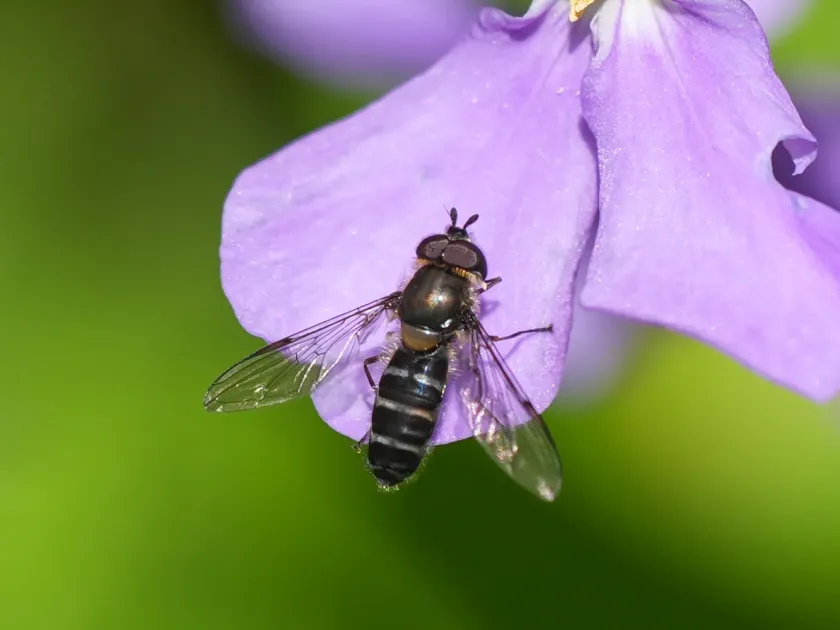
Description
How to identify
Betasyrphus serarius belongs to the Syrphidae family, commonly known as hoverflies or flower flies, within the order Diptera.
Adult flies exhibit Batesian mimicry, featuring yellow and black abdominal patterns that resemble wasps or bees to deter potential avian predators.
The larvae are typically slug-like, lacking legs, and are often greenish or brownish, allowing them to blend seamlessly into aphid colonies.
Morphological identification focuses on the specific structure of the male genitalia and wing venation, which distinguishes this species from others in the genus.
The life cycle includes four stages: egg, three larval instars, puparium, and adult, with development time being highly dependent on ambient temperature.
What it damages
Contrary to the status of a plant pest, Betasyrphus serarius is an important beneficial insect in agricultural and garden ecosystems.
The larvae are voracious predators that feed primarily on various species of aphids, effectively reducing pest pressure on crops.
There is no evidence of this species causing damage to plant tissues, as adults feed exclusively on nectar and pollen.
By controlling aphid populations, these insects contribute significantly to the health of fruit, vegetable, and ornamental plants.
The economic value of this species lies in its ability to provide natural biological control, reducing the need for synthetic pesticides.
When it appears
Adults are active throughout the growing season, typically observed from late spring through early autumn whenever weather conditions are favorable.
Larval activity peaks concurrently with aphid outbreaks, usually during the warmer months of June and July when plant growth is rapid.
The species overwinters as a puparium, typically located in the soil, among leaf litter, or in protected crevices near host plants.
Development is temperature-sensitive, with multiple generations possible during a single summer season in temperate climates.
Populations are highly mobile, allowing adults to colonize areas with abundant food resources for their offspring quickly.
Signs of infestation
Adults are easily identified by their hovering behavior, where they remain stationary in the air before darting to another flower.
Larval presence can be detected by examining the underside of infested leaves, where they are seen feeding on aphid aggregations.
Empty aphid exoskeletons on leaves provide evidence of predatory activity, indicating that Betasyrphus serarius is successfully controlling the pest.
The absence of typical herbivorous damage, such as leaf mining or tissue consumption, confirms the insect's status as a predator.
Monitoring the frequency of hoverflies visiting flowering crops is a reliable indicator of potential biological control activity on the farm.
Control measures
No control measures are necessary for Betasyrphus serarius; on the contrary, efforts should be made to preserve and encourage their presence.
Avoid the use of broad-spectrum insecticides that can decimate populations of these natural aphid predators and disrupt biological balance.
Enhancing biodiversity by planting nectar-rich flowers provides necessary supplemental food for adult hoverflies, increasing their local density.
Sustainable farming practices, such as minimal soil disturbance in autumn, help protect overwintering puparia from mechanical damage.
Integrating biological pest management practices is the most effective way to utilize the natural services provided by this species.
Taxonomy
- Latin name
- Betasyrphus serarius
- Order
- Diptera (flies)
- Family
- Syrphidae
- EPPO code
- SYRPSE
Discussion
No discussions yet — be the first.