
Bembidion obscurellum
Bembidion obscurellum
Description
How to identify
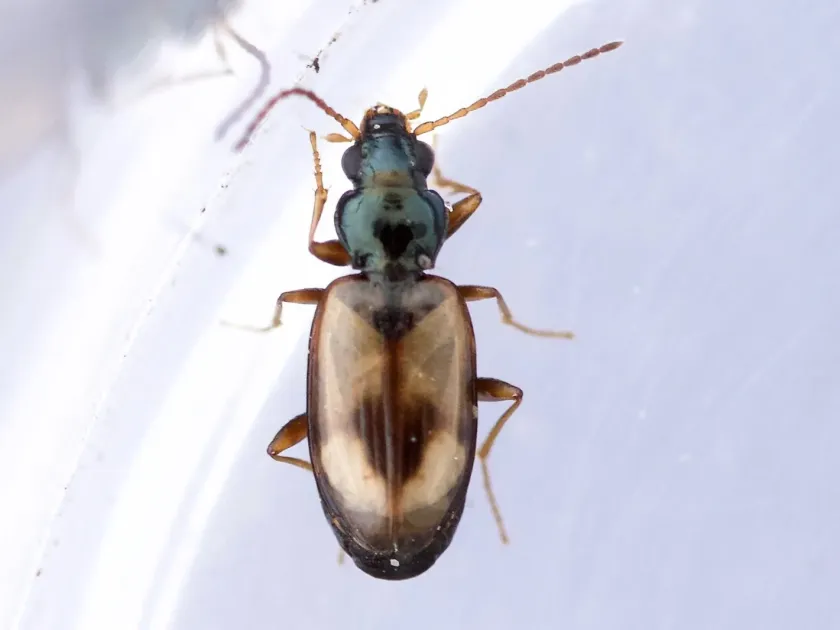
Bembidion obscurellum belongs to the family Carabidae (ground beetles) within the order Coleoptera. It is a small beetle, typically measuring between 3.5 and 4.5 mm in body length.
The appearance is characterized by a dark, often bronze-black coloration with a metallic sheen. The elytra feature fine striae, while the legs and antennae are usually lighter than the rest of the body.
The beetle possesses a body shape typical of the Bembidion genus: slightly flattened, with powerful mandibles adapted for active movement across the soil surface.
Larvae of this species exhibit the characteristic form of ground beetles: elongated, with well-developed thoracic legs, sclerotized integument, and forward-directed mandibles.
This species is a typical representative of the open-field entomofauna, frequently encountered in moist sections of agricultural fields and near water bodies bordering crops.
What it damages
The primary damage occurs during the early stages of crop development, when beetles and larvae may feed on germinating seeds and young seedlings.
Crops potentially at risk include small grains (wheat, barley, rye) and certain row crops, especially in cases of thin stands.
The nature of the damage involves the consumption of tender seedling tissues, which leads to gaps in the stand and may necessitate reseeding on heavily affected areas.
The pest often shows higher activity under conditions of high soil moisture, where it can destroy a significant portion of seedlings in localized infestation patches.
It is important to note that many species of the genus Bembidion are predators, and the pest status of Bembidion obscurellum is often facultative or localized in nature.
When it appears
The active phase of the life cycle begins in spring after the topsoil warms, when adults emerge from their overwintering sites.
Peak abundance of adults is typically observed during May and June, coinciding with the active emergence period of spring grain crops.
Reproduction occurs in the soil, where females lay eggs, followed by larval development through several instars while feeding actively in the soil substrate.
Pupation takes place in soil cells, and the emergence of the new generation often occurs toward the end of summer or early autumn.
Overwintering of adults takes place directly in the soil or beneath plant debris, which ensures high survival rates during unfavorable winter conditions.
Signs of infestation
The first sign of the pest's presence in a field is the appearance of bare patches in the stand where seedlings have been destroyed or damaged at the base.
Visual inspection of damaged plants often reveals mechanical injury to the tissues of young seedlings in the root collar zone.
Beetles can be detected by conducting soil sampling or inspecting the root zone during early morning or evening hours when the pest is most active.
The use of pitfall traps helps to assess population density and informs decisions regarding the necessity of control measures in a specific field.
- Loss of seedlings during early growth stages.
- Mechanical damage to young stems at the base.
- Presence of small black beetles in the soil surface layer.
Control measures
The primary method of control is proper pre-sowing soil cultivation, which disrupts overwintering sites and reduces larval habitats.
Adhering to crop rotation and optimal sowing dates helps minimize the risk of crop damage by creating conditions for rapid and uniform stand establishment.
The application of insecticidal seed treatments prior to sowing is the most effective preventative measure against soil-dwelling pests.
In cases of high pest pressure on young seedlings, the application of registered insecticides during the vegetative stage may be permitted according to local regulations.
Controlling weeds in fields and along field margins eliminates additional food sources and breeding sites for the pest, effectively suppressing population growth.
Taxonomy
- Latin name
- Bembidion obscurellum
- Order
- Coleoptera (beetles)
- Family
- Carabidae
- EPPO code
- BEMDOB
Discussion
No discussions yet — be the first.