
Bembidion intermedium
Bembidion intermedium
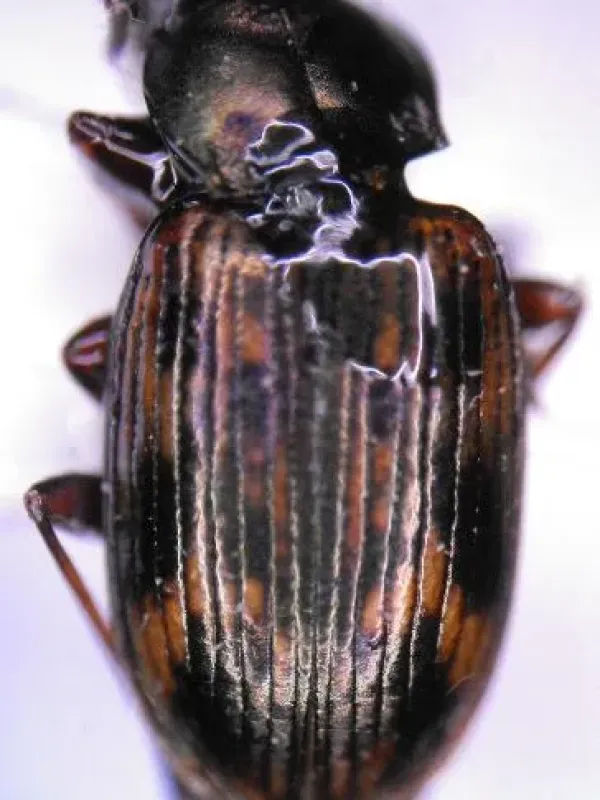
Description
How to identify
Bembidion intermedium is a small ground beetle belonging to the family Carabidae within the order Coleoptera.
The adult beetles are typically small, measuring between 3 to 5 mm in length, which makes them difficult to spot in the field.
Their physical appearance includes an oval-shaped body with a metallic sheen, usually showing bronze or dark green reflections.
They possess strong, well-developed mandibles and legs designed for rapid movement across soil surfaces and between crop debris.
The larvae are typically slender and pale, living a secretive existence in the upper soil layers, which makes them hard to detect without specialized equipment.
What it damages
This beetle causes significant agricultural damage primarily during the germination and seedling emergence stages of various crops.
Adults and larvae can feed on germinating seeds, potentially destroying the embryo and leading to poor field emergence and gaps in rows.
Young seedlings are often damaged at the stem base, which weakens the plant and eventually causes it to wilt and die prematurely.
High moisture areas within fields are the most susceptible to infestation, as these conditions favor the survival and reproduction of this species.
Severe infestations can lead to substantial reductions in plant density, necessitating re-seeding and resulting in major economic losses for the farmer.
When it appears
The life cycle of Bembidion intermedium is heavily influenced by seasonal shifts in temperature and moisture levels.
Overwintering adults emerge from the soil in early spring as soon as the soil temperature rises enough to support their metabolic activity.
Their peak activity often coincides with the timing of spring sowing, placing newly planted seeds and young sprouts at high risk of damage.
The reproductive cycle occurs during the spring and summer months when soil humidity is optimal for larval development.
As the season progresses toward autumn, adults move into deeper soil layers or sheltered areas to enter a state of diapause for the winter.
Signs of infestation
A primary indicator of infestation is the appearance of patchy, sparse seedling stands in areas that are otherwise healthy.
Close inspection of the seedlings may reveal characteristic feeding marks or notches at the base of the stem near the soil line.
Small exit or entry holes in the soil surface around the plants may serve as evidence of beetle or larval burrowing activity.
The sudden wilting of young plants without clear evidence of fungal pathogens often points to damage by soil-dwelling insects.
Observing the beetles during the early morning hours on the soil surface is a clear sign that a significant population is present in the field.
Control measures
Effective management of Bembidion intermedium requires a combination of preventative agricultural practices and timely intervention.
Deep autumn plowing and proper field preparation are essential to disrupt the overwintering sites of the beetles.
Using systemic seed treatments provides a necessary layer of protection, preventing feeding damage during the most vulnerable early growth stages.
Maintaining clean fields by eliminating weeds reduces the alternative food sources and nesting habitats that support beetle populations.
- Crop rotation to break the pest's reproductive cycle.
- Optimizing sowing dates to avoid the peak emergence period of the adults.
- Application of approved insecticides if the pest density exceeds the economic threshold.
Taxonomy
- Latin name
- Bembidion intermedium
- Order
- Coleoptera (beetles)
- Family
- Carabidae
- EPPO code
- BEMDRA
Discussion
No discussions yet — be the first.