
Illiger's ground beetle
Bembidion illigeri
Description
How to identify
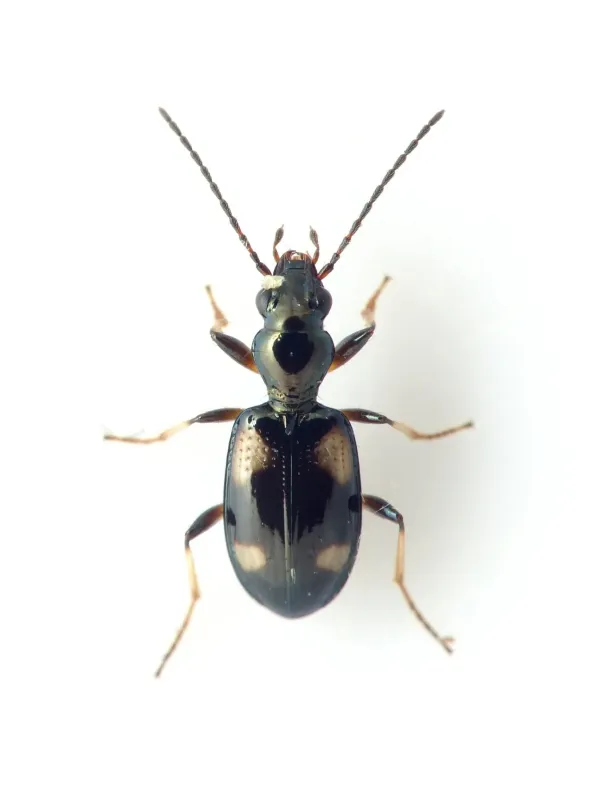
The Illiger's ground beetle (Bembidion illigeri) is a small insect belonging to the family Carabidae within the order Coleoptera. Adult beetles are typically 3-5 mm long and possess a distinct metallic sheen.
Their body shape is slender and elongated, with colors ranging from bronze-brown to almost black, often exhibiting a greenish reflection. They are highly mobile and possess wings, enabling them to move across fields efficiently.
The larvae live within the top layers of the soil. They are elongated and equipped with strong mandibles, which they use to feed on soil organic matter or, when food is scarce, on plant roots.
Adult beetles are active predators, but under specific conditions—such as high population density or lack of alternative food—they may turn to feeding on agricultural crops.
Correct identification requires expert taxonomic knowledge. Because they share characteristics with other species in the Bembidion genus, field identification should be confirmed using microscopical examination of the pronotum and elytra.
What it damages
The primary damage caused by Bembidion illigeri occurs during the germination and seedling emergence stages. Beetles feed on the subterranean parts of plants, hypocotyls, and the initial leaves.
Crops at risk include cereals like wheat and barley, as well as various vegetable crops sown directly into the soil. Damage is particularly severe during cold, wet springs which prolong the emergence phase.
Feeding activity leads to thin, uneven plant stands. In severe cases, the seedlings are completely destroyed, necessitating field reseeding, which adds significant costs to the production process.
Mechanical injuries caused by the beetles provide entry points for soil-borne pathogens, leading to secondary fungal infections and root rot, further weakening the already stressed seedlings.
The risk is higher in fields with minimal tillage or high levels of crop residue. These conditions provide ideal habitats for the beetles to overwinter and congregate near the newly planted crops.
When it appears
The activity of adult beetles begins in early spring as soon as the soil temperatures reach 8-10 degrees Celsius. They emerge from their overwintering sites to forage.
The peak period of damage occurs during the 'pinhead' stage of crop growth. This is the most critical window where seedlings are highly vulnerable to the feeding activities of emerging beetle populations.
Adult activity continues throughout the growing season, though the intensity fluctuates depending on soil moisture levels. They prefer moist environments and are often found in higher numbers near irrigation points or waterlogged areas.
Egg laying occurs in the autumn. The larvae develop over the winter period, and the species primarily overwinter as adults, allowing them to start feeding immediately upon the arrival of spring.
Monitoring the seasonal cycles of this pest is crucial for effective farm management. Knowing when adults become active helps farmers time their planting and potential control measures correctly.
Signs of infestation
The initial sign of an infestation is the appearance of patchy, sparse seedling stands across the field. These patches often show signs of plant loss that are not attributable to environmental factors.
Close observation of the seedlings reveals chewed margins or small, irregular holes in the stems and leaves. Finding small, metallic-colored beetles in the soil around these plants confirms the pest presence.
If seedlings appear to disappear overnight, this is a strong indication of nocturnal feeding by beetles. Soil excavations around affected plants often yield several individuals of the species.
Inconsistent germination quality combined with beetle activity in the seedbed is a major indicator. Distinguishing these signs from those of wireworms or other fly larvae is essential for correct management.
Healthy plants adjacent to damaged ones often show signs of secondary decay, which is common when beetle feeding wounds the plant tissue and exposes it to soil fungi.
Control measures
The primary control measure is sound agronomical practice, specifically deep autumn tillage. This practice disturbs overwintering habitats and significantly reduces the beetle population before the next spring.
Seed treatment with systemic insecticides is the most effective way to protect crops from beetle damage during the vital seedling phase. This ensures the young plant is protected from the inside out.
Crop rotation remains a fundamental strategy to interrupt the lifecycle of the beetle. Avoiding consecutive years of highly susceptible crops in the same field helps prevent population build-ups.
Effective weed management is also necessary, as many weeds act as alternative hosts and refuges for beetles during periods when no main crop is available.
- Use of insecticidal seed dressings.
- Implementation of robust crop rotation schemes.
- Deep ploughing to disrupt soil habitats.
- Optimal planting density and depth for vigorous emergence.
- Field monitoring via soil traps to determine population density.
Taxonomy
- Latin name
- Bembidion illigeri
- Order
- Coleoptera (beetles)
- Family
- Carabidae
- EPPO code
- BEMDIL
Discussion
No discussions yet — be the first.