
Dalmatian ground beetle
Bembidion dalmatinum
Description
How to identify
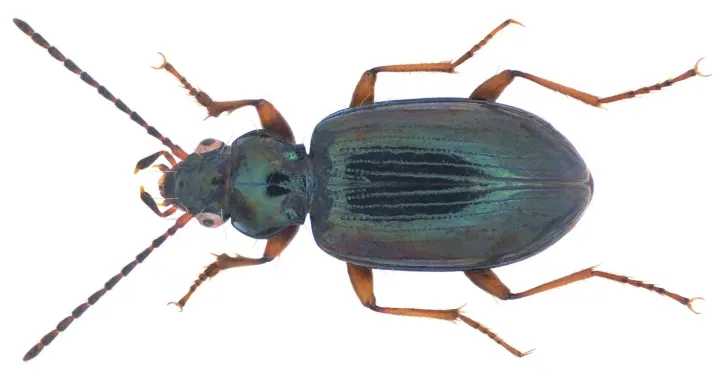
The Dalmatian ground beetle (Bembidion dalmatinum) belongs to the family Carabidae (ground beetles). While many carabids are considered beneficial, this specific species can cause agricultural damage in certain soil conditions.
The adult beetle possesses a typical streamlined body shape, often dark or metallic in appearance, which allows it to thrive in dense soil environments.
The life cycle involves egg, larval, pupal, and adult stages. Its development is highly dependent on environmental moisture and the availability of organic matter in the soil profile.
Identifying this species in the field can be challenging due to its similarity to other beneficial ground beetles, often requiring expert entomological analysis of morphology.
These beetles are highly mobile and can quickly colonize agricultural fields, especially those located near water sources or in areas with consistent moisture levels.
What it damages
Damage caused by Bembidion dalmatinum is primarily concentrated during the sowing phase and the early stages of plant development, affecting various cereal and technical crops.
Adult beetles may feed on seeds newly sown in the soil, preventing them from germinating, while larvae are known to chew on delicate roots, causing plant wilting.
This feeding activity leads to uneven field emergence and thinning of the crop stand, which directly reduces overall yield potential.
Furthermore, the physical damage created by these beetles facilitates the entry of secondary soil pathogens, such as fungi, leading to root rot and other seedling diseases.
Economic losses are usually highest in cool, wet springs when seedling growth is slow, leaving plants vulnerable to beetle feeding for an extended period.
When it appears
The activity of these ground beetles starts in early spring as soon as the soil temperatures rise, triggering the emergence of overwintering adults.
The critical risk period occurs from the time of sowing through the emergence of the first true leaves, when the crop is most susceptible to direct damage.
During the dry summer months, beetle activity often shifts into deeper soil layers or areas with higher humidity, such as irrigation zones or drainage ditches.
In the autumn, the population prepares for overwintering, seeking refuge under crop residues, clods of earth, or within the upper soil horizons.
Monitoring the seasonal migration patterns is essential for agronomists to determine the optimal timing for intervention and soil-based protection measures.
Signs of infestation
A primary sign of infestation is a sudden, inexplicable loss of seedlings across the field, often observed in patches rather than uniformly.
Close inspection of the soil around damaged seedlings often reveals the presence of small adult beetles hiding in the surface layer or in loose soil crevices.
Characteristic damage includes missing seed embryos or chewed radicles, which differentiates beetle feeding from other seedling pests like cutworms.
Visual observation of the field surface might show signs of small galleries or tracks near the base of the plant stem, indicating previous feeding activity.
- Patchy seedling emergence.
- Evidence of gnawed seed remains in the soil.
- Presence of carabid beetles during morning inspections.
Control measures
Effective management begins with proper field sanitation and the removal of weeds that can provide shelter for the beetle population between seasons.
Deep tillage or thorough soil cultivation prior to planting disrupts beetle habitats and exposes larvae and adults to natural predators and environmental stressors.
Seed treatments with systemic insecticides are a standard approach to protect seedlings during the crucial early development window against soil-dwelling pests.
Implementing a diverse crop rotation is a vital preventive strategy to prevent the buildup of beetle populations over several consecutive seasons.
In cases of severe infestation, targeted soil-applied insecticides can be used as a rescue treatment, provided they are applied according to safety and regulatory standards.
Taxonomy
- Latin name
- Bembidion dalmatinum
- Order
- Coleoptera (beetles)
- Family
- Carabidae
- EPPO code
- BEMDDL
Discussion
No discussions yet — be the first.