
Bamboo scale
Bambusaspis bambusae
Description
How to identify
The bamboo scale Bambusaspis bambusae belongs to the Asterolecaniidae family, commonly known as pit scale insects. It is a tiny insect that forms a hard, waxy protective test closely adhered to the surface of bamboo culms.
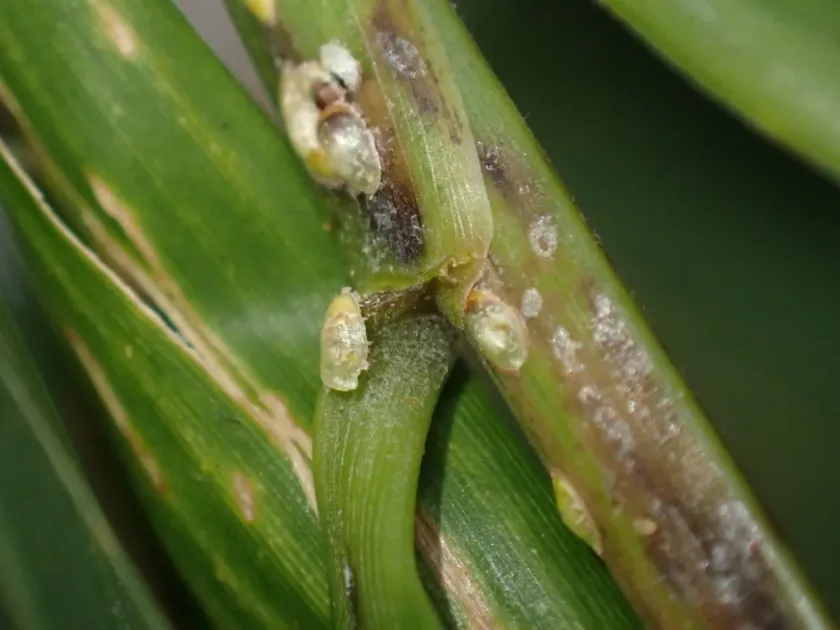
Visually, the females appear as small, oval or elongated convex structures, often yellow-brown or greenish, allowing them to blend seamlessly into the texture of the bamboo stems.
The nymphs, known as crawlers, are mobile, which allows them to disperse across the bamboo plant to find succulent areas suitable for feeding.
Identification is often difficult because these insects prefer to hide within leaf sheaths or under the protective bracts of the bamboo stem, where they remain shielded from view.
Systematically, this species is classified under the order Hemiptera, which dictates their feeding method: using their piercing-sucking mouthparts to extract sap directly from the plant's tissues.
What it damages
The primary hosts for this pest are various species of bamboo, whether grown in natural environments, greenhouses, botanical gardens, or private collections.
The scale feeds on culms, emerging shoots, and leaf bases, causing significant depletion of plant nutrients and overall vitality.
Substantial economic losses occur in nurseries, as heavy infestations cause deformity in young shoots and reduce the aesthetic value of ornamental plants.
During severe outbreaks, the plants exhibit stunted growth, loss of vibrant color, and may eventually wither and die if left untreated.
Furthermore, these insects excrete honeydew, which fosters the growth of sooty mold, a fungus that covers the leaves and hinders the plant's ability to photosynthesize effectively.
When it appears
The activity of bamboo scale is heavily dependent on temperature and humidity, allowing for year-round reproduction in indoor or greenhouse settings.
In natural conditions, the peak dispersal period for nymphs occurs during the warmer months, corresponding with the emergence of new crawlers from beneath the maternal covering.
The development time for a single generation can range from several weeks to a couple of months depending on the ambient environmental conditions.
During colder months, development slows significantly; however, the females remain viable, essentially waiting for warmer conditions to resume active reproduction.
Regular monitoring of bamboo plants is recommended throughout the growing season, especially during periods of high humidity which favor nymph survival.
Signs of infestation
One of the earliest indicators of an infestation is the yellowing and gradual wilting of foliage, regardless of proper watering practices.
The appearance of a sticky substance on stems, which eventually turns black due to the growth of sooty mold, is a definitive sign of sap-sucking pest activity.
Upon close inspection of the culms, one can find small characteristic pits or bumps where adult scales are sheltering.
A noticeable delay in new shoot production and overall lack of vigor often signal that a scale colony is hidden deep within the leaf sheaths.
- Sticky residue on stems and leaves;
- Presence of black sooty mold fungus;
- Deformed or stunted growth of new shoots;
- Small sedentary waxy bumps on the stems;
- Premature leaf drop.
Control measures
Managing bamboo scale requires a multi-faceted approach, as the tough waxy test provides excellent protection against many contact insecticides.
Mechanical removal using a stiff brush and soapy water can be effective on a small scale, but it is labor-intensive and often insufficient for heavy infestations.
Applying systemic insecticides, such as those containing imidacloprid or other neonicotinoids, allows the chemical to be absorbed into the plant sap, rendering it toxic to the scales.
Repeated applications spaced 10–14 days apart are essential to target subsequent generations of crawlers that emerge after the initial treatment.
Implementing a strict quarantine for new plants is a crucial preventive measure to stop the introduction of this pest into clean, healthy bamboo stands.
Taxonomy
- Latin name
- Bambusaspis bambusae
- Order
- Hemiptera (bugs, aphids, leafhoppers)
- Family
- Asterolecaniidae
- EPPO code
- ASTLBA
Discussion
No discussions yet — be the first.