
Bamboo scale
Bambusaspis
Description
How to identify
Bamboo scale (genus Bambusaspis) belongs to the Asterolecaniidae family, order Hemiptera. These small insects are known for their sedentary lifestyle, where females reside under a protective waxy scale or shell.
The protective covering often blends perfectly with the color and texture of bamboo stems, making these pests extremely difficult to detect during the early stages of an infestation.
Biological development involves a stage where eggs are laid beneath the mother's shell. Once hatched, the mobile nymphs, known as crawlers, spread across the plant to find suitable feeding sites along the stems or leaf sheaths.
The life cycle varies depending on environmental conditions, but in warm or indoor climates, they can complete multiple generations per year, leading to rapid population expansion.
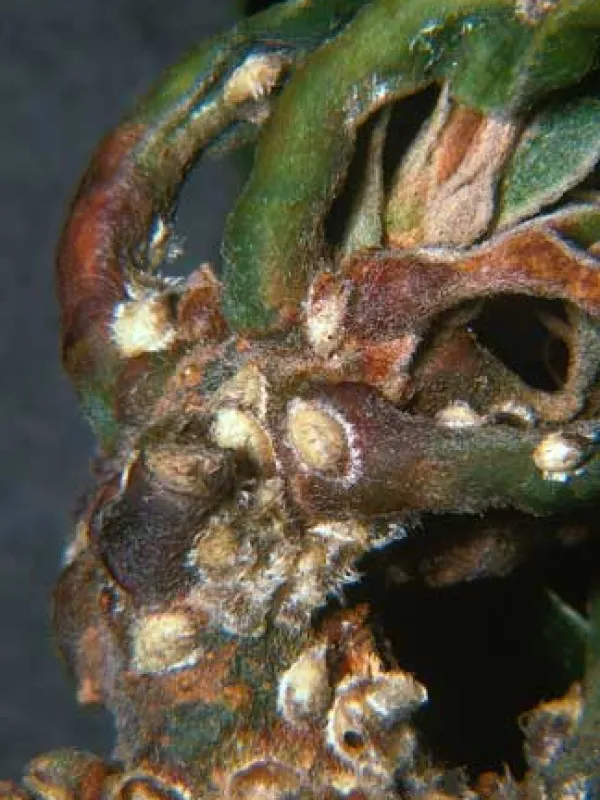
Identification often requires careful inspection with a magnifying glass to distinguish between natural bamboo node structures and the slightly raised, oval-shaped bumps caused by scale insects.
What it damages
Bamboo scales feed by piercing the plant tissue and sucking out the sap. This process removes vital nutrients and water, which causes the plant to weaken and lose its vigor over time.
They prefer young, tender shoots and nodes where the vascular system is easily accessible. Persistent feeding leads to stunted growth, stem deformation, and a significant loss in the aesthetic value of the bamboo.
As they feed, they excrete honeydew, a sugary substance that coats the surface of the bamboo. This honeydew attracts sooty mold, which creates a black, dusty layer on the leaves, interfering with photosynthesis.
Severe infestations result in yellowing leaves, premature leaf drop, and dieback of the main shoots. If left untreated, a heavy infestation can ultimately lead to the death of the bamboo plant.
The wounds created by the scale's feeding tubes also provide entry points for secondary pathogens, such as fungi or bacteria, which can cause further damage to the structural integrity of the cane.
When it appears
Activity is highly dependent on temperature. The spring and summer months provide the most favorable conditions for scale reproduction and the emergence of crawlers.
In greenhouses or indoor bamboo collections, bamboo scales can remain active year-round due to stable temperatures, which eliminates the period of winter dormancy.
The peak period for crawler emergence typically coincides with the beginning of the bamboo's spring growth flush. This is the most crucial time to monitor for new colonies and apply preventative measures.
During the autumn and winter seasons in outdoor settings, metabolic activity slows down, and the insects remain dormant under their protective shells until the return of warmer weather.
Frequent monitoring is essential throughout the growing season, especially in humid conditions which are often conducive to the survival and spread of scale nymphs.
Signs of infestation
The most obvious sign of an infestation is the appearance of unusual bumps or crust-like growths on the stems that do not correspond to the bamboo's natural growth pattern.
The presence of a sticky residue on the foliage or stems is a strong indicator of scale activity, as this is the honeydew excreted by the feeding insects.
- Stunted growth and distorted new shoots.
- A black, sooty coating on the leaves and stems.
- Yellowing or chlorosis of the foliage without drought stress.
- Small, scale-like bumps appearing clustered around nodes.
The bamboo will lose its vibrant green color and healthy luster, appearing dull and sickly. In extreme cases, the infestation density can be so high that the cane surface is almost entirely covered by the pests.
Control measures
Managing bamboo scale is challenging because the hard, waxy shell of the adult female acts as a shield against many standard contact-based insecticides.
Systemic insecticides, which are absorbed by the plant and move through its vascular system, are generally the most effective method for long-term control of this pest.
Mechanical removal is a helpful first step; using a soft brush dipped in a mild soapy solution or isopropyl alcohol can remove many adults from reachable stems before they reproduce.
Cultural practices such as improving air circulation, pruning and disposing of heavily infested canes, and maintaining adequate plant hydration are critical to reducing the habitat for scale.
Regular inspection and early intervention are the keys to success. By catching the infestation at the crawler stage, growers can effectively prevent the establishment of large, difficult-to-treat colonies.
Taxonomy
- Latin name
- Bambusaspis
- Order
- Hemiptera (bugs, aphids, leafhoppers)
- Family
- Asterolecaniidae
- EPPO code
- BAMBSP
Discussion
No discussions yet — be the first.