
Badister
Badister
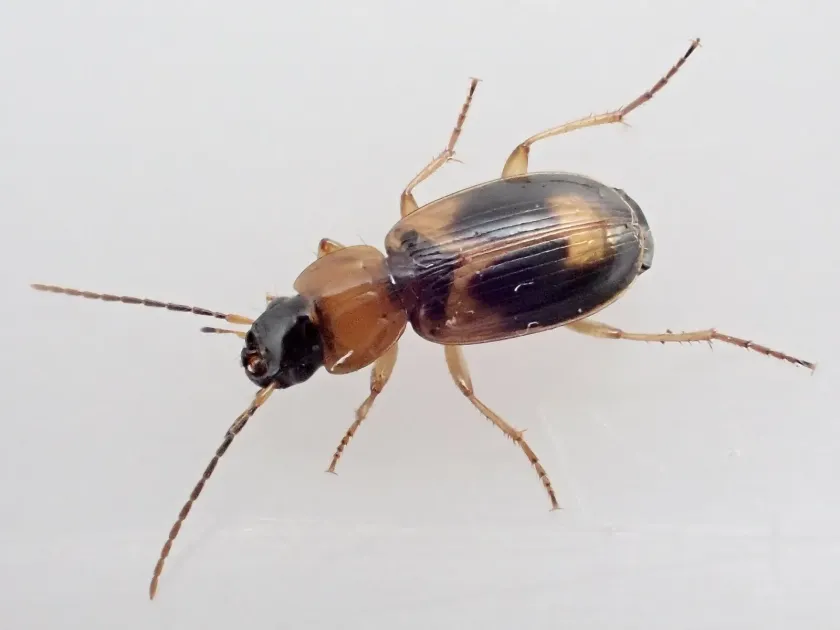
Description
How to identify
The genus Badister belongs to the family Carabidae (ground beetles) within the order Coleoptera. These beetles are primarily recognized as predatory insects.
They are characterized by a distinct morphology, particularly their asymmetrical mandibles, which are specialized for capturing small prey items like gastropods.
Adult beetles typically measure between 4 to 8 mm in length, featuring a flattened body shape that allows them to navigate through tight spaces in soil or leaf litter.
The coloration of these beetles varies from reddish-brown to dark brown or black, often with a slight metallic luster depending on the specific species.
Identification at the species level usually requires detailed inspection of the male genitalia, as many members of this genus share very similar external physical traits.
What it damages
Badister beetles are generally not considered major agricultural pests. They often act as beneficial organisms that prey on smaller insects and invertebrates.
In rare instances, when natural prey populations are extremely low, some species may feed on young plant shoots or seeds, causing minor superficial damage.
This activity is rarely systemic and does not usually result in significant economic loss or reduction in crop quality for most commercial farms.
Damage symptoms are typically localized, consisting of small nibbles on leaves or stems that are often indistinguishable from the damage caused by other insects.
Their presence is more frequently associated with healthy, undisturbed soils where they serve as part of the natural biological control mechanism.
When it appears
These beetles are primarily active during the warmer months, emerging from their overwintering sites as early as the first warm days of spring.
Their life cycle typically involves one generation per year, with peak population activity occurring during the summer months when environmental conditions are optimal.
They overwinter as adults, seeking refuge in deep soil crevices, beneath decaying logs, or within dense piles of organic plant matter.
Activity levels gradually decrease in autumn as the beetles prepare for their period of winter dormancy or hibernation within the soil profile.
The duration of each developmental stage is heavily dependent on local temperature and moisture levels within their specific habitat.
Signs of infestation
Because they are not primary pests, there are no specific diagnostic signs or symptoms that indicate a "Badister infestation" on a field or crop.
Presence of these beetles is usually detected during general entomological monitoring using pitfall traps or by manual inspection of ground-level debris.
Gardeners or farmers might notice the beetles themselves while performing routine cultivation tasks, but this is usually a chance encounter.
If significant plant damage is observed, it is recommended to conduct a thorough analysis to rule out more common and destructive agricultural pests.
Monitoring these beetles is often conducted to assess the overall biodiversity and ecological health of a specific agricultural plot.
Control measures
There are no established control programs for Badister beetles, as they are not deemed economically significant threats to agricultural production.
Integrated Pest Management (IPM) practices, including proper crop rotation and soil maintenance, are sufficient to manage their populations naturally.
The use of broad-spectrum insecticides should be minimized, as it can inadvertently harm beneficial carabid populations that provide natural pest control services.
Maintaining field margins and buffer zones provides adequate habitat for these beetles to thrive and perform their ecological role as predators.
No chemical intervention is advised; instead, focus on fostering an environment that balances insect populations through natural predatory relationships.
Taxonomy
- Latin name
- Badister
- Order
- Coleoptera (beetles)
- Family
- Carabidae
- EPPO code
- BADISP
Discussion
No discussions yet — be the first.