
Asterolecanium vittatum
Asterolecanium vittatum
Description
How to identify
Asterolecanium vittatum is a scale insect belonging to the family Asterolecaniidae. These insects are known for their ability to blend into the bark of their host plants, making them difficult to detect at early stages.
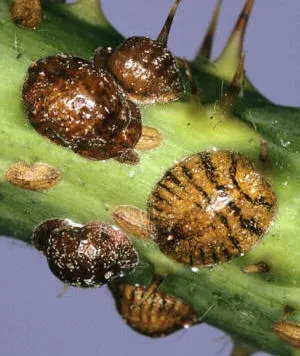
The adult females are sessile, protected by a hard, wax-like test (shell). This shell is usually yellowish-brown and features distinct patterns, which gives the insect its name.
The life cycle involves the crawler stage, during which young nymphs are highly mobile and disperse across the branches of the host tree to find suitable feeding sites.
Reproduction is primarily parthenogenetic, meaning females can produce offspring without fertilization, allowing a single individual to initiate a new colony.
As they settle, they insert their mouthparts into the bark and begin to secrete the protective covering that defines their appearance throughout the adult stage.
What it damages
This pest primarily targets various oak species. The damage is caused by the insects feeding on the sap, which siphons vital nutrients directly from the tree's vascular system.
Severe infestations lead to a noticeable decline in tree vigor. Affected branches may show signs of stunting, wilting, or even dieback over several seasons.
The local tissue around the feeding site often becomes deformed, creating pits or ridges in the bark that interfere with normal growth patterns.
The excretion of honeydew serves as a substrate for sooty mold, which coats leaves and branches, significantly reducing the tree's photosynthetic capacity.
Weakened trees become susceptible to secondary pathogens, including wood-boring insects and various fungal diseases that exploit the stressed condition of the host.
Signs of infestation
The most common sign is the presence of small, waxy, stripe-patterned tests on the bark of twigs and branches, often clustered in rows.
A sticky, shiny residue on the leaves below the infested branches is a strong indicator of honeydew production by the feeding colonies.
In mid-to-late summer, if a tree looks unusually dull or is losing its foliage prematurely, a close inspection of the bark is necessary to confirm scale presence.
The presence of ants or wasps swarming around the tree canopy is another clear sign that an infestation of sap-sucking insects is occurring.
During the dormant season, the scales remain attached to the bark, appearing as tiny, hardened bumps that are often mistaken for natural bark textures.
Control measures
Integrated Pest Management (IPM) is essential. This includes regular tree monitoring, ensuring adequate irrigation, and maintaining proper fertilization to keep the tree resilient.
Chemical control is most effective when timed with the crawler emergence period, as crawlers lack the thick wax shell that protects adults from contact insecticides.
Systemic insecticides applied to the soil or as a trunk injection can provide long-term control by transporting the poison directly through the plant's sap.
Horticultural oils applied in early spring can help suffocate overwintering nymphs by coating their protective shells and disrupting their respiration.
- Prune and dispose of heavily infested branches to reduce local population density.
- Promote biological control by protecting populations of lady beetles and parasitic wasps.
- Avoid broad-spectrum insecticides that may kill beneficial insects.
- Use dormant oil sprays before bud break to minimize the impact on the environment.
Taxonomy
- Latin name
- Asterolecanium vittatum
- Order
- Hemiptera (bugs, aphids, leafhoppers)
- Family
- Asterolecaniidae
- EPPO code
- ASTLVI
Discussion
No discussions yet — be the first.