
Oak pit scale
Asterolecanium notatum
Description
How to identify
The oak pit scale Asterolecanium notatum belongs to the Asterolecaniidae family and the Hemiptera order. These are small scale insects that live fixed to the bark of host trees.
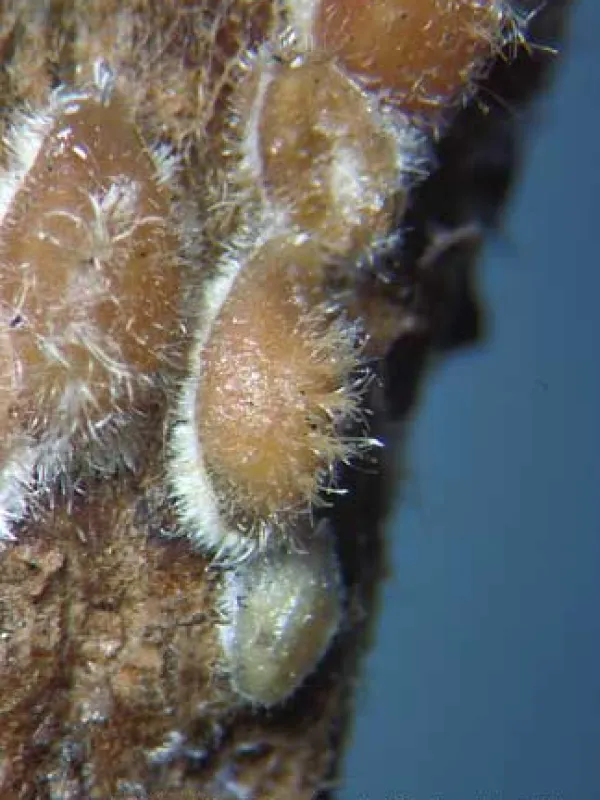
Adult females are protected by a yellowish or golden wax covering, which blends in with the bark. Their size is small, usually between 1 and 2 mm, making them hard to spot.
The life cycle involves a mobile crawler stage. These larvae move along the branches before settling in a specific spot to begin feeding and secreting their wax test.
This species is highly host-specific, primarily targeting oak trees. They prefer younger branches where the bark is relatively thin, allowing for easier access to sap.
As the insects mature, they become sessile and spend their lives feeding on the phloem of the tree. Their development is marked by gradual metamorphosis typical for scale insects.
What it damages
The oak pit scale causes damage by draining nutrients from the tree's vascular system. This constant removal of sap puts significant stress on the host.
Heavy infestations result in structural changes in the bark, such as pitting and localized deformations. These pits give the insect its common name.
Branches weakened by the scale are prone to dieback. In severe cases, the entire tree can become stunted, losing its vigor and overall health over several seasons.
Damaged tissues are more susceptible to secondary infections by pathogens, including fungi and bacteria, which can worsen the tree's condition significantly.
In landscaping and forestry, an infestation decreases the aesthetic and timber value of oaks, often leading to reduced canopy density and premature leaf drop.
When it appears
Crawler emergence typically occurs in late spring and early summer. This is the period when the population expands to new, uncolonized parts of the tree.
Summer is the primary growth phase where larvae feed aggressively and develop their waxy shields. This is the most active part of their life cycle.
By autumn, the insects have completed their development and are mostly immobile. They enter a state of dormancy during the winter months, remaining on the branches.
Spring temperatures trigger the resumption of feeding activity. The timing of crawler emergence can vary annually based on local climate conditions and spring temperatures.
Monitoring throughout the spring and early summer is crucial for identifying the peak crawler activity, which is the best time for implementing control measures.
Signs of infestation
Visible signs of an infestation include the presence of tiny golden-yellow spots on the twigs and small branches. These spots represent the insects' protective tests.
Pitting or small, depressed craters on the bark surface are hallmark signs of damage. These pits occur where the scale insect has induced a physiological reaction in the plant tissue.
Deformation of small twigs is often visible. Affected branches may look twisted or stunted compared to those that remain healthy and uncolonized.
The presence of sooty mold on the bark or leaves beneath the infestation indicates that the scales are producing honeydew, which fuels fungal growth.
- Presence of waxy, yellow circular bumps on bark.
- Small pits or depressions on twigs.
- Dieback of thin, terminal branches.
- Stunted annual growth in infested areas.
Control measures
The primary control strategy involves maintaining tree health through proper silvicultural practices. Well-watered and fertilized oaks are less likely to suffer severe damage.
In cases of light infestation, pruning and disposing of heavily colonized branches can effectively reduce the local population of the scale.
Systemic insecticides are effective when applied during the crawler emergence period. The chemical moves through the tree sap and kills the feeding insects.
Dormant oil sprays applied in late winter can suffocate overwintering scales by covering them in a thin film of oil that blocks their respiratory pores.
Encouraging natural predators, such as ladybird beetles and parasitic wasps, provides a biological control method that can help keep populations in check over time.
Taxonomy
- Latin name
- Asterolecanium notatum
- Order
- Hemiptera (bugs, aphids, leafhoppers)
- Family
- Asterolecaniidae
- EPPO code
- ASTLNO
Discussion
No discussions yet — be the first.