

Scale insect
Aspidiotus
Description
How to identify
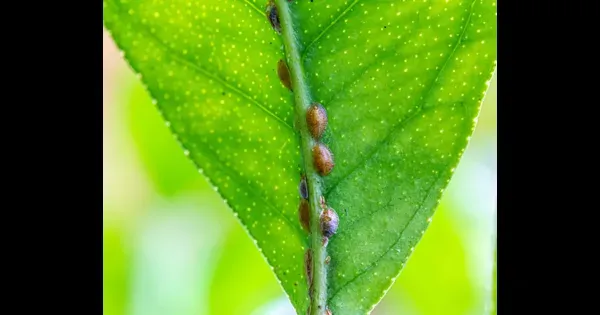
Scale insects are small insects belonging to the order Hemiptera and the family Diaspididae. The adult female is almost immobile and covered with a dense, often convex scale (test), which adheres tightly to the plant's bark or leaves.
The insect's body is concealed beneath this protective formation, which consists of discarded larval skins and wax secretions. Sizes typically range from 1 to 3 millimeters, and their coloration often mimics the bark or leaf, making the pest difficult to spot when populations are low.
Males are significantly different from females: they possess wings, developed legs, and are capable of active movement to locate mates. However, males have very short lifespans and do not feed, meaning the primary threat to plants comes from the sessile females and their offspring.
In terms of systematics, the genus Aspidiotus includes species with broad specialization. One of the most prominent representatives is the San Jose scale, which is capable of causing massive damage to fruit trees on an industrial scale.
For accurate identification, a magnifying glass is often required, as early stages of scale insects resemble small bumps or wax droplets on shoots. Once the protective scale is damaged, the insect becomes vulnerable, but it remains highly resistant to external environmental factors.
What it damages
Scale insects are dangerous polyphages that damage a wide range of plants. Their diet includes fruit trees, ornamental shrubs, as well as indoor plants and various forest tree species.
The greatest damage is observed in pome fruits, such as apples, pears, and quinces, as well as citrus crops. The pest feeds on young shoots, leaves, petioles, and even fruits, which leads to a significant loss of marketability of the produce.
In addition to direct feeding, scale insects provoke secondary infections. The puncture sites serve as entry points for fungal and bacterial diseases, which significantly weaken the plant's immune system and may lead to its death.
Plants infested with scale insects stop growing properly due to the disruption of nutrient circulation. Heavy infestations result in premature leaf drop, dieback of shoot tips, and deep cracking of the bark.
In agricultural production, the presence of scale insects on fruit is a quarantine factor, leading to export bans and significant financial losses for farmers.
When it appears
The life cycle of the scale insect is closely tied to temperature, with development accelerating as stable spring warmth arrives. The emergence of crawlers—the first-instar larvae—typically coincides with the blooming period of trees.
The crawler stage is the most critical for population control because, at this point, the larvae lack a dense scale and are actively moving across the plant to find a site to settle. The crawler stage usually lasts for several days.
Depending on the climatic zone, the scale insect can produce from one to several generations per season. High temperatures during the summer promote faster metabolic activity and rapid population growth.
In autumn, development slows down, and the pest enters a diapause phase. Scale insects typically overwinter as first or second-instar larvae, anchored to the bark of trunks and branches, which allows them to survive low winter temperatures.
In greenhouses and indoor environments, scale insects can reproduce year-round, as stable temperatures and the absence of seasonal fluctuations create ideal conditions for a continuous developmental cycle.
Signs of infestation
The first clear sign of infestation is the appearance of numerous small bump-like spots on trunks, branches, and the underside of leaves. They are firmly attached to the plant and are difficult to remove manually.
Another characteristic sign of scale activity is the discoloration of tissue at the puncture sites. Often, red or purple rings form around the insect's attachment point, which is particularly visible on the young bark of apple and pear shoots.
When fruit is infested, characteristic dents and spots form on its surface, ruining the appearance of the fruit and causing deformation. This makes the produce unsuitable for market sale.
Sticky residue or sooty mold on leaves can also indirectly indicate the presence of pests, although this is less common for scale insects than for aphids or mealybugs. Nevertheless, general canopy distress should always alert the gardener.
In advanced cases, the plant begins to show stunted growth, shortened internodes, and chlorotic leaves. Without intervention, entire branches may die, followed eventually by the death of the entire plant.
Control measures
Controlling scale insects requires a comprehensive approach, as the dense scale protects the insect from most pesticides. The most effective method is to apply treatments during the mass crawler emergence period, when they are most vulnerable.
Agrotechnical methods include regular sanitary pruning of infested branches and their immediate destruction. It is also important to ensure good canopy ventilation and to clean trunks of dead bark, where pests often hide.
Chemical control is based on the use of systemic insecticides, which penetrate plant tissues and make the sap toxic to the pest. Treatments should be timed to the crawler stage and applied at 10–14 day intervals to cover all generations.
Applying mineral oils in early spring before sap flow begins allows for the mechanical blockage of oxygen access to overwintering individuals beneath their scales. This is an environmentally safe method that helps significantly reduce the initial pest population.
- Regular inspection of garden plants;
- Use of systemic neonicotinoid-based insecticides;
- Attracting natural enemies such as parasitic wasps and ladybugs;
- Bark cleaning and whitewashing trunks with lime solution;
- Strict quarantine procedures for new nursery stock.
Content graph
Connections · Scale insect
Most often together:
Marketplace
Products · 8
Biology
Taxonomy
- Latin name
- Aspidiotus
- Order
- Hemiptera (bugs, aphids, leafhoppers)
- Family
- Diaspididae
- EPPO code
- ASPDSP
Community
Discussion
No discussions yet — be the first.