
Great Southern White
Ascia monuste
Description
How to identify
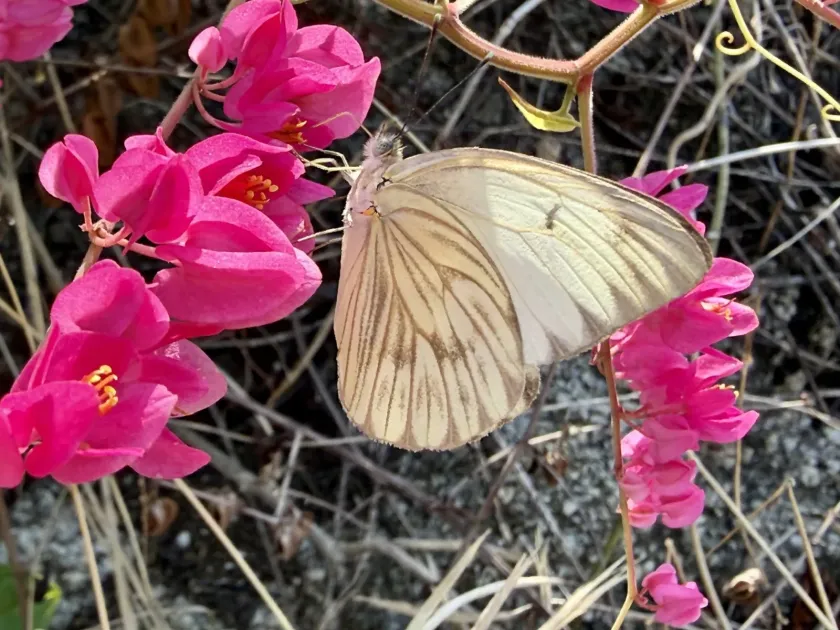
The Great Southern White (Ascia monuste) belongs to the Pieridae family within the order Lepidoptera. It is a butterfly species widely distributed throughout tropical and subtropical regions of the Americas.
Adults typically have a wingspan ranging from 5 to 8 cm. The wing coloration varies from white to creamy, with females often displaying a distinct dark margin on their forewings.
The larvae, commonly known as caterpillars, can grow up to 4 cm in length. They are characterized by a yellowish-green or olive base color, marked with longitudinal dark stripes and scattered fine hairs.
The pupae attach to the substrate using a silk girdle. Their color is highly adaptive and can transition from light green to brown depending on environmental conditions, providing camouflage from predators.
The lifecycle of this insect is heavily influenced by regional climate. In warmer areas, the species reproduces continuously throughout the year, allowing for multiple overlapping generations and rapid population spikes.
What it damages
The primary food source for the larvae consists of plants from the Brassicaceae family. This includes all varieties of cabbage, radishes, turnips, mustard, and canola, making them significant agricultural pests.
In the absence of cultivated host crops, the caterpillars easily migrate to wild cruciferous weeds, ensuring their survival and continuous availability throughout the growing season.
Caterpillars demonstrate intense feeding behavior, especially in later instars. A large population can quickly defoliate a plant, leaving only the primary leaf veins behind.
Feeding damage to the apical meristem and young leaves severely stunts growth and reduces yields. In heading cabbage, larvae often burrow into the center of the head, causing decay and contamination.
Beyond physical destruction of plant tissues, the damage sites serve as entry points for bacterial and fungal pathogens, which can lead to rapid soft rot and render the produce unmarketable.
Signs of infestation
The first visual indicator of an infestation is the presence of irregular holes in leaves, usually starting along the margins or within the interveinal tissue of the foliage.
Clusters of yellowish, cone-shaped eggs laid on the underside of leaves serve as a key sign for early detection before significant larval feeding begins.
The accumulation of frass (dark green to black insect droppings) on leaf surfaces and at the base of plants is a clear signal that caterpillars are present and feeding actively.
Skeletonization of the leaves is a common late-stage symptom, where the leaf tissue is consumed entirely, leaving only a network of vascular bundles, which leads to wilting.
During peak infestation periods, observant growers will notice large numbers of adult butterflies fluttering over fields, signaling an upcoming surge in larval activity that requires immediate attention.
Control measures
Cultural management is crucial, specifically the removal of wild cruciferous weeds from around fields and gardens to eliminate secondary host sources for the pest.
Implementing a strict crop rotation schedule prevents the buildup of larval populations, as does keeping cabbage crops away from high-risk historical infestation areas.
Biological control options, such as the application of Bacillus thuringiensis (Bt) based products, are highly effective against larvae while being relatively safe for beneficial insects.
For severe outbreaks, chemical control utilizing pyrethroids or organophosphates may be necessary, provided that pre-harvest intervals are strictly observed to ensure food safety.
- Monitor fields frequently for egg masses to intervene before hatching.
- Encourage local populations of natural enemies, including predatory wasps and tachinid flies.
- Use row covers or physical barriers to prevent adult butterflies from laying eggs on crops.
Taxonomy
- Latin name
- Ascia monuste
- Order
- Lepidoptera (butterflies)
- Family
- Pieridae
- EPPO code
- PIERMO
Discussion
No discussions yet — be the first.