
Small white
Artogeia rapae
Description
How to identify
The small white (Artogeia rapae), also known as the small cabbage white, is a butterfly in the Pieridae family that is a notorious pest of cultivated vegetables.
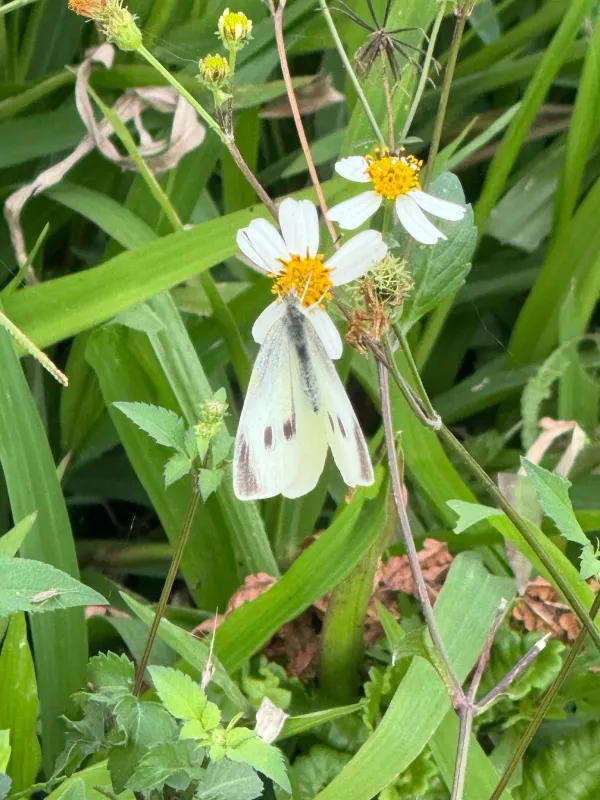
Adults have white wings with a black tip on the forewings and one or two black spots, with a wingspan ranging from 40 to 50 mm, making them distinct from the larger cabbage white.
Females lay small, pale yellow, bottle-shaped eggs individually on the underside of host plant leaves, which makes them quite difficult to spot during early inspections.
The larvae, or caterpillars, are velvety green with a faint yellow stripe along the back, which provides excellent camouflage against the foliage of their host plants.
The pupae are typically green or brown, allowing them to blend into the environment such as stems, fences, or stone surfaces where they hibernate during the colder months.
What it damages
The damage is caused primarily by the larvae, which feed on the leaves of brassica crops, often burrowing deep into the heart of the cabbage or cauliflower head.
Commonly attacked crops include cabbages, kale, broccoli, Brussels sprouts, radishes, and turnips, leading to significant yield loss in vegetable gardens.
Early-stage caterpillars create small holes in the leaves, while older larvae can cause severe defoliation, stripping the plant of its ability to photosynthesize effectively.
Apart from the physical tissue damage, the presence of frass (caterpillar excrement) leaves the vegetables unsightly and prone to secondary bacterial infections or rot.
Large-scale infestations can destroy entire fields of cabbage, resulting in major financial losses for farmers if the population is not monitored and managed properly.
When it appears
The first generation of adults typically emerges in mid-spring, following a pupal overwintering period that ends when temperatures consistently exceed 10°C.
The butterflies are active throughout the summer months, with multiple overlapping generations occurring in warmer climates, making constant monitoring necessary.
The duration of the life cycle is highly dependent on ambient temperature, with development from egg to adult occurring much faster during hot, dry summer days.
As autumn approaches, the final generation of larvae pupates and enters diapause, remaining in this form until the following spring's emergence cycle.
Environmental conditions play a critical role in the survival rate of the pupae, which are highly sensitive to extreme winter weather and natural predators.
Signs of infestation
One of the primary indicators of a small white infestation is the appearance of irregular, often small to medium-sized holes in the leaves of brassica plants.
Small green or dark pellets of frass found on the leaf surfaces or tucked into the leaf axils are clear signs that larvae are feeding on the plant.
Stunted growth or missing leaf tissue, especially in the center of a developing cabbage head, indicates that the caterpillars have begun their destructive work.
Observing adult butterflies hovering over the crop is a warning signal that egg-laying is likely occurring, necessitating immediate preventative measures.
- Holes in leaves of cabbage, broccoli, and other brassicas.
- Visible presence of green caterpillars on the underside of leaves.
- Contamination of produce with larvae frass.
Control measures
The most effective mechanical control is the use of insect-proof netting or fine-mesh covers over crops to prevent adult butterflies from laying eggs on plants.
Good agricultural practice, such as removing weeds from the cruciferous family, denies the pest alternative food sources and breeding grounds near the fields.
Biological control methods, specifically the use of Bacillus thuringiensis sprays, are highly effective against larvae while remaining safe for most beneficial insects.
Deep soil cultivation after harvest helps disrupt the lifecycle by destroying the pupae hidden in the ground or in remaining plant debris near the garden.
If chemical control becomes necessary, selective insecticides should be applied only when the infestation exceeds the economic threshold, minimizing impact on the ecosystem.
Taxonomy
- Latin name
- Artogeia rapae
- Order
- Lepidoptera (butterflies)
- Family
- Pieridae
- EPPO code
- PIERRA
Discussion
No discussions yet — be the first.