
Apolygus plant bug
Apolygus
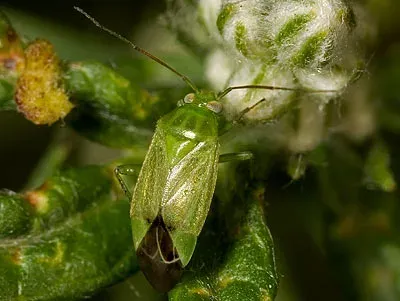
Description
How to identify
The Apolygus genus belongs to the Hemiptera order and the Miridae family. These insects are commonly referred to as plant bugs and are frequent inhabitants of various agricultural ecosystems.
Adult bugs typically measure between 5 and 7 millimeters in length. Their coloration ranges from light green to brownish or yellowish, which provides excellent camouflage against leaves and stems.
Key morphological features include specific patterns on the pronotum and the scutellum, as well as a distinct four-segmented antenna structure that helps in species identification.
The nymphs resemble the adults but are smaller in size and lack fully developed wings, growing through several instars before reaching the mature adult stage.
These bugs are highly mobile and diurnal. When threatened, they often drop from leaves or fly away, making them elusive for quick visual inspection in dense foliage.
What it damages
This pest is a polyphagous insect that damages a wide variety of agricultural crops, including fruit trees like apples and pears, as well as several berry bushes.
The damage is primarily caused by feeding on plant sap from young shoots, leaves, and developing fruitlets during the early stages of the growing season.
While feeding, Apolygus bugs inject saliva containing enzymes that cause localized necrosis, tissue distortion, and stunting of the affected plant parts.
Heavy infestations can significantly degrade the market value of fruits, leading to deformities, pitting, and corky spots that make the produce unappealing or unsellable.
Furthermore, the physical punctures and enzymatic damage provide entry points for secondary infections, such as various fungi and bacteria that further weaken the plant.
When it appears
The winter is typically spent in the egg stage, with females depositing eggs into the bark of young shoots or leaf petioles of their host plants.
The mass hatching of nymphs generally aligns with the budding phase and the beginning of rapid vegetative growth in the spring.
Adult activity peaks during the early and mid-summer months, a period that coincides with mating and the oviposition of the next generation.
Depending on the climate and geographical region, the pest may complete one or two generations per year, which directly impacts the population pressure on crops.
As temperatures drop in autumn, the bugs move to overwintering sites, where they enter diapause until the following spring season begins.
Signs of infestation
Early signs of infestation include small, light-colored spots or chlorotic stippling on the leaves, which can later merge into larger necrotic patches.
Young shoots often exhibit curling, deformation, or stunted growth as a result of constant sap-sucking by the nymphs and adult bugs.
Developing fruits may show small, depressed lesions that later turn into hardened, corky areas, clearly indicating that the fruit was damaged during its formative phase.
The presence of exuviae (shed skins from molting) on the undersides of leaves, along with characteristic insect secretions, often signals an active pest population.
Symptoms are usually exacerbated by drought conditions, as plants have reduced ability to recover from the stress induced by the feeding activity of the bugs.
Control measures
The most effective strategy involves regular field monitoring throughout the growing season to detect early infestation spots before they spread to the whole orchard.
Cultural control is essential, including the removal of weeds from orchard understory, as many weeds act as alternative hosts for the bug population.
Encouraging beneficial insects, such as lacewings and ladybirds, can provide natural suppression of the bug population, keeping numbers below economic thresholds.
If chemical intervention is required, the use of selective insecticides that minimize impact on non-target beneficial species is highly recommended.
- Crop rotation and spatial isolation of susceptible plant varieties.
- Pruning and destroying heavily infested plant material during the off-season.
- Using sticky traps for monitoring and reducing adult numbers.
Taxonomy
- Latin name
- Apolygus
- Order
- Hemiptera (bugs, aphids, leafhoppers)
- Family
- Miridae
- EPPO code
- APLYSP
Discussion
No discussions yet — be the first.