

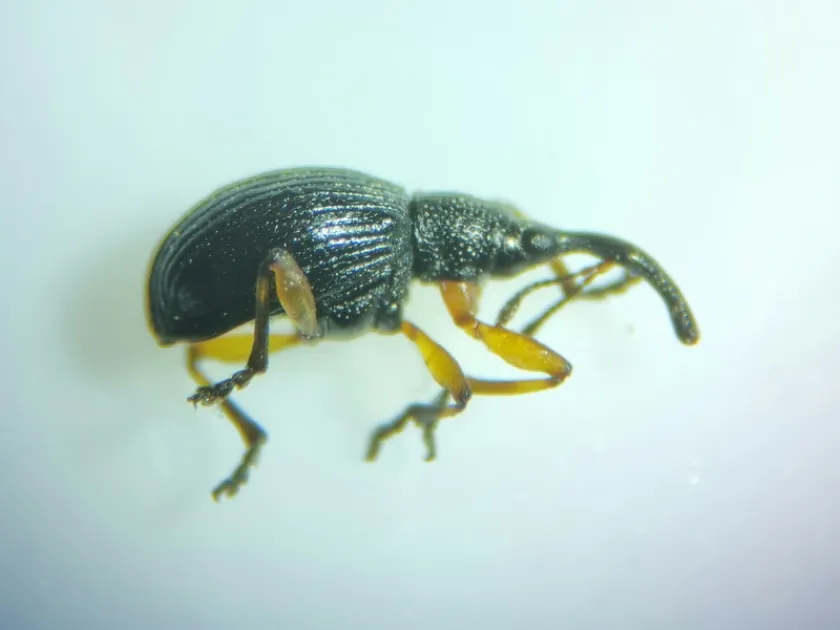
Description
How to identify
The clover seed weevil (Apion varipes) is a small beetle belonging to the Apionidae family, within the order Coleoptera. Adult weevils are typically 2–2.5 mm long, characterized by a distinct elongated rostrum.
The body color is predominantly black, with a mat appearance due to fine hair covering. A key diagnostic feature for this species is its yellowish-brown tibiae and tarsi, which distinguish it from closely related species.
The larvae are legless, slightly curved, and creamy-white in color with a dark, well-developed head capsule. They are specifically adapted to feeding inside the small seeds of clover plants.
Pupation occurs within the damaged seed or flower head, where the insect remains until the final stage of development. The entire lifecycle is tightly synchronized with the growth stages of the host plant.
These insects overwinter as adults in the soil or beneath leaf litter, emerging in spring when temperatures become suitable for clover growth and development.
What it damages
The clover seed weevil primarily targets clover and other perennial legumes, focusing its feeding activity on the reproductive organs of the plants. It is a major pest for seed production fields.
Adult weevils feed on buds and leaves, causing minor foliage damage. However, the most severe impact occurs when females lay eggs inside the developing ovary of the clover flower.
Upon hatching, the larvae feed internally on the forming seed, destroying the endosperm and embryo completely. This results in significant yield loss, as the seeds become hollow and unviable.
High infestation levels lead to reduced germination rates and weakened crop stands, as damaged seeds are prone to secondary infections from pathogens entering through the feeding holes.
Economic damage is severe in commercial seed fields, where losses can be extensive if integrated management strategies are not implemented during the crucial flowering stage.
When it appears
Adult emergence typically begins in late spring, around the bud formation stage of clover. Activity levels rise significantly as ambient temperatures reach 15-18 degrees Celsius.
The mating and egg-laying period coincides with the blooming season. Females move between flower heads, using their rostrum to drill into the ovaries and deposit eggs.
The larval stage lasts for several weeks, during which they grow inside the seed capsule. The cycle from egg to adult is generally completed within a single growing season.
New adults emerge in mid-to-late summer, following a period of additional feeding on the foliage of the host plants to build energy reserves for the upcoming winter.
While the pest typically has one generation per year, favorable weather conditions such as warm, dry summers can lead to an extended activity period and higher population pressure.
Signs of infestation
Initial signs of infestation appear as tiny punctures or holes on leaves and unopened buds, created by the adults feeding during the early spring months.
Affected flower heads often show signs of premature wilting, stunted development, or discoloration, indicating that the seeds inside have been consumed by larvae.
Careful inspection of flower heads reveals hollowed-out seeds or the presence of white, legless larvae inside the seed coat, which confirms the presence of Apion varipes.
At harvest, an increase in "light" or empty seeds, along with poor seed quality, serves as a retrospective indicator of infestation intensity throughout the season.
Field monitoring using yellow sticky traps or sweep nets during the pre-blooming phase helps in identifying the presence of adult weevils before they cause irreversible damage.
Control measures
Effective management of the clover seed weevil requires an integrated approach that focuses on agricultural practices to disrupt the pest's lifecycle.
- Early cutting of clover for hay to remove larvae before they migrate to the soil for pupation.
- Strategic spacing of new seed fields far from older, established clover stands to prevent adult migration.
- Deep autumn plowing to bury and destroy overwintering sites, significantly reducing the spring population.
Chemical control should be limited to the pre-flowering stage, using selective insecticides that minimize harm to essential pollinators like bees and bumblebees.
Regular scouting using sweep nets during the budding phase is critical for determining whether the economic threshold for pest treatment has been reached.
Content graph
Connections · Clover seed weevil
Most often together:
Marketplace
Products · 3

Biology
Taxonomy
- Latin name
- Apion varipes
- Order
- Coleoptera (beetles)
- Family
- Apionidae
- EPPO code
- APIOVA
Community
Discussion
No discussions yet — be the first.