

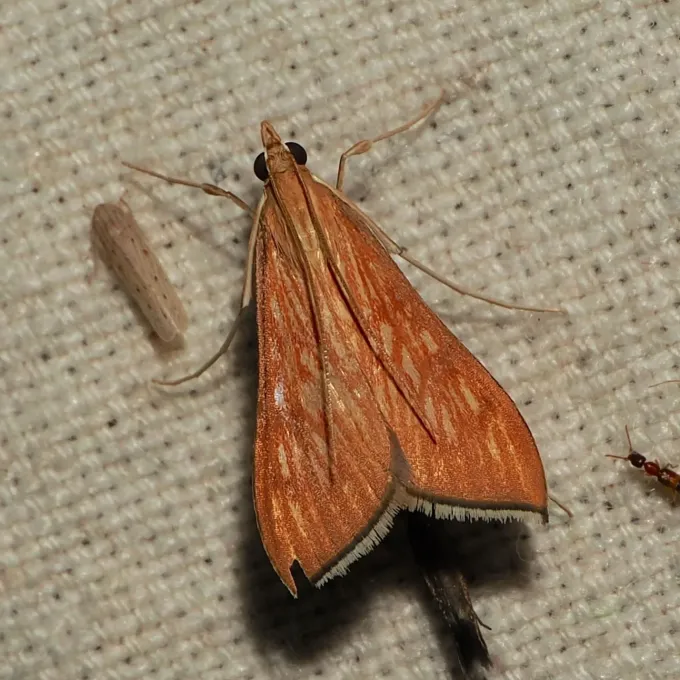
Description
How to identify
The sesame leaf webber, scientifically known as Antigastra catalaunalis, belongs to the family Crambidae of the order Lepidoptera. It is a small moth with a wingspan ranging from 18 to 22 millimeters, commonly found in tropical and subtropical regions.
The adult moth is characterized by ochre-yellow forewings marked with distinct dark patterns and spots. The hindwings are paler, often exhibiting a silky or pearly luster, which helps distinguish it from other pyralid moths.
Larvae pass through five instars, initially appearing pale green and transitioning to a darker greenish or brownish shade with conspicuous dark dots on the body segments. The head capsule is typically brown.
Pupation occurs within a white, silken cocoon often hidden inside rolled leaves or bored holes within the seed capsules of the host plant. The pupa itself is reddish-brown and is the resting stage before the next adult emergence.
The reproductive rate of the moth is highly temperature-dependent, allowing for rapid generation turnover in hot and humid environments, which is common in major sesame-producing areas.
What it damages
The primary host of Antigastra catalaunalis is the sesame plant (Sesamum indicum), where it can cause devastating losses if left unmanaged. It is considered one of the most significant pests affecting sesame yield worldwide.
The larvae damage all aerial parts of the sesame plant. Early infestation often involves the webbing together of top leaves, which leads to stunted growth and the loss of the plant's apical dominance.
As the plant progresses to the reproductive phase, the larvae bore into the developing flower buds and capsules. By feeding on the internal tissues, they prevent proper seed development and reduce the oil content of the grain.
In severe cases of infestation, the damage to the capsules is so extensive that the entire crop yield can be destroyed, leaving only empty shells or damaged seeds unfit for harvest.
Indirect damage occurs when the webbing prevents normal pollination and photosynthetic activity, further stressing the plant and making it susceptible to other opportunistic pathogens.
When it appears
The sesame leaf webber population generally peaks during the mid-to-late growing season, coinciding with the flowering and pod formation stages of the sesame crop.
Adult moths are primarily nocturnal and demonstrate high mobility, frequently migrating between fields to locate host plants during the early stages of the crop development.
Depending on local climatic conditions, multiple generations can occur per season. In warm climates, the cycle from egg to adult can be completed in as little as three weeks, facilitating a rapid population buildup.
Late-season generations tend to be the most damaging as they focus their feeding directly on the capsules, which are the main economic component of the harvest.
Overwintering usually occurs in the pupal stage, with the insects hiding in soil crevices or plant residues, waiting for the return of favorable temperatures in the spring.
Signs of infestation
The most visible sign of infestation is the webbing of leaves at the terminal shoots, which gives the plant a scorched or bunched appearance. This is a clear indicator that larvae are present inside.
Holes bored into the sesame capsules, often surrounded by larval frass (excrement), signify that the insect has moved from the foliage to feed on the reproductive parts of the plant.
Drooping and drying of top leaves are common symptoms, as the internal tissues have been consumed by the larvae, disrupting the transport of water and nutrients to the plant apex.
Visible feeding damage on buds, resulting in flower drop and reduced fruit set, is another critical sign that monitoring efforts have missed the early stages of the infestation.
Observing adult moths fluttering around the fields at dusk is a warning sign that egg-laying is imminent and that immediate control measures may be required.
Control measures
Integrated Pest Management (IPM) is essential for controlling the leaf webber. This includes deep plowing after the harvest to expose and destroy pupae residing in the soil, which helps reduce the initial population for the next season.
Chemical control involving systemic insecticides is most effective when applied at the onset of flowering, targeting the young larvae before they penetrate the capsules.
Biological control methods, such as encouraging natural predators like spiders, ladybirds, and parasitic wasps, can play a significant role in keeping populations below the economic threshold.
Crop rotation and the destruction of alternate weed hosts (from the Pedaliaceae family) are vital practices to break the lifecycle of the pest between growing cycles.
- Use of pheromone traps to monitor adult flight activity.
- Timely and efficient harvesting to avoid prolonged exposure to late-season larvae.
- Application of botanical pesticides like neem oil as a preventive measure in low-infestation areas.
Content graph
Connections · Sesame leaf webber
Most often together:
Marketplace
Products · 1
Biology
Taxonomy
- Latin name
- Antigastra
- Order
- Lepidoptera (butterflies)
- Family
- Crambidae
- EPPO code
- ANTISP
Community
Discussion
No discussions yet — be the first.