
Anaphes nitens
Anaphes nitens
Description
How to identify
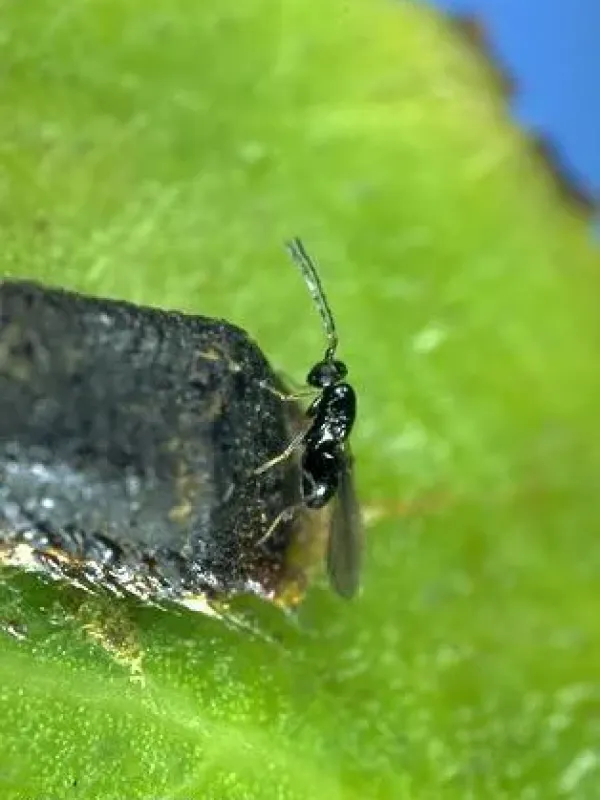
Anaphes nitens is a minute parasitic wasp belonging to the order Hymenoptera and the family Mymaridae, commonly known as fairyflies.
Adult specimens are extremely small, often less than 1 millimeter in length, featuring delicate, fringed wings that aid in aerial movement.
This species is highly specialized as an egg parasitoid, meaning its entire larval development occurs within the eggs of specific host insects.
Morphologically, females possess a specialized ovipositor designed to penetrate the outer layer of host eggs, allowing them to lay their own eggs inside.
Its small size and specialized biological niche make it a crucial component in maintaining forest health by limiting pest populations.
What it damages
Contrary to the label of a pest, Anaphes nitens is a beneficial insect, serving as a primary biological control agent for the eucalyptus weevil (Gonipterus scutellatus).
The eucalyptus weevil is a destructive pest that feeds on the foliage of eucalyptus trees, causing significant defoliation and growth stunting in forest plantations.
By parasitizing the eggs of the weevil, Anaphes nitens effectively prevents the larvae from hatching and causing further damage to the canopy.
This biological interaction reduces the overall population density of the pest, thereby mitigating the economic impact on timber production.
Without this parasitoid, eucalyptus plantations are highly susceptible to outbreaks of weevils, which can lead to widespread tree mortality in non-native habitats.
When it appears
The life cycle of this parasitoid is closely tied to the reproductive cycle of the eucalyptus weevil, as its larvae require the host's eggs to survive.
In temperate climates, the species can produce multiple generations annually, ensuring a continuous presence throughout the growing season.
Optimal conditions for development typically involve warm, stable temperatures which maximize the reproductive rate of the wasp.
In regions with distinct seasons, the parasitoid survives winter stages either as larvae protected within host eggs or in an inactive state.
The emergence of adults typically coincides with the first warm spells of spring, when weevils begin laying eggs on fresh eucalyptus foliage.
Signs of infestation
The primary visual indicator of Anaphes nitens activity is the appearance of darkened, parasitized weevil eggs on the leaves of eucalyptus trees.
Healthy host eggs are typically lighter in color, whereas those infected by the parasitoid larvae undergo a distinct change in pigment during development.
Upon completion of the metamorphosis, the adult wasp exits the host egg by creating a small, circular emergence hole in the shell.
Finding a high proportion of such empty, punctured eggs on the leaf surface is a positive sign that the wasp is actively managing the weevil population.
A lack of significant defoliation in the presence of parasitized egg clusters confirms the wasp's effectiveness as a natural pest deterrent.
Control measures
Effective management focuses on conserving existing populations of Anaphes nitens and promoting their presence in infested areas.
One of the most critical measures is to avoid the use of broad-spectrum insecticides that could inadvertently harm the parasitoid population.
If chemical interventions are necessary to control other pests, selecting systemic or highly selective products that are safer for beneficial insects is recommended.
In large-scale forestry operations, successful control is often achieved through the careful introduction and monitoring of the wasp population.
- Restrict unnecessary pesticide use to protect beneficial insects.
- Implement regular monitoring of egg parasitism rates.
- Prioritize biological control over chemical suppression wherever possible.
Taxonomy
- Latin name
- Anaphes nitens
- Order
- Hymenoptera
- Family
- Mymaridae
- EPPO code
- PATSNI
Discussion
No discussions yet — be the first.