
Anaphes flavipes
Anaphes flavipes
Description
How to identify
Anaphes flavipes is a tiny parasitic wasp belonging to the Mymaridae family, commonly known as fairyflies. Despite its small size, it plays a vital role as a natural enemy in agricultural ecosystems.
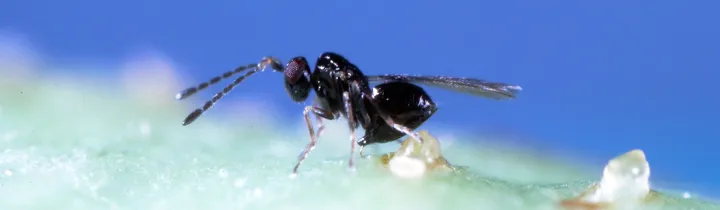
The adult insect is usually less than 1 mm in length. Its body is dark, and it possesses delicate, feather-like wings that are characteristic of the Mymaridae family.
As an egg parasitoid, the female wasp is highly efficient at locating the host. It uses specialized sensors to detect the chemical cues emitted by host eggs on the leaf surfaces of host plants.
Once the host egg is found, the wasp inserts its ovipositor to lay its own egg inside. The development of the wasp larva occurs entirely within the host's egg, effectively killing the host.
This species is highly specialized, meaning it targets specific hosts, which makes it an excellent candidate for biological control programs in cereal production.
What it damages
Anaphes flavipes is not a pest; it is a beneficial organism. Its primary host is the cereal leaf beetle (Oulema melanopus), a well-known pest of various small grains.
By consuming the contents of the beetle's eggs, this parasitoid significantly reduces the larval population that would otherwise cause extensive damage to leaves of wheat, barley, and oats.
The reduction in host population density is crucial for maintaining crop health. When the population of Anaphes flavipes is high, the damage caused by cereal leaf beetles is kept below the economic threshold.
This natural regulation minimizes the reliance on synthetic pesticides, making it an essential component of Integrated Pest Management (IPM) strategies for cereal crops.
Therefore, farmers should consider Anaphes flavipes as a valuable ally rather than an organism that causes damage to their crops.
When it appears
The emergence of Anaphes flavipes in the spring is strictly synchronized with the egg-laying period of its host, the cereal leaf beetle. This timing ensures that the parasitoid finds its host at the optimal stage of development.
Throughout the growing season, multiple generations of this wasp can occur. The speed of the life cycle allows it to respond quickly to outbreaks of the beetle population in the field.
As the season progresses toward autumn, the final generation enters a state of diapause or overwintering, typically residing in the soil or protected plant debris near the fields.
Environmental factors such as temperature and humidity play a significant role in the parasitoid's success. Warm, stable weather conditions generally favor its reproductive activity.
Understanding the seasonal behavior of this parasitoid is essential for timing any necessary field interventions that might affect its survival and effectiveness.
Control measures
The primary control measure for maintaining high populations of Anaphes flavipes is the careful use of insecticides. Broad-spectrum pesticides should be avoided during the peak activity of the wasp.
Integrated Pest Management (IPM) practices, including monitoring host population levels, should be used to determine if chemical intervention is strictly necessary.
Preserving natural habitats, such as field borders and non-crop vegetation, provides refuge areas where the parasitoid can overwinter and persist throughout the season.
Choosing selective pesticides that target specific pests without harming beneficial insects is a cornerstone of preserving natural control populations.
- Use selective insecticides when pest thresholds are reached.
- Incorporate biological control in crop management planning.
- Protect non-crop areas to maintain biodiversity.
Taxonomy
- Latin name
- Anaphes flavipes
- Order
- Hymenoptera
- Family
- Mymaridae
- EPPO code
- ANAHFL
Discussion
No discussions yet — be the first.