
Amara fulvipes
Amara fulvipes
Description
How to identify
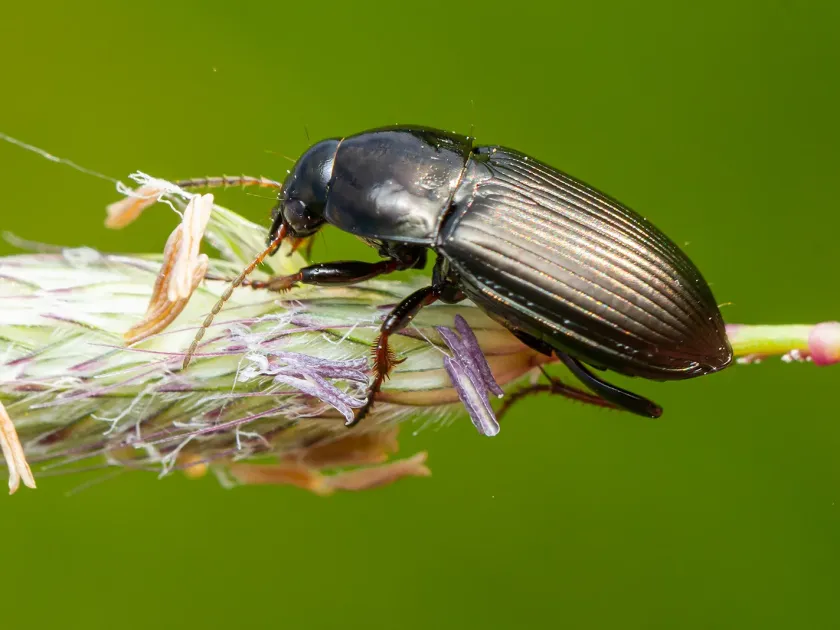
Amara fulvipes belongs to the family Carabidae (ground beetles) within the order Coleoptera. Adult specimens typically measure 7–9 mm in body length and exhibit a black or dark-bronze coloration with a metallic sheen.
The defining characteristic of this species is its yellowish-red legs, which is reflected in its scientific and common names. The elytra surface is smooth with distinct longitudinal grooves.
The larvae of this ground beetle species lead a cryptic lifestyle within the soil. They possess an elongated, slightly flattened body, colored dirty-white or grayish, and are equipped with well-developed mandibles.
Adult beetles are highly active during nighttime, preferring to remain hidden under soil clods or plant debris during the daylight hours. They overwinter primarily as adults in the upper soil layers.
The insect undergoes complete metamorphosis. In temperate climates, there is typically one generation per year, contributing to the relative stability of the population within agricultural ecosystems.
What it damages
Unlike many other carabid species that are strictly predatory, adult Amara fulvipes exhibit phytophagy. They cause the most significant damage to cereal crops during the milk-wax maturity stage.
The beetles actively feed on grains within the wheat, barley, and rye spikes. Damage manifests as the mechanical destruction of the crop, directly leading to a decline in grain quality and yield.
In addition to cereal crops, these beetles may feed on the seeds of various weeds, making them facultative phytophages. However, in cases of mass proliferation, their contribution to harvest losses becomes economically significant.
Larvae, unlike the adults, feed more frequently on organic matter; however, in the absence of primary food sources, they may cause damage to germinating seeds and the root systems of cereal seedlings.
Mass emergence of the pest often correlates with drought conditions and violations of crop rotation, which create optimal environments for population accumulation in the soil.
When it appears
The primary activity of the adults coincides with the grain-filling stage, usually occurring in the mid-to-late summer season. During this time, beetles congregate heavily in cereal fields.
The first beetles emerge from overwintering sites in the spring when soil temperatures reach +10–12 degrees Celsius. After a period of supplemental feeding, they initiate the reproductive phase.
Egg-laying occurs in the soil, where larvae pass through several instars of development during the summer. By August, the majority of the population has transformed into the next generation of adults.
During the autumn, the beetles continue to feed on weed seeds and crop residues, preparing for the upcoming winter. They endure the cold season in deep soil strata or beneath vegetative litter.
The peak of damage coincides with grain developmental phases, when the content of the spike becomes highly accessible to the feeding apparatus of the beetles.
Signs of infestation
The primary indication of pest presence is the discovery of damaged grains within the spikes, characterized by uneven edges where the endosperm has been consumed.
Fields often show visible clusters of beetles during the evening and morning hours on the soil surface or resting on the stalks. Visual detection is possible during field monitoring using light traps.
Damaged spikes may exhibit a "white-head" appearance or partial sterility if the beetles have severely affected the grain during the early stages of its development.
The presence of these beetles is often accompanied by a distinct, unpleasant odor, which serves as a chemical defense mechanism against natural predators.
Seedlings may appear sparse in patches where larval concentration in the soil is high, which can be identified during agronomic field surveys in the spring.
Control measures
The fundamental method of control is strict adherence to crop rotation. Avoiding the planting of cereals immediately following other cereal precursors significantly reduces population density in the field.
Deep autumn plowing (tillage) is an effective agrotechnical practice. It disrupts the overwintering habitat of the pest and leads to the mortality of adults and larvae due to mechanical stress and exposure to harsh conditions.
Managing weeds within the fields and along headlands is a critical preventive measure, as weeds serve as alternative food sources for beetles when the primary crop is not available.
Chemical control via insecticides is recommended only when the economic injury level is reached. Commonly used treatments include organophosphorus compounds or pyrethroids.
Timely harvesting of the crop within a narrow window allows farmers to avoid mass reproduction of the pest and minimizes the grain losses caused by beetles feeding on standing crops.
Taxonomy
- Latin name
- Amara fulvipes
- Order
- Coleoptera (beetles)
- Family
- Carabidae
- EPPO code
- AMARFI
Discussion
No discussions yet — be the first.