
Red Ground Beetle
Amara fulva
Description
How to identify
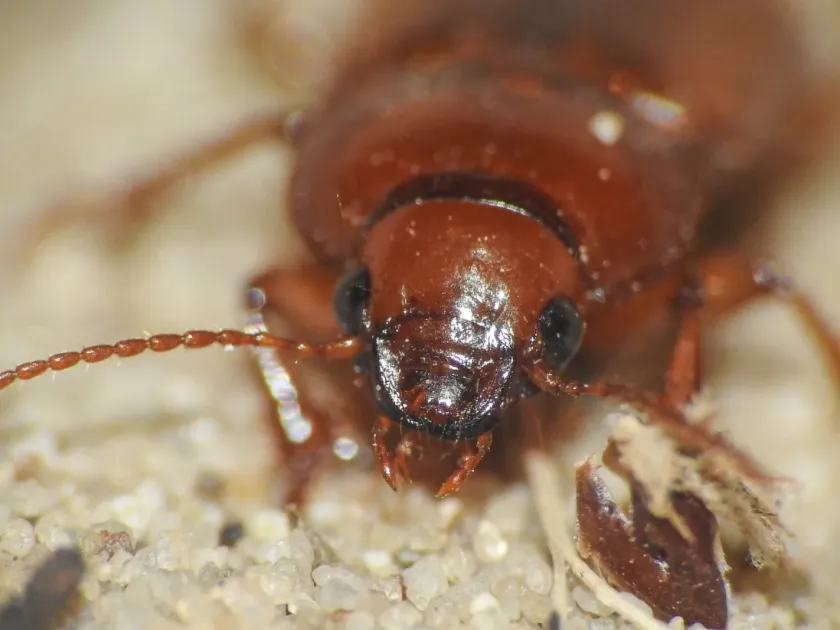
The Red Ground Beetle (Amara fulva) is a member of the Carabidae family within the order Coleoptera. It is a medium-sized beetle, easily identified by its distinct reddish-brown or yellowish-red body color, which often carries a subtle metallic sheen.
The body of this insect is oval and slightly flattened, equipped with well-developed mandibles. Unlike many strictly predatory ground beetles, this species frequently exhibits herbivorous feeding habits, making it a unique member of its family.
The beetle typically measures between 8 and 11 millimeters in length. Its elytra (wing covers) are smooth and feature clearly defined punctate striae, which serves as a key diagnostic feature for field identification.
Larvae of Amara fulva are campodeiform, characterized by an elongated body, well-developed thoracic legs, and cerci at the end of the abdomen. They undergo several developmental stages, increasing significantly in size as they feed.
This species is a typical inhabitant of open landscapes such as fields, meadows, and steppes. It prefers areas with light, sandy, or loamy soils, which facilitate easier movement and provide favorable conditions for their life cycle.
What it damages
The Red Ground Beetle primarily causes damage to cereal crops, including wheat, rye, barley, and oats. Unlike typical predatory ground beetles, this species often shifts its diet to include vegetative and reproductive parts of cultivated plants.
Adult beetles can damage sown seeds by gnawing into their contents, which results in reduced plant emergence and significant yield losses at the germination stage. Feeding on ovaries and developing grains in the ear has also been documented.
Populations that exceed the economic threshold pose the greatest risk. In years with favorable weather conditions, beetle activity can lead to the partial destruction of crops across specific sections of a field.
The pest is not limited to cereal crops and can also feed on the seeds of various weeds, which makes it a facultative phytophage. However, the presence of grain fields attracts massive aggregations of these beetles.
Secondary damage occurs through the feeding on young shoots during the tillering phase, which weakens the plant's overall health and makes it more susceptible to secondary fungal infections transported by the beetles.
When it appears
The life cycle of the Red Ground Beetle is closely tied to the phenology of agricultural crops. They overwinter primarily as adults in the soil, under plant debris, or in soil crevices, entering a state of diapause.
In spring, when the soil temperature rises to 10–12 degrees Celsius, the beetles emerge and begin active feeding. During this period, they are often found in high concentrations in winter crops, where they find abundant food and moisture.
Mass reproduction and egg-laying occur in the first half of the summer. Eggs are deposited in the soil in small clusters, where larvae eventually hatch and begin their feeding process.
The summer period is characterized by the presence of all insect developmental stages. A second generation of beetles may emerge in late summer or early autumn, feeding actively before preparing for the winter diapause.
The entire biology of the species is dictated by seasonal cycles, requiring agronomists to monitor population levels specifically during the germination and grain-filling phases, when damage is most critical for yield potential.
Signs of infestation
The main sign of infestation is the presence of specific damage to seeds in the soil, appearing as hollowed-out cavities with jagged edges. This is often confused with wireworm damage, although the edges in beetle-damaged seeds are typically more uneven.
Visual inspection of fields during evening or early morning hours allows for the detection of the beetles on the soil surface or on plant stems. Using soil traps is the most accurate method for counting population density.
In the fields, noticeable patches of thin or missing stands appear because seeds were consumed before germination. Gradual wilting of individual plants can also indicate the activity of larvae in the root zone.
The presence of large numbers of beetles in wheat ears during the milk stage of grain development is a warning sign that the insects have shifted their diet to reproductive plant parts.
- Thinning or gaps in cereal crop stands.
- Damaged seeds found in the upper soil layer.
- Mass counts of beetles in Barber pitfall traps.
- Evidence of feeding on young leaves and stems.
- Damage to grain ovaries during the ear-heading phase.
Control measures
Effective protection starts with high-quality primary tillage, including plowing with moldboard inversion, which disrupts the overwintering sites of beetles and larvae, significantly reducing their population density in the field.
Crop rotation is a critical management factor; it is not recommended to sow cereals after predecessors that favor the reproduction of this species, such as stubble-based fields.
The use of insecticidal seed treatments reliably protects seedlings from damage by adults and larvae during the early stages of plant development, minimizing the risk of significant crop loss.
If population thresholds are exceeded during the growing season, chemical applications of broad-spectrum insecticides are applied, preferably in the evening when the beetles reach their peak activity.
An important element of control remains weed management. Weeds serve as a food reservoir for beetles in the off-season, so clearing fields and surrounding areas helps to substantially limit the pest population.
Taxonomy
- Latin name
- Amara fulva
- Order
- Coleoptera (beetles)
- Family
- Carabidae
- EPPO code
- AMARFA
Discussion
No discussions yet — be the first.