
Common Amara
Amara communis
Description
How to identify
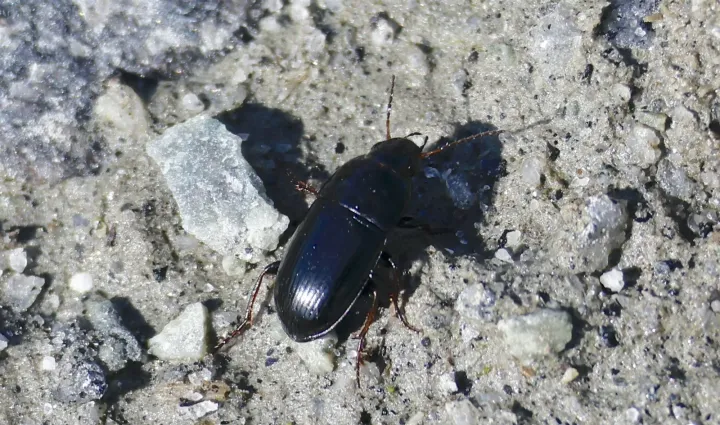
Common Amara (Amara communis) is a ground beetle belonging to the Carabidae family, order Coleoptera. These beetles are typically 7 to 9 mm long, with a dark, oval-shaped body often exhibiting a dull or metallic luster which helps them camouflage within the soil.
The adult beetle is equipped with strong mandibles adapted for a generalist diet. They possess thread-like antennae and smooth or finely grooved elytra. Unlike many other predatory ground beetles, Amara species often include seeds and plant matter in their diet.
The larvae are campodeiform, featuring elongated bodies and well-developed thoracic legs, allowing them to move efficiently through the soil layers. Their body structure is adapted for a semi-subterranean life, making them difficult to detect without careful excavation.
The life cycle involves complete metamorphosis, consisting of the egg, larval, pupal, and adult stages. This complex development allows the species to survive in various environments, using the soil as a refuge during unfavorable conditions.
Adult beetles are capable of flight, which facilitates their migration to crop fields during the early spring. This dispersal behavior means that infestations can occur rapidly at the start of the planting season as adults search for suitable food and egg-laying sites.
What it damages
Damage is caused by both adults and larvae. They are particularly known for damaging cereal crops during germination, as they target the swollen seeds and the newly emerged seedlings, leading to reduced plant density in the field.
Larvae living in the topsoil feed on the underground parts of stems and root systems. This underground grazing weakens the young plants, causing yellowing, reduced vigor, and often death if the root damage is severe during the critical early growth stage.
Common Amara is a significant pest for winter wheat, rye, and spring cereals. The damage often presents in patches, which can lead to significant economic losses when high populations are present at the time of sowing.
Apart from cereals, these beetles can affect legumes and sugar beets if the soil contains significant plant debris. The presence of food sources like weed seeds and crop residues often encourages their concentration in agricultural fields.
Injured seedlings are susceptible to secondary infections by soil-borne pathogens. The wounds created by the beetles' mandibles serve as entry points for fungi, further compromising the survival of the crop stand.
When it appears
Activity peaks in early spring when temperatures rise above 10 degrees Celsius, triggering the adults to emerge from hibernation. This timing coincides with the planting season of major cereal crops, creating a high-risk window for damage.
The primary period of concern is the germination and early seedling stage. If the seeds remain in the soil for too long due to cold weather, they are exposed to feeding pressure from the beetles for a longer duration.
During the summer months, adult activity continues, although they may shift their diet to ripening grains or weed seeds. Larvae remain active in the soil, completing their development before entering pupation in late summer or early autumn.
As autumn approaches, the adults seek protected sites for overwintering. They bury themselves deep in the soil or hide under dense plant debris, remaining dormant until the following spring, when the cycle repeats.
Climatic conditions, specifically soil moisture, play a crucial role. Wet and warm springs are generally more favorable for the survival of larvae and the reproductive success of adults, leading to higher population levels.
Signs of infestation
The most noticeable sign of infestation is the patchy emergence of seedlings. Fields may show bare spots or rows with missing plants, and digging in these areas often reveals hollowed-out seeds or chewed remnants of seedlings.
Using pitfall traps or bait traps (like grain-baited containers) placed on the soil surface is an effective way to confirm the presence of adult beetles during the night. Monitoring these traps provides data on population density.
Young plants appear stunted or withered compared to healthy ones. When pulled from the soil, the roots may show uneven, ragged edges, which is a classic indication of beetle feeding rather than smooth-edged damage from other pests.
In fields with high activity, adults can often be found near the base of the stems under soil clods or crop debris. A manual inspection of the soil around the affected seedlings usually reveals the larvae or adult beetles hiding near the roots.
- Patchy field emergence;
- Empty seed cavities found in soil;
- Ragged chewing marks on young roots and stems;
- Presence of beetles in pitfall traps.
Control measures
Deep autumn tillage is the most effective agronomic method to control the population. This process disrupts the overwintering sites and exposes larvae and adults to extreme temperatures and natural predators like birds.
Crop rotation is essential to prevent the buildup of beetle populations. Moving away from continuous cereal cropping discourages the concentration of the pest in the soil and breaks the cycle of continuous food availability.
Ensuring optimal sowing conditions, such as proper depth and moisture, promotes rapid germination. Seedlings that emerge quickly are more resistant to pest damage because they pass the vulnerable stage faster.
For fields with a history of infestation, treating seeds with systemic insecticides is the standard and most effective practice. This provides protection directly in the root zone during the most critical period of crop development.
In cases where infestations exceed economic thresholds, foliar insecticide applications may be necessary. However, because these beetles are often protected by soil or debris, the timing must be precise, and efficacy may vary compared to seed treatments.
Taxonomy
- Latin name
- Amara communis
- Order
- Coleoptera (beetles)
- Family
- Carabidae
- EPPO code
- AMARCM
Discussion
No discussions yet — be the first.