
Common sun beetle
Amara aenea
Description
How to identify
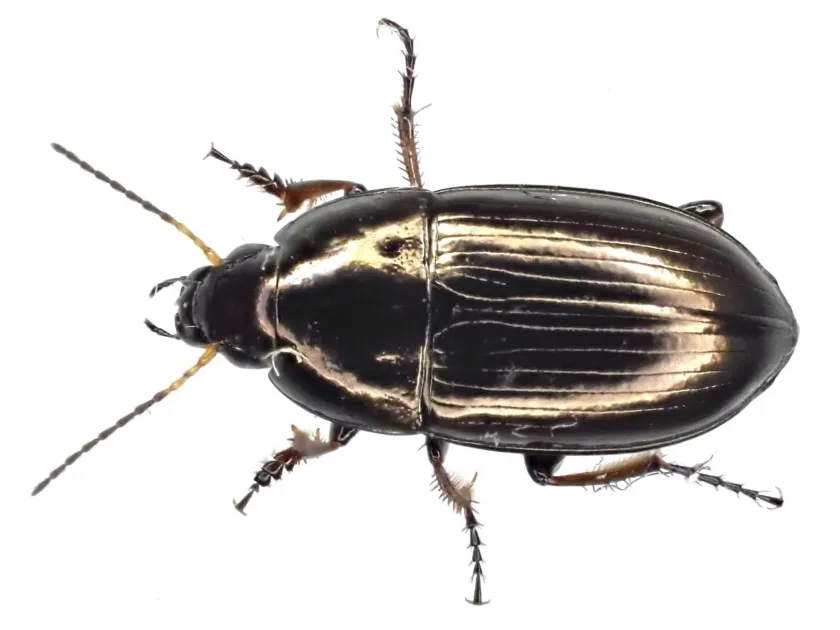
The common sun beetle (Amara aenea) belongs to the Carabidae family, commonly known as ground beetles, within the order Coleoptera. These beetles typically measure between 6 and 9 millimeters in length and are distinguished by a metallic bronze or greenish luster on their elytra.
Their bodies are oval and slightly flattened, an adaptation that allows them to move swiftly across the soil surface and crawl into crevices. The coloration ranges from deep bronze to dark green or almost black, providing effective camouflage in their habitat.
Larvae are elongated, light-colored, and possess well-developed mouthparts. They lead a cryptic life, inhabiting the upper layers of the soil where they feed on seeds and organic matter, developing into pupae within the soil profile.
Adult beetles are predominantly nocturnal. During the day, they shelter under soil clumps, vegetation debris, or within cracks in the earth to avoid predators and desiccation. They are most visible during the night or when soil is disturbed.
The life cycle involves complete metamorphosis: egg, larva, pupa, and adult. Hibernation occurs primarily in the adult stage, with beetles burying themselves deep in the soil to survive winter conditions.
What it damages
The primary damage is caused by adult beetles, which are opportunistic feeders specializing in cereal seeds and young sprouts. They are particularly destructive to newly sown seeds, boring into them to consume the embryo and endosperm.
These pests pose a significant threat to winter and spring cereals, including wheat, barley, and rye. In addition to cereals, they can occasionally damage emerging maize or sugar beet seedlings if the population density is high.
Economic damage occurs when the beetles reach high numbers, leading to sparse crop stands. This forces farmers to re-sow fields, resulting in increased labor costs, additional seed expenses, and delayed harvest times.
Seedlings are most vulnerable during the germination phase. If germination is delayed due to cold or dry weather, the seeds remain in the soil for longer periods, providing the beetles with a prolonged window to cause significant damage.
Besides seed consumption, adults may graze on tender leaves of young seedlings. While this rarely kills the plant outright, it weakens the seedling, making it more susceptible to environmental stress and secondary pathogen infections.
When it appears
The activity of Amara aenea begins in early spring as soil temperatures rise. This emergence typically coincides with the planting season for spring cereals, which explains why the pests are frequently found in newly sown fields.
Throughout the summer, the adult beetles are active, though their diet shifts to include a wider range of food sources, including the seeds of various weeds, which decreases their immediate impact on cultivated crops.
Egg-laying usually occurs in the late summer and autumn. The larval development takes place in the soil, followed by pupation. By autumn, a new generation of adults emerges, which will eventually hibernate to survive the winter months.
Monitoring for the presence of these beetles is typically conducted before sowing, using soil traps or by inspecting the soil during tillage. Early detection is crucial for determining the necessity of seed treatments.
Favorable weather conditions, such as mild, moist springs, significantly boost the population growth of the beetle. Conversely, extreme temperature fluctuations can reduce their activity and survival rate during the critical spring phase.
Signs of infestation
The most prominent sign of an infestation is the appearance of bare patches or gaps in crop rows shortly after emergence. These irregular gaps are often indicators of seed destruction by ground beetles.
When digging into the soil near damaged rows, one can often find hollowed-out seeds with shredded hulls. These markings are characteristic of the feeding activity of Amara aenea adults.
During the night, beetles can be seen actively moving on the soil surface. Using light traps in the field can also provide insight into the density of the adult population present in the area.
High weed density in the previous season often correlates with larger beetle populations in the following year, as weeds provide both shelter and a consistent food source for the beetles throughout the summer.
Stunted, yellowing, or wilting seedlings are also signs of damage. If the root system or the base of the stem has been chewed by the larvae or adults, the plant's ability to absorb water and nutrients is severely impaired.
Control measures
Controlling the common sun beetle requires a combination of good agronomic practices and precise chemical interventions to protect the crop during its most vulnerable growth stages.
Deep plowing in the autumn is the most effective mechanical control method. By turning the soil, many overwintering beetles are buried too deep to survive or are exposed to surface predators, significantly reducing the spring population.
Seed treatment with systemic insecticides is the standard and most reliable practice for preventing damage. This method ensures that the germinating seed is protected from beetle feeding from the moment it is planted.
Maintaining clean fields free from weeds is essential. By eliminating alternative food sources for the beetles, their ability to survive and reproduce in the field environment is drastically reduced.
- Deep autumn plowing to disrupt life cycles.
- Optimal sowing timing to minimize germination delays.
- Proactive seed treatment with insecticides.
- Effective weed management throughout the season.
- Regular population monitoring using soil traps.
Taxonomy
- Latin name
- Amara aenea
- Order
- Coleoptera (beetles)
- Family
- Carabidae
- EPPO code
- AMARAE
Discussion
No discussions yet — be the first.