
Amara
Amara
Description
How to identify
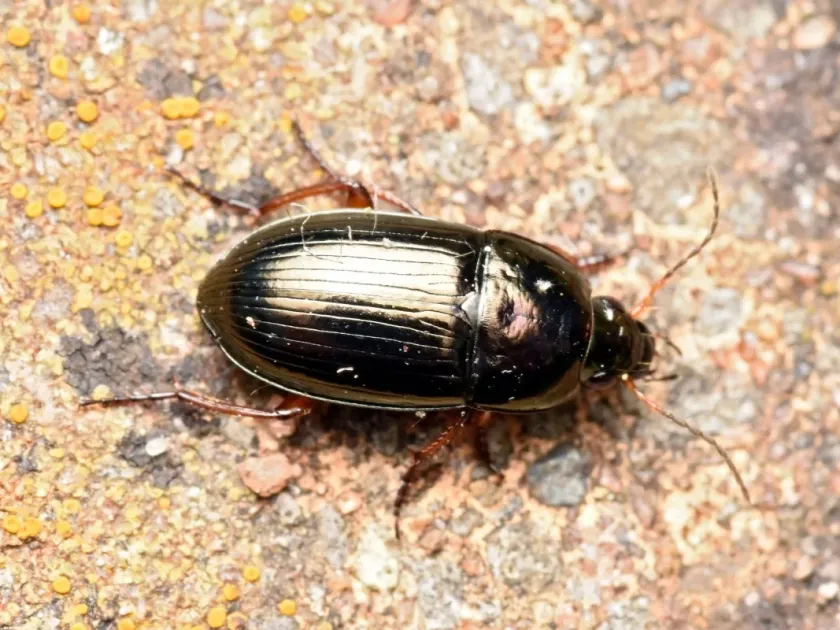
The genus Amara belongs to the family Carabidae, commonly known as ground beetles. These are small to medium-sized beetles, typically ranging from 5 to 15 mm in length, with a glossy, somewhat flattened body structure.
The coloration of these beetles is usually black or dark brown, sometimes with a faint metallic luster. They possess a well-developed mandibulary system, adapted for both predatory activity and consumption of plant tissues.
Larvae are elongated and active, possessing three pairs of thoracic legs and a distinct head capsule. This morphological profile is characteristic of many carabids and allows them to move efficiently through the soil.
Unlike strictly carnivorous ground beetles, many species within the genus Amara are mixophagous, meaning they consume both soil-dwelling invertebrates and plant materials, which places them in the category of agricultural pests.
They are primarily nocturnal, preferring to hide in soil crevices, under crop residues, or beneath surface debris during the daylight hours to avoid desiccation and predation.
What it damages
Damage caused by Amara species is primarily directed toward cereal crops, including wheat, barley, rye, and oats. The beetles are known to feed on developing grain kernels during the milk and dough stages.
Beyond grain damage, adults and sometimes larvae can feed on seedling crops. They may chew on cotyledons and stems of sugar beets and various vegetables, leading to reduced plant stands and uneven emergence.
In cases of high infestation, the total loss of seedlings can occur, necessitating replanting. Even moderate feeding can significantly weaken young plants, making them more susceptible to subsequent stressors.
Feeding damage on the grain head reduces yield quantity and quality, often creating openings for secondary fungal infections that further lower the market value of the harvested crop.
The economic impact of Amara is often linked to field margins and areas with minimal soil disturbance, where populations can survive and multiply over several seasons.
When it appears
The lifecycle of Amara involves overwintering as adults in the soil, protected by stubble, leaf litter, or deep crevices. They emerge in the spring once soil temperatures reach a suitable threshold.
Spring activity coincides with the early vegetative phases of cereal crops. This is the period when beetles feed most aggressively to recover energy reserves and prepare for the reproductive phase.
Oviposition occurs in the soil, and larval development typically proceeds through several stages throughout the late spring and summer months, utilizing soil moisture and organic matter.
New generations of adults generally emerge in the mid-to-late summer. They continue feeding actively until the onset of autumn, when cooling temperatures trigger the migration toward overwintering sites.
The duration and timing of each life stage are highly dependent on local climatic conditions, particularly soil moisture, which is critical for the survival of the larval stages.
Signs of infestation
The most evident signs of an Amara infestation in cereal fields include partially consumed kernels within the head, often appearing as empty hulls or hollowed-out grains.
In seedling stages, damage is identified by irregular, ragged edges on leaves and stems, indicating the activity of a chewing pest rather than a piercing-sucking insect.
Sparse crop emergence in patches, coupled with the presence of larvae or adult beetles in the root zone during soil examination, strongly suggests the presence of these pests.
Monitoring using pitfall traps is the most reliable way to confirm the presence of Amara before the damage becomes economically devastating.
Because they are nocturnal, night-time field surveys using a flashlight can reveal adult beetles feeding on the canopy, providing a direct confirmation of the species involved.
Control measures
Integrated pest management for Amara emphasizes cultural practices, such as deep autumn tillage, which disturbs overwintering sites and reduces the overwintering population.
Crop rotation remains one of the most effective ways to disrupt the lifecycle of these pests by changing the host plant environment and limiting food availability for larvae.
Seed treatments using systemic insecticides are highly recommended for high-risk areas to provide early-season protection to germinating seeds and young seedlings.
Field scouting for adult activity is essential to decide on the necessity of foliar insecticide applications, which should be timed according to economic injury levels.
- Maintain field sanitation by removing crop residues that provide shelter.
- Implement balanced fertilization to ensure fast seedling establishment.
- Utilize localized insecticide treatments at field edges where infestation often starts.
Taxonomy
- Latin name
- Amara
- Order
- Coleoptera (beetles)
- Family
- Carabidae
- EPPO code
- AMARSP
Discussion
No discussions yet — be the first.