
Six-spotted ground beetle
Agonum sexpunctatum
Description
How to identify
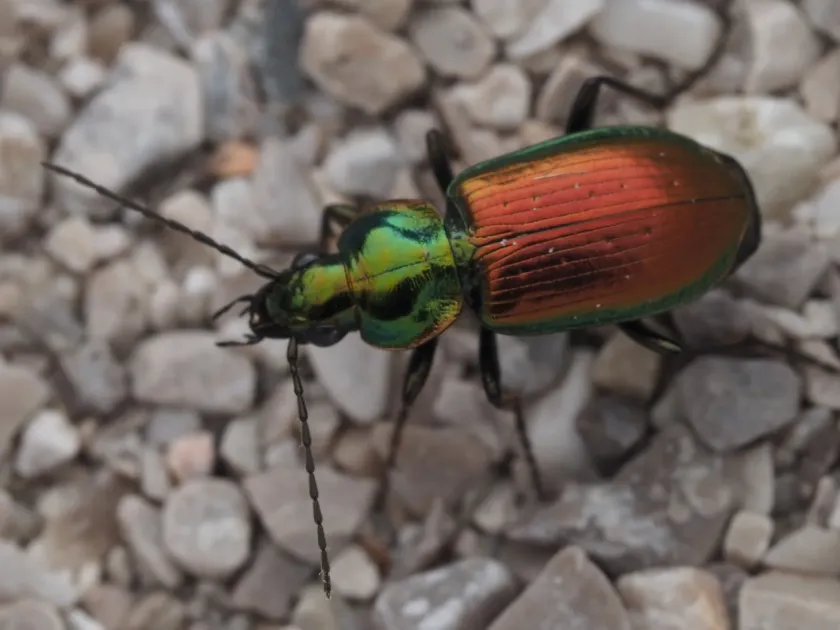
The six-spotted ground beetle, known scientifically as Agonum sexpunctatum, belongs to the family Carabidae within the order Coleoptera. Adult beetles are typically 8 to 10 millimeters long and display a distinctive metallic sheen, ranging from emerald green to coppery bronze.
The primary identification feature is the set of six visible indentations, or punctures, on the elytra (wing covers), positioned specifically on the third interval. The body is relatively flattened, enabling the beetle to navigate through narrow soil fissures and under debris.
Larvae of this species are campodeiform, meaning they are active, elongated, and possess well-developed legs and functional mouthparts, allowing them to hunt effectively in the soil layer.
The species is primarily associated with moist environments, frequently inhabiting forest edges, meadows, and agricultural fields where soil moisture levels are consistently high.
Their life cycle typically includes overwintering as adults in the soil or under dense plant matter. Mating and oviposition occur in the spring, with eggs laid in damp soil substrates.
What it damages
Although many ground beetles are beneficial predators, the six-spotted ground beetle can exhibit mixophagous behavior, occasionally causing damage to crops when preferred insect prey is scarce.
The main threat is posed to germinating seeds and young seedlings. In agricultural settings, they may feed on sown grains and delicate plant shoots, resulting in reduced stand density.
Damage is most prevalent during the early stages of grain development, where the beetles feed on the endosperm or the growing points of seedlings, causing stunted growth or total plant failure.
Crops such as winter and spring cereals are particularly vulnerable, especially when the soil remains cool and damp, favoring the activity of the beetles over the rapid development of the plant.
In addition to cereals, damage can be observed in vegetable crops where the beetles graze on tender stem tissues, weakening the plants and making them susceptible to secondary infections.
When it appears
Adult beetles become active in early spring, once soil temperatures rise. The peak of adult activity is typically observed during the months of May and June.
During the hotter months of the year, adult activity decreases significantly as they seek refuge in deeper, more humid soil layers to avoid desiccation and extreme heat.
A second wave of activity often occurs in autumn before the beetles migrate to their wintering sites. They seek protected areas such as hedgerows, field margins, or forest edges to survive the winter.
Larval development takes place primarily in the first half of the summer, requiring sufficient soil moisture to ensure survival through the various larval instars.
Population dynamics are strongly influenced by weather patterns, specifically rainfall, which dictates the availability of suitable nesting and hunting grounds for the beetles.
Signs of infestation
The first indication of an infestation is the appearance of bare patches or thinned areas in the crop fields, particularly soon after emergence in the spring.
Close inspection of seedlings often reveals uneven, ragged edges on leaves and stems, and in some cases, the total destruction of the seedling tissue near the base.
One can confirm the presence of the beetle by utilizing pitfall traps or by manually inspecting soil debris during the cooler parts of the day, such as early morning or late evening.
Damaged seeds excavated from the soil often show clear signs of chewing, characterized by irregular holes and missing portions of the seed coat or endosperm.
Monitoring for the metallic-colored adults in the soil is an effective way to assess the current population density before significant damage to the crop is sustained.
Control measures
Cultural control is the most effective approach; this includes implementing strict crop rotation, which disrupts the beetles' habitat and reduces their ability to colonize specific fields.
Deep autumn tillage is highly recommended as it physically disrupts the overwintering sites, exposing the beetles to harsh winter conditions and predators.
Chemical protection is primarily achieved through the use of high-quality insecticidal seed treatments, which provide a critical safety buffer for seedlings during the early germination phase.
Maintaining a clean field environment by eliminating weeds and crop residues around field margins deprives the beetles of essential shelter and food sources during the off-season.
- Ensure optimal planting dates to promote rapid seedling vigor.
- Apply targeted insecticides if population thresholds are exceeded.
- Foster local biodiversity to support natural predator populations.
Taxonomy
- Latin name
- Agonum sexpunctatum
- Order
- Coleoptera (beetles)
- Family
- Carabidae
- EPPO code
- AGOUSE
Discussion
No discussions yet — be the first.