
Agonum muelleri
Agonum muelleri
Description
How to identify
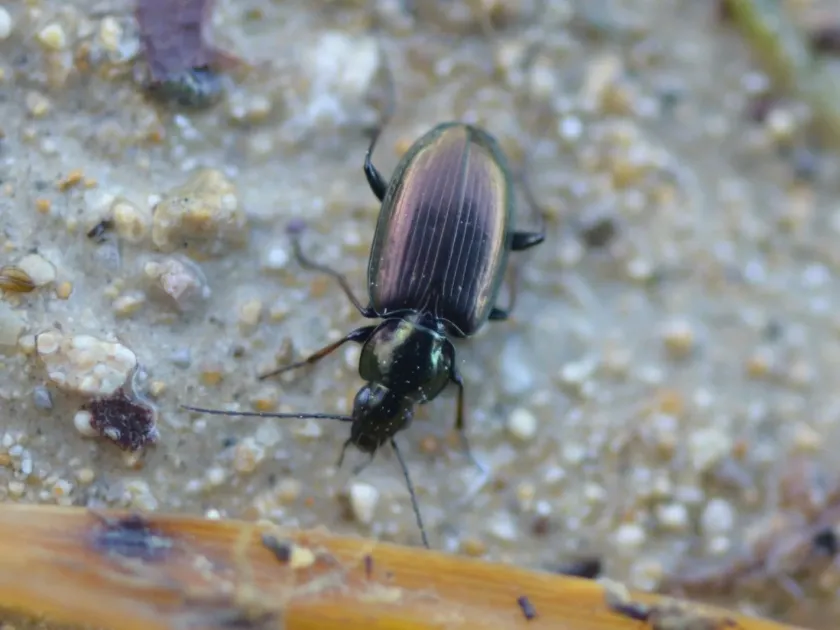
Agonum muelleri is a species of ground beetle belonging to the family Carabidae within the order Coleoptera. Adult beetles are typically 7 to 9 millimeters long, characterized by a flattened, elongated body shape.
The coloration of the beetle ranges from dark bronze to black, often exhibiting a subtle metallic luster. The elytra, or wing covers, feature distinct longitudinal grooves, which are key diagnostic traits for this species.
The larvae are typically slender and possess a well-developed chewing mouthpart system. They are highly active and dwell primarily within the top layer of the soil, where they forage for food.
These beetles prefer moist habitats and are frequently found in fields near water bodies, wetlands, or areas with poor soil drainage where humidity levels remain consistently high throughout the season.
As nocturnal insects, they are highly mobile and fast-moving, often retreating into soil crevices or under debris during the daylight hours, making them difficult to spot during routine field inspections.
What it damages
While many carabid species are considered beneficial predators in agroecosystems, Agonum muelleri can occasionally shift its feeding habits to plant tissues, causing damage to agricultural crops.
The primary threat is posed to germinating seeds and young seedlings of cereal crops. Adult beetles consume the delicate stems and cotyledons, which often leads to sparse stands and significant yield reduction.
Seeds in the soil are also highly vulnerable; the beetle can hollow out the grain, preventing germination entirely and leaving gaps in the crop rows that are difficult to correct later in the season.
During the autumn, the pest can impact winter-sown crops. Extensive feeding during this time weakens the seedlings before the winter dormancy period, increasing their susceptibility to frost and disease.
Secondary damage occurs as the mechanical wounds caused by the beetles provide entry points for soil-borne pathogens, including various fungal infections that can lead to root rot or stem blight.
When it appears
The life cycle of Agonum muelleri is heavily influenced by soil temperature and moisture. Activity typically commences in early spring as the soil begins to warm up, triggering the emergence of overwintering adults.
The peak reproductive period usually occurs during the summer months, facilitated by adequate moisture levels. This coincides with the time of year when adult density on the soil surface is at its highest.
Winter survival is achieved by adults through hibernation in the upper soil layers or beneath dense plant litter, which offers protection against the harsh cold and frost cycles of the winter months.
Larval development proceeds throughout the growing season. High rainfall or excessive irrigation can create favorable conditions for larval survival, occasionally resulting in population outbreaks in specific fields.
The species generally completes one generation per year. However, if late-season temperatures remain above average, a prolonged period of activity can be observed, affecting crop establishment.
Signs of infestation
The most prominent sign of an infestation is the presence of irregular, notched edges on the leaves of young seedlings, indicating that adult beetles have been feeding on the vegetation.
In cases of severe seedling damage, plants may appear withered or show signs of being cut off at the base. Field inspections often reveal areas of patchy growth or missing plants in rows.
Digging into the soil around damaged plants often reveals hollowed-out seeds or remnants of seedlings, confirming the presence of ground beetle activity in the root zone.
Nocturnal visual monitoring with a flashlight is the most reliable way to confirm the presence of adult beetles, as they are most active on the surface after sunset in moist conditions.
Small tunnel networks or disturbances in the soil crust near the base of the crop can also serve as an indicator that larvae or adults have been active in the immediate vicinity of the plants.
Control measures
Effective management of Agonum muelleri relies on an integrated pest management (IPM) strategy that emphasizes cultural practices to reduce the beetle's habitat and population density.
- Implementing deep autumn plowing to disturb overwintering sites and reduce adult survival.
- Rotating crops to break the life cycle and reduce the build-up of specific ground-dwelling pests.
- Ensuring rapid crop establishment through optimal planting depths and healthy seed vigor.
- Maintaining clean field margins to reduce shelters for the pest population.
Chemical control, such as insecticidal seed treatments, is often the most effective method for protecting early-stage seedlings from ground beetle damage before emergence or during the initial growth phase.
In extreme cases of infestation, foliar or soil-applied insecticides may be used, but these should be chosen based on local economic thresholds and the presence of other beneficial insects in the field.
Taxonomy
- Latin name
- Agonum muelleri
- Order
- Coleoptera (beetles)
- Family
- Carabidae
- EPPO code
- AGOUMU
Discussion
No discussions yet — be the first.