
Agonum fuliginosum
Agonum fuliginosum
Description
How to identify
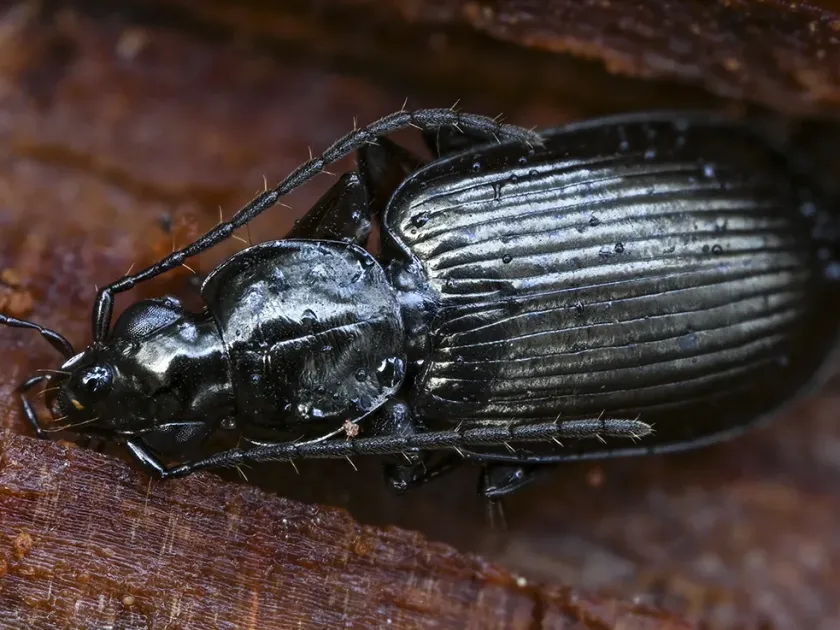
Agonum fuliginosum belongs to the ground beetle family (Carabidae), order Coleoptera. Adult specimens typically have a body length of about 6–8 mm, colored in dark, almost black or dark brown shades with a metallic luster.
The beetles have a slender body and long legs, allowing them to move quickly across the soil surface and through plant litter. The pronotum is heart-shaped, and the elytra feature distinct longitudinal striations.
The biology of this species is closely linked to high moisture levels. Unlike many other ground beetle species, Agonum fuliginosum prefers waterlogged areas, pond edges, and marshy lowlands, which determines its primary distribution.
The larvae of these ground beetles have an elongated body, well-developed mandibles, and three pairs of thoracic legs. They are active predators living in the topsoil layer, maintaining a cryptic lifestyle.
For accurate identification, monitoring should be conducted in damp field areas using Barber pitfall traps, as it is extremely difficult to spot the beetles visually within dense vegetation.
What it damages
Although ground beetle family members are often considered beneficial entomophages, Agonum fuliginosum can exhibit phytophagy under certain conditions, damaging young shoots of various agricultural crops.
Potentially affected crops include winter and spring cereals, where beetles may gnaw on germinating seeds and young sprouts, causing damage to plant density and stand uniformity.
The greatest damage is observed during years with drastic soil moisture fluctuations, when the natural food base for the beetles shrinks, forcing them to feed on the vegetative parts of cultivated plants.
Damage to cereal crops occurs primarily during the "spike" phase, when young shoots are most vulnerable to the mechanical impact of the adult beetles' powerful mouthparts.
Furthermore, these injuries can create entry points for secondary fungal and bacterial infections, significantly weakening the immune system of agricultural crops during their early developmental stages.
When it appears
Mass emergence of adults is observed in the spring when soil temperatures reach optimal levels for the insects to emerge from their overwintering sites.
The life cycle includes complete metamorphosis: egg, larva, pupa, and adult. Adult beetles are capable of active dispersal into fields immediately after the upper soil horizon warms up.
The peak activity of adults occurs in May and June, coinciding with the mating and egg-laying process in the soil. This is the period when fields require the most diligent monitoring.
Larval development takes place during the summer. They remain in the soil, feeding on organic debris and small soil-dwelling organisms, continuing their cycle until pupation.
Overwintering typically occurs at the adult stage in deep soil layers or under plant residues, ensuring high population survival throughout the winter season.
Signs of infestation
The main sign of the pest's presence is the thinning of cereal crop stands in the absence of obvious disease symptoms.
Upon careful inspection of the sprouts, one can observe characteristic mechanical damage, such as eaten-out areas of the stem or seed, which exhibit uneven edges.
During nighttime, the beetles themselves can be spotted moving on the soil surface, which can be verified using a handheld flashlight or light traps.
An indirect sign is the location of fields in low-lying areas or near open water bodies, where the microclimate promotes the reproduction of Agonum fuliginosum.
The presence of a large number of ground beetles in pitfall traps during the emergence of seedlings indicates a risk of crop damage and the necessity of implementing protection measures.
Control measures
Effective management begins with agrotechnical measures, including high-quality soil cultivation that disrupts the beetles' habitat and destroys their overwintering sites.
Adherence to optimal sowing dates is an important practice, allowing plants to pass through their most vulnerable developmental phases before the pest's peak activity.
The use of insecticidal seed treatments significantly reduces the pest's harmfulness during early stages, providing reliable protection for young sprouts.
In cases of high pest population density based on monitoring results, spraying with permitted contact-stomach insecticides in the evening is recommended.
Crop rotation and weed management are essential, as weeds create a favorable microclimate for the reproduction and feeding of ground beetles.
Taxonomy
- Latin name
- Agonum fuliginosum
- Order
- Coleoptera (beetles)
- Family
- Carabidae
- EPPO code
- AGOUFU
Discussion
No discussions yet — be the first.