
Hemlock woolly adelgid
Adelges tsugae
Description
How to identify
The Hemlock woolly adelgid (HWA), or Adelges tsugae, is a highly destructive aphid-like insect that has become a major threat to hemlock populations, particularly in North America. It is characterized by its sessile lifestyle during most of its developmental stages.
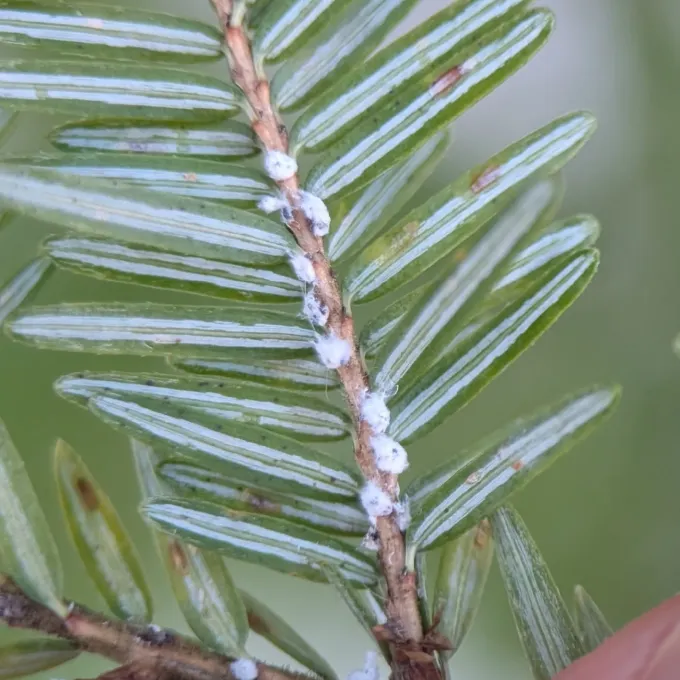
Adult females are tiny and dark, but they are easily recognized by the conspicuous white, woolly ovisacs they produce. These sacs serve to protect the eggs from desiccation and environmental stressors throughout the year.
The life cycle is complex, involving two generations per year. The «crawlers» are the only mobile stage and are responsible for spreading the infestation from tree to tree, often carried by wind, birds, or human activity.
These insects insert their mouthparts into the tree's xylem ray parenchyma at the base of the needles. They feed on the nutrients stored by the tree, essentially draining its vitality over time.
Due to their small size and the protective woolly covering, they can easily go unnoticed until significant damage has already occurred, making early detection a primary challenge for arborists and foresters.
What it damages
The Hemlock woolly adelgid causes damage primarily by feeding on the nutrient reserves of hemlock trees. As they feed, they inject toxic saliva into the tree, which triggers a defensive response and disrupts the flow of water and nutrients.
Visible damage starts with the discoloration of the needles, which fade from a healthy dark green to a grayish or yellowish color. This is followed by the premature drop of needles, leaving the branches bare.
Chronic infestation leads to the dieback of twigs and eventually entire branches, starting from the lower canopy and progressing upwards. This loss of foliage reduces the tree's photosynthetic capacity, leading to gradual starvation.
Infested trees become stressed and are often subsequently attacked by secondary pests, such as wood-boring beetles, which accelerate the tree's decline and death. A heavy infestation can kill a mature tree within a few years.
The loss of hemlock trees has profound ecological consequences, including the loss of habitat for various species and the alteration of riparian zones, which increases water temperatures in streams.
When it appears
The activity of the Hemlock woolly adelgid is heavily influenced by the seasons. The population is most active during the cooler months, specifically from late autumn through spring, when temperatures allow for development.
During the peak of summer, the insects enter a state of dormancy or diapause, during which they show very little activity. This makes them less susceptible to contact-based insecticides during the hottest parts of the year.
The crawler stage, which is the most critical for dispersal, is typically observed in early spring. This is the time when sanitation measures and quarantine efforts are most effective in preventing the spread.
Monitoring should be a year-round effort, but it is easiest to spot the white woolly sacs during the winter and early spring months when they stand out clearly against the dark green foliage.
Understanding the synchronization between the tree’s growth cycles and the insect’s life stages is crucial for timing any intervention, especially when using integrated pest management strategies.
Signs of infestation
The most reliable sign of a Hemlock woolly adelgid infestation is the presence of small, white, cotton-like masses found at the base of the needles on the underside of branches.
Observing the canopy for signs of thinning is also important. If the tree’s foliage appears sparse or dull, it is an indicator that the health of the tree is significantly compromised.
- White cottony masses on the undersides of twigs.
- Needle drop and graying or yellowing of the foliage.
- Absence of new green growth at the tips of branches.
- Presence of sticky honeydew deposits on the branches.
- Black sooty mold growing on the honeydew-covered areas.
If you see branches losing needles rapidly or a general lack of vigor in a previously healthy hemlock, examine the undersides of the twigs for these characteristic white egg sacs.
Control measures
Managing the Hemlock woolly adelgid requires a strategic combination of chemical, biological, and cultural methods to reduce population density and protect individual high-value trees.
Chemical control often involves systemic insecticides, such as neonicotinoids, applied via soil drenching, soil injection, or trunk injection. These treatments are absorbed by the tree and provide protection for several years.
Horticultural oils and insecticidal soaps can be used for smaller trees where complete coverage is possible. These work by suffocating the insects, so precise timing is required to hit the crawler stage.
Biological control, which involves the release of predatory beetles like Laricobius nigrinus, is a key component of long-term landscape and forest management, aiming to establish sustainable predator populations.
Cultural practices, such as maintaining healthy soil conditions and avoiding unnecessary stress, can help trees remain resilient, though these methods are often insufficient on their own to combat a heavy infestation.
Taxonomy
- Latin name
- Adelges tsugae
- Order
- Hemiptera (bugs, aphids, leafhoppers)
- Family
- Adelgidae
- EPPO code
- ADLGTS
Discussion
No discussions yet — be the first.