
Late spruce gall adelgid
Adelges tardus
Description
How to identify
The late spruce gall adelgid (Adelges tardus) is a small insect belonging to the family Adelgidae, order Hemiptera. This pest is a specialized parasite that exclusively feeds on spruce species.
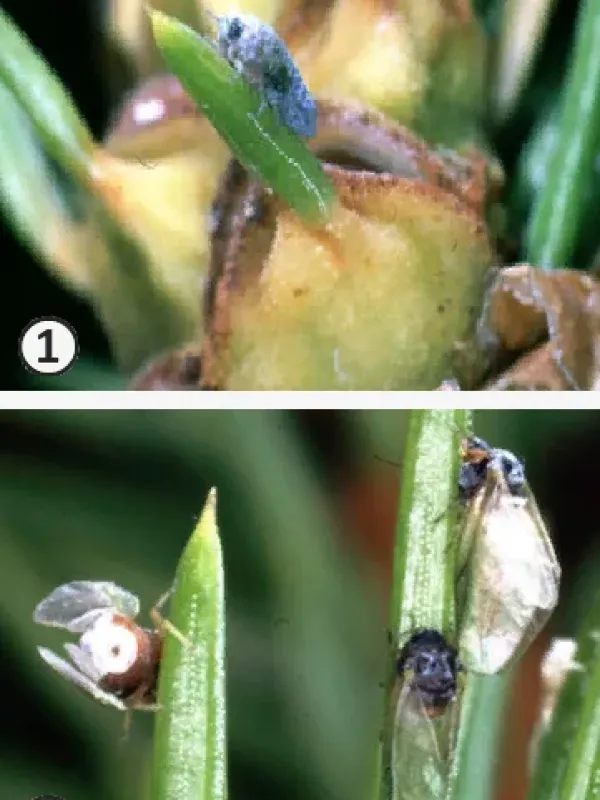
Adult females are characterized by a white waxy secretion that covers their bodies, providing protection against predators and environmental factors. They undergo a complex lifecycle with several distinct developmental stages.
The nymphs overwinter at the base of the spruce buds, remaining nearly invisible due to their microscopic size and color, which blends with the bark.
Unlike some other adelgid species, the late spruce gall adelgid does not require an alternate host plant, completing its entire life cycle on a single spruce tree.
The insect's biological activity is closely synchronized with the phenological phases of the spruce tree, particularly the timing of bud burst and shoot expansion.
What it damages
The primary host for this pest is the Norway spruce (Picea abies), though it also impacts various exotic spruce species planted in ornamental landscapes.
These insects feed by piercing the plant tissues with their stylet-like mouthparts to extract sap, which disrupts the normal development of the spruce foliage.
The feeding activity causes the formation of small galls on the tips of young shoots. These galls significantly distort the growth of the twigs and can cause lasting deformities.
Heavy infestations weaken the trees, making them less vigorous and prone to secondary infections from other diseases or environmental stressors.
In nursery settings, this pest is highly destructive as it ruins the aesthetic value and commercial quality of young saplings, often leading to total loss.
When it appears
The active cycle begins in early spring when the overwintering nymphs emerge and start feeding on the developing buds of the spruce tree.
Late spring and early summer represent the period of intensive gall formation, inside which the subsequent generation of the pest develops.
In mid-summer, the winged adults emerge from the galls and relocate to other parts of the tree or to nearby spruce trees to continue their reproductive cycle.
By autumn, the females lay eggs, and the resulting nymphs move toward the bud scales to enter hibernation for the winter months.
The most vulnerable stage for chemical intervention is during the early spring as the nymphs begin to wake and feed, prior to the formation of the protective galls.
Signs of infestation
The first visual sign of infestation is the appearance of white, cottony or waxy tufts on the spruce shoots, which often resemble small patches of snow or fuzz.
Deformed, swollen buds or stunted, bent twigs are clear indicators of adelgid activity occurring within the developing tissues.
In cases of severe damage, foliage may turn yellow and drop prematurely, particularly in areas immediately surrounding the infested shoots.
Detailed inspection during late spring reveals the presence of small, cone-like galls on the tips of the current year's growth, indicating the insect's habitat.
- White waxy tufts on branches and needles.
- Distortion and curling of young spruce shoots.
- Presence of galls on the ends of the twigs.
- Early yellowing and needle cast.
- Sticky residue (honeydew) on the branches.
Control measures
Management strategy relies heavily on the use of systemic insecticides applied in early spring before the buds break to eliminate nymphs before they produce galls.
During the summer months, applying contact insecticides can be effective when the adults are active and vulnerable as they transition between locations.
Cultural control involves pruning and destroying infested twigs and galls as soon as they are spotted to prevent further spread of the population.
Maintaining optimal tree health through proper fertilization and watering is essential, as healthy trees are better equipped to tolerate low-level infestations.
Biological control, including the protection and encouragement of natural predators like lady beetles and lacewings, helps suppress adelgid numbers naturally.
Taxonomy
- Latin name
- Adelges tardus
- Order
- Hemiptera (bugs, aphids, leafhoppers)
- Family
- Adelgidae
- EPPO code
- ADLGTR
Discussion
No discussions yet — be the first.