
Zygosaccharomyces bailii
Zygosaccharomyces bailii
Zygosaccharomyces bailii is a species of osmophilic yeast belonging to the kingdom Fungi and the division Ascomycota. It is globally recognized as one of the most preservative-resistant microorganisms in the food industry.
What the section contains
Zygosaccharomyces bailii
This yeast is a unicellular organism that possesses unique metabolic pathways, enabling it to thrive in high-sugar and high-acid environments that typically inhibit other common spoilage organisms.
While not a classical phytopathogen that destroys crops in the field, it is a significant post-harvest contaminant that affects fruit-based products and agricultural raw materials intended for processing.
The organism is characterized by its remarkable ability to withstand conventional concentrations of preservatives like sorbic acid, benzoic acid, and acetic acid, which are standard in food safety protocols.
Its life cycle includes asexual budding and the formation of resistant spores during environmental stress, facilitating its persistence in processing facilities and storage environments.
The primary damage caused by Zygosaccharomyces bailii is the spoilage of fruit juices, syrups, concentrates, wines, and vinegar-based products, leading to significant economic losses for agricultural processors.
Fermentation activity results in the loss of original product quality, the development of off-flavors and odors, and the production of carbon dioxide, which causes packaging to bloat or burst.
In the agricultural sector, the presence of this yeast on raw produce can lead to the widespread contamination of batches during the pressing and extraction stages of production.
Because of its resistance, it often survives traditional processing methods, necessitating more aggressive sterilization techniques to ensure the final product's shelf stability.
This yeast does not attack growing crops directly, but its presence on the surface of harvested fruits acts as a reservoir of infection that enters the food supply chain.
The risk of contamination is highest during the harvest and processing seasons when fruits and berries are bruised, providing a rich, sugary substrate for yeast development.
Inside manufacturing plants, the organism can persist year-round, accumulating in micro-environments like pipe joints, gaskets, and equipment surfaces that are hard to reach during sanitation.
Optimal growth occurs at temperatures between 20°C and 30°C, making warm processing environments highly susceptible to rapid proliferation if cleanliness standards lapse.
As the yeast can enter a dormant spore state, it remains a constant threat that can be re-activated whenever moisture and nutrient conditions become favorable.
Seasonal pulses in agricultural production often correlate with increased pressure on sanitation systems, providing opportunities for this yeast to colonize new batches of product.
Visual identification includes cloudiness in clear liquids, the formation of sediments, and the appearance of a yeast film on the surface of sugar-rich products.
The most common diagnostic sign of contamination in commercial products is the physical distortion of containers, such as bulging lids or burst seals due to gas accumulation.
Organoleptic changes are significant, with products often developing a characteristic alcoholic, yeasty, or overly acidic flavor that indicates active fermentation.
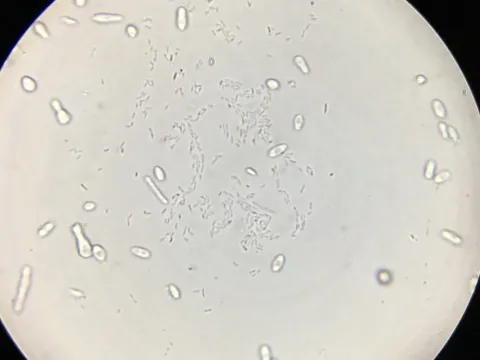
Microscopic examination reveals oval-shaped, budding cells that are highly motile and dense, often forming clusters or chains under optimal growth conditions.
On laboratory agar media, colonies typically appear as smooth, white, and convex growths, which grow rapidly even in high-solute (high-sugar) nutrient environments.
Control measures primarily involve rigorous sanitation protocols, emphasizing the elimination of niches where the yeast can form biofilms on processing equipment.
Thermal pasteurization is essential, but due to the organism's high heat resistance, validation of time-temperature parameters is critical to ensuring total inactivation.
Sterile filtration is a highly effective physical method to remove yeast cells from juices and liquid products, thereby preventing secondary contamination after processing.
Adjusting the chemical environment, such as lowering the pH and using a combination of hurdle technologies, can limit the growth potential of this resistant strain.
- Regular sanitation of filling lines and transport systems.
- Implementation of robust microbiological quality control of raw materials.
- Use of low-temperature storage for all finished sugary products.
- Application of advanced filtration techniques for liquid agricultural extracts.