
Zucchini yellow mosaic virus
Squash yellow
Zucchini yellow mosaic virus (ZYMV) is a significant plant pathogen within the family Potyviridae, genus Potyvirus. It is a single-stranded RNA virus that causes severe disease in various horticultural crops.
What the section contains
Zucchini yellow mosaic virus
As an obligate parasite, the virus requires a living host to survive and replicate. It does not have the ability to move independently and relies heavily on environmental vectors to travel between host plants.
The primary vectors for ZYMV are aphid species, most notably the melon aphid (Aphis gossypii) and the green peach aphid (Myzus persicae). Transmission is non-persistent, meaning aphids can acquire and transmit the virus within seconds.
Mechanical transmission is another major pathway. The virus can easily be transferred through contaminated tools, equipment, and even direct plant-to-plant contact in dense greenhouse or field conditions.
The virus survives the off-season in perennial weeds or alternative host plants belonging to the Cucurbitaceae family, serving as a persistent reservoir that triggers seasonal outbreaks in agricultural zones.
ZYMV primarily affects plants in the Cucurbitaceae family. This includes widely cultivated vegetables such as zucchinis, summer and winter squash, pumpkins, cucumbers, melons, and watermelons.
Beyond cultivated crops, the virus can infect various wild weeds, which complicates eradication efforts. These weeds often remain symptomless or exhibit very mild signs, making them stealthy sources of infection.
Crop loss can be devastating, sometimes reaching total failure. The economic impact is felt globally, as the virus drastically reduces both the volume and the marketability of harvested produce.
Infected plants show reduced metabolic efficiency, leading to inhibited growth and a weakened defense system. This physiological stress makes the plants more susceptible to other pathogens, such as fungal wilt or bacteria.
Yield loss is not only quantitative but also qualitative. Even if the plant produces fruit, the severe deformity and discoloration often render the crop useless for commercial retail and culinary purposes.
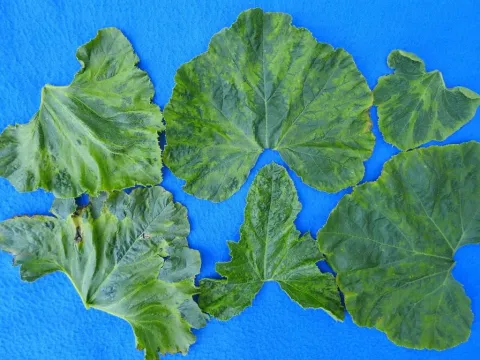
The hallmark symptoms of ZYMV include intense yellow mottling, mosaic patterns, and chlorosis on the leaves. Infected foliage often exhibits extreme curling, crinkling, and distortion of the leaf lamina.
Growth is significantly stunted. Infected plants typically display shortened internodes, which gives them a compact, rosette-like, or dwarf appearance in the early stages of development.
Fruits produced by infected plants show severe symptoms, including knobby, warty, and twisted shapes. The typical uniform color of the fruit is replaced by green-yellow mottling, making them unattractive and unmarketable.
Flower development is frequently disrupted, leading to smaller, deformed blossoms that may abort before fruit set. This results in a sharp decline in overall crop production.
- Bright yellow mosaic patterns on leaves
- Severe leaf distortion, puckering, and filiformity
- Stunted growth and shortened internodes
- Knobby, twisted, and deformed fruit structure
- Reduced fruit set and flower abortion
Management of ZYMV is challenging because there is no direct cure for the virus once a plant is infected. Therefore, control strategies must focus strictly on preventative measures and vector suppression.
Regular monitoring and control of aphid populations are essential. Using insecticides or organic deterrents can help limit the spread, although the non-persistent nature of the transmission makes this difficult to achieve perfectly.
Sanitation practices are vital. This includes the regular disinfection of cutting tools and equipment to prevent mechanical transmission. Infected plants should be promptly identified and removed from the field to reduce the virus load.
The use of resistant or tolerant cultivars is the most effective long-term solution. Many modern breeding programs are actively working to introduce ZYMV-resistance genes into popular squash and cucumber varieties.
Exclusion methods, such as the use of floating row covers or insect-proof greenhouse netting, provide an effective physical barrier that prevents aphids from landing on young, vulnerable plants during the critical early growth stages.