
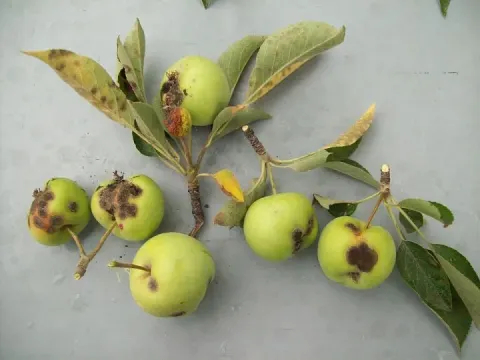
Apple scab
Venturia inaequalis
The causative agent of apple scab is the ascomycete fungus Venturia inaequalis. It is a highly specialized pathogen that affects domestic apple trees (Malus domestica) and several wild relatives.
What the section contains
Apple scab
The life cycle includes both a sexual stage, which occurs in fallen leaves over winter, and an asexual stage (anamorph: Fusicladium dendriticum) that persists during the growing season.
In spring, when conditions are wet, the fungus releases ascospores from overwintering pseudothecia. These spores are wind-dispersed and land on young foliage and fruit to initiate primary infection.
The fungus develops primarily beneath the cuticle, where it forms a dense stroma. This growth pattern results in the characteristic rupturing of the host's epidermis to produce conidia.
Secondary infections are caused by conidia, which are produced in the lesions. These are spread by rain splash and wind, allowing the disease to multiply throughout the spring and summer.
The disease affects all aerial parts of the tree, including leaves, flowers, fruit stalks, and fruit. It is particularly damaging to young, succulent tissues early in the season.
Severe infection leads to premature leaf drop, which reduces the tree's photosynthetic capacity, weakens its vigor, and negatively impacts fruit bud formation for the following year.
Fruit infection results in scab-like lesions, deep cracking, and significant deformation. These symptoms drastically reduce the marketability and storage life of the harvest.
When the pathogen infects the pedicels or flower stalks, it often leads to premature fruit abortion, significantly lowering the overall fruit yield in the orchard.
Under favorable environmental conditions, apple scab can cause total crop loss and make trees more susceptible to secondary infections and winter damage.
The development of apple scab is heavily dependent on moisture. Primary infection typically occurs during the spring when temperatures are mild and rainfall is frequent.
The length of the wetting period is the most critical factor for ascospore germination. If leaves remain wet for prolonged periods, the risk of successful infection increases dramatically.
Cool to moderate temperatures (between 15°C and 20°C) are optimal for the growth of Venturia inaequalis, while hot summer weather tends to inhibit the pathogen.
Throughout the summer, periodic rainfall allows the secondary cycle to continue, providing new inoculum for continuous reinfection of the orchard foliage and fruit.
In late autumn, the fungus enters its saprophytic stage on fallen apple leaves, where it develops the reproductive structures (pseudothecia) necessary for overwintering.
Early symptoms appear as light olive-green, velvety spots on the undersides of young leaves, which eventually turn dark brown or nearly black as they mature.
As the infection progresses, the spots enlarge and coalesce, causing the leaves to become distorted, necrotic, and eventually drop off prematurely.
Fruit symptoms begin as small, circular, dark-colored spots. As the apple grows, the lesion becomes corky and cracked, leading to deformed and stunted fruit development.
Severe infections on stems and petioles can be observed as dark lesions, which may sometimes girdle the tissue and lead to the death of the affected part.
The presence of an olive-colored, velvet-like conidial mass on the surface of the lesions is the most definitive sign for identifying apple scab in the field.
Sanitation is a cornerstone of management: removing and destroying fallen leaves reduces the primary inoculum source for the following season's infection cycle.
Pruning to open the canopy improves air circulation, which helps foliage dry faster after rain, thereby reducing the time available for spore germination.
Chemical control involves the application of fungicides, such as contact and systemic products, applied based on weather patterns and disease risk models.
Timing is crucial: protecting the tree during critical developmental stages like the "green tip" and "pink bud" stages is essential for effective disease prevention.
The use of resistant or tolerant apple cultivars is the most sustainable approach, significantly reducing the need for chemical interventions in modern orchards.