
Selenosporium tricinctum
Selenosporium tricinctum
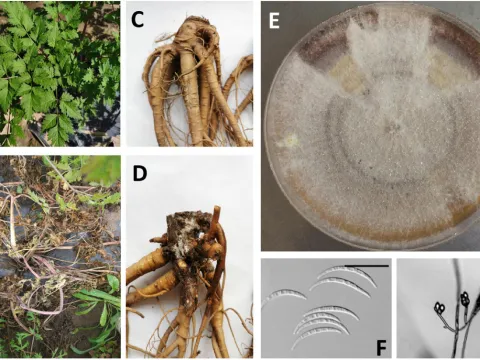
Selenosporium tricinctum (often reclassified as Fusarium tricinctum) is a significant fungal pathogen within the Ascomycota division. It is widely recognized as a causal agent of various cereal diseases.
What the section contains
Selenosporium tricinctum
The fungus produces a complex array of reproductive structures, including microconidia, macroconidia, and chlamydospores. These structures allow the pathogen to persist in diverse environments.
Its mycelium typically exhibits white to pale pink coloration when grown on culture media. The microscopic examination of its conidia morphology is critical for precise species identification.
As a soil-borne and seed-borne pathogen, it survives in agricultural debris for several seasons. It easily adapts to changing climate conditions, maintaining its presence in fields.
Scientists monitor this pathogen due to its potential to cause yield losses and its capability to produce toxins, which pose risks to both animal and human health.
The host range of this pathogen primarily includes cereals such as wheat, barley, rye, and oats. It also affects various wild grasses, which act as reservoirs for the fungus.
It causes systemic diseases, including seedling blight, crown and root rot, and head blight. These infections severely disrupt the development of the cereal crop at multiple stages.
Root rot reduces the plant's ability to absorb water and nutrients, leading to stunted growth, yellowing, and potential collapse of the plants before reaching maturity.
Head blight damage is particularly destructive, as the fungus colonizes the spikelets, causing them to bleach and wither, directly reducing the grain filling process.
Yield reduction is caused by both the decrease in the number of healthy grains and the lower overall quality, as the kernels become shriveled and contaminated with fungal metabolites.
Infection cycles typically begin in early spring when environmental conditions, specifically moisture and soil temperatures, become favorable for the fungus to reactivate.
Wet weather during the stem elongation and flowering stages significantly increases the risk of the disease spreading, as spores are splashed or carried by the wind to susceptible parts.
During the summer, the pathogen persists if high humidity levels are maintained. These conditions promote the production of secondary inocula, intensifying the disease pressure in fields.
Winter survival is ensured through chlamydospores or mycelia embedded in decaying plant biomass or deep within the soil profile, protected from extreme temperatures.
The lifecycle is continuous, with spores overwintering in crop residues to initiate new infections in the subsequent growing season, creating a cycle of persistent presence.
Seedling blight is indicated by brown, necrotic lesions on the base of the shoots, often resulting in damping-off before the plants emerge or shortly after germination.
Adult plants may show dark discoloration at the stem base, often accompanied by the presence of a fuzzy mycelial mat, which confirms the active growth of the fungus.
Premature bleaching of spikes or individual spikelets in the field is a major diagnostic sign, indicating that the vascular system is blocked by the fungal colonization.
Internally, the tissues of the affected stems lose their structural integrity, turning dark and brittle. This weakness often leads to widespread lodging of the crop in infected areas.
Examination of infected seeds may reveal surface discoloration or the presence of fungal growth, which serves as the primary source of infection for new fields when planted.
Effective management begins with the use of high-quality, certified seeds. Treating seeds with systemic fungicides is essential to eliminate internal and external inoculum.
Implementing a diversified crop rotation plan is vital. Avoiding successive cropping of cereals significantly reduces the concentration of fungal spores in the soil environment.
Tillage practices that incorporate crop residues deep into the soil help accelerate decomposition and reduce the survival of the pathogen until the next season.
Balanced fertilization, particularly adequate potassium and phosphorus levels, improves plant physiological health and strengthens resistance to fungal invasion.
Foliar fungicide applications during the critical stages, such as heading and flowering, are recommended to provide a protective barrier against head blight infection.