
Selenophoma linicola
Selenophoma linicola
The causative agent of the disease is the fungus Selenophoma linicola (synonym Septoria linicola), which belongs to the class Ascomycota. It is a highly specialized pathogen that exclusively affects flax plants.
What the section contains
Selenophoma linicola
The fungus overwinters in the soil on infected plant debris and is also transmitted through seeds, making it a critical threat to crop safety during the sowing season.
The biological cycle involves the formation of pycnidia, where curved conidia (spores) are produced. These spores are released during wet weather and serve as the primary source of infection.
The fungus propagates through the spread of these conidia, which are carried by wind and rain splashes across the field, allowing the disease to transition from local spots to general infestation.
Understanding the life cycle of the pathogen is crucial, as its survival depends heavily on the presence of moisture and suitable hosts, which defines the persistence of the disease in flax fields.
Selenophoma linicola causes significant damage by affecting both the quality of the flax fiber and the yield of the seeds, often leading to reduced crop value.
Infection in the seedling stage can lead to damping-off, causing gaps in the field and poor establishment of the crop stand.
Damage to the stems causes structural weakening, resulting in increased breakage during harvesting and a decline in the quality of long flax fibers.
Infected seed capsules often produce stunted or shriveled seeds that are unsuitable for sowing, as they carry the fungus internally, promoting the cycle of infection.
Economic losses are often substantial, particularly in wet seasons, which facilitate the rapid spread of the fungus and limit the marketability of the fiber.
The pathogen becomes active as soon as the flax seeds germinate, with the fungus moving from the seed coat into the developing hypocotyl of the plant.
The peak activity of the fungus occurs during the active growth and budding phases of flax, especially when environmental conditions are cool and wet.
High relative humidity and frequent rainfall are the most critical factors for the development of the disease, as they enable the germination of spores on the leaf and stem surfaces.
The disease cycle continues throughout the summer, with the severity of the infection often correlating with the number of rainy days during the flowering stage.
As the plant matures, the fungus transitions to survival mode, forming pycnidia on the senescing tissues, which will serve as the inoculum source for the following season.
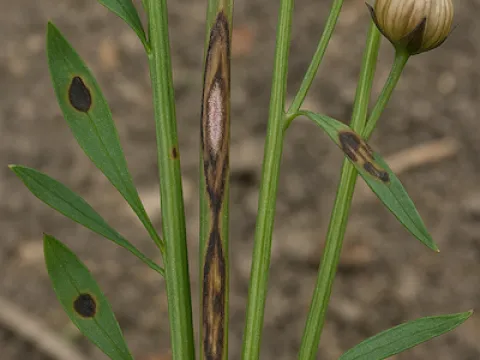
The infection first appears as small, yellowish or brown spots on the leaves and stems, which gradually enlarge and darken over time.
A distinctive feature of the infection is the appearance of tiny, black dot-like structures known as pycnidia scattered across the necrotic spots on the plant tissue.
On stems, the lesions may become elongated and sunken; if these lesions encircle the stem, they can cause the plant to lodge or break prematurely.
Leaves affected by the fungus exhibit yellowing and necrosis, which eventually leads to premature leaf fall and a reduction in the plant's overall photosynthetic capacity.
Infected capsules show dark brown lesions that can penetrate the seed tissue, often leading to the malformation or total collapse of the seed-bearing organs.
The primary control strategy is the use of high-quality, certified seeds combined with effective seed treatment using systemic fungicides to eliminate surface-borne pathogens.
Crop rotation is essential; ensuring a gap of at least 5 years between flax crops allows for the natural decomposition of infected debris, reducing soil-borne inoculum.
Choosing resistant cultivars is the most effective long-term strategy for managing the disease and minimizing the need for chemical intervention.
Good agricultural practices, including deep tillage and the removal of crop residues, help to minimize the survival rates of the fungus in the field environment.
When weather forecasts predict prolonged periods of wet weather, the prophylactic application of registered fungicides during the vegetative growth phase can prevent epidemic spread.