
Barley scald
Rhynchosporium secalis
Barley scald is a serious fungal disease caused by the pathogen Rhynchosporium secalis. It is one of the most common and damaging diseases affecting barley crops worldwide, particularly in regions with temperate and moist climates.
What the section contains
Barley scald
The pathogen is an ascomycete fungus that spreads via conidia. It survives between seasons on crop debris, volunteer barley plants, and occasionally on infected seeds, making it a persistent threat in continuous cropping systems.
Barley scald is characterized by its ability to cause rapid necrosis of leaf tissue. The disease cycle is highly dependent on humidity, as water splash is required for the dispersal of spores from the lower to the upper leaves.
Identification of the fungus involves observing the distinct lesion morphology, as the pathogen does not produce large visible fruiting bodies on the surface of the lesions, unlike other leaf spot diseases.
Understanding the epidemiology of Rhynchosporium secalis is crucial for integrated pest management, as the fungus exhibits high genetic diversity and can rapidly overcome host resistance.
The primary damage caused by barley scald is the reduction of the photosynthetic surface area due to widespread leaf necrosis, which directly impacts the grain-filling process.
In severe cases, yield losses can be substantial, often ranging from 10% to 40%. The weight of individual grains and the overall thousand-kernel weight are significantly reduced, leading to lower-quality harvests.
Beyond yield reduction, the quality of the grain is compromised. Shriveled kernels are common in heavily infected crops, which can be problematic for both malting and feed industries.
Increased lodging is often observed in diseased crops, as the structural integrity of the stems and leaf sheaths is weakened by the progression of the fungal infection.
The economic impact is further magnified by the cost of chemical control measures required to manage the disease during high-risk growing seasons.
Disease development typically begins in the early vegetative stages, such as tillering, when moderate temperatures and frequent precipitation provide ideal conditions for infection.
The pathogen thrives at temperatures between 15°C and 20°C. Prolonged periods of leaf wetness, such as fog or heavy dew, are critical for the successful germination and penetration of the fungus.
As the season progresses, if conditions remain dry, the disease may slow down; however, mid-season rainfall events can trigger new cycles of infection and rapid spread through the canopy.
The pathogen can also affect winter barley during the autumn months, establishing a reservoir of inoculum that persists through the winter and threatens the crop in the following spring.
Survival mechanisms include the formation of dormant mycelium within infected tissues, allowing the pathogen to withstand adverse environmental conditions effectively.
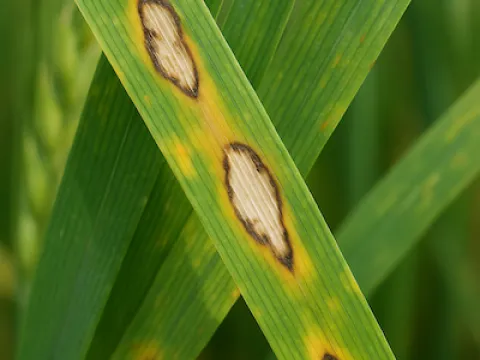
Symptoms appear as large, irregular, pale grey-green lesions with dark brown margins. These lesions are most commonly found on the leaves and leaf sheaths but can also affect the heads.
As the disease progresses, the central portion of the lesion becomes lighter in color, often turning bleached or straw-colored, while the characteristic dark border remains visible.
Lesions can coalesce, resulting in large areas of necrotic tissue that eventually cause the entire leaf to wither and die prematurely.
Unlike other fungal diseases, the surface of the scald lesion is typically smooth. There is no visible fungal growth or sporulation on the necrotic areas during the early stages of the disease.
Lesions on the awns or glumes appear as dark brown streaks, which can hinder the development of the grain inside the floret.
Management of barley scald requires a multifaceted approach, combining genetic resistance with agronomic practices and chemical interventions.
Seed treatment with systemic fungicides is an effective first line of defense to prevent early-season infection from seed-borne inoculum.
Foliar application of fungicides, such as strobilurins or triazoles, should be timed according to the stage of crop development and the presence of environmental conditions favorable for the disease.
- Use of resistant or tolerant barley varieties.
- Crop rotation to minimize inoculum buildup.
- Elimination of volunteer barley plants.
- Deep plowing to bury infected crop residues.
Integrated management plans should prioritize monitoring disease thresholds to ensure the most effective and sustainable use of fungicides throughout the growth cycle.