
Barley leaf rust
Puccinia hordei
Description
How to identify
Barley leaf rust is caused by the fungus Puccinia hordei, a member of the Basidiomycota phylum. It is an obligate parasite, meaning it requires living host tissue to complete its life cycle.
The fungus is host-specific to barley (Hordeum vulgare) and follows a heteroecious life cycle, which typically involves an alternate host, Ornithogalum species.
During the growing season, the fungus produces masses of orange-brown urediniospores on barley leaves, which spread via wind currents to infect neighboring plants.
The pathogen is highly capable of overwintering as mycelium in mild climates or as teliospores, ensuring its persistence in agricultural environments.
Genetic diversity within Puccinia hordei populations allows it to evolve rapidly, leading to the emergence of new physiological races that can overcome host resistance.
What it damages
This disease is a major limiting factor in barley production globally, causing significant yield losses in areas with moderate to high humidity.
By consuming plant nutrients and disrupting photosynthesis, the pathogen causes chlorosis and premature senescence of the foliage.
Severe infestations drastically reduce grain filling, resulting in shriveled kernels, lower test weights, and poor overall grain quality.
Yield losses can range from 10% in low-pressure years to over 50% in severe epidemics, significantly impacting the economic viability of the barley crop.
Reduced photosynthetic activity also impairs the plant's ability to store carbohydrates, which may indirectly lower the plant's tolerance to other environmental stresses.
When it appears
Infection cycles begin in the spring when temperatures range between 15°C and 20°C, provided that free moisture is present on the leaves.
The incubation period is relatively short, typically lasting between one to two weeks, which facilitates multiple infection cycles within a single season.
Epidemics usually develop rapidly during the stem elongation and flowering stages when canopy density creates a favorable microclimate.
High humidity and consistent dew provide the necessary conditions for urediniospore germination and subsequent penetration of the leaf tissue.
The disease progression often plateaus during hot, dry summer months, at which point the fungus produces dark teliospores to survive the dormant phase.
Signs of infestation
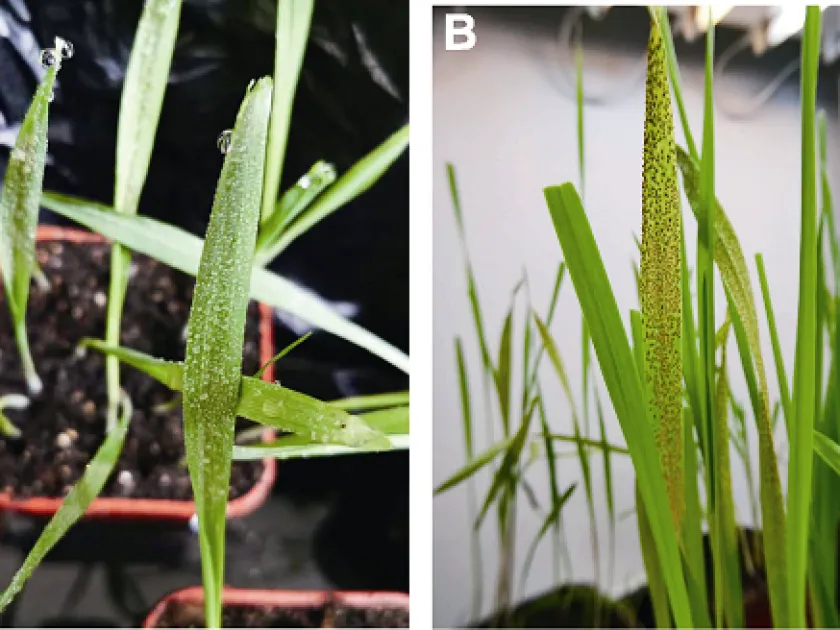
The primary symptom is the presence of numerous small, circular, bright orange-brown pustules (uredinia) scattered across the leaf blade.
These pustules emerge through the leaf epidermis, and when touched, they release a dusty cloud of spores, leaving an orange residue on the fingers.
As the infection advances, the leaf tissue surrounding the pustules turns yellow, eventually leading to widespread necrosis and leaf death.
- Darkening of pustules to a deep brown or black color as the season progresses.
- Increased severity on the lower and middle leaves during early infection stages.
- Overall yellowing of the crop stand if the infection becomes widespread.
Field scouting for these distinct orange-brown patches is the standard method for determining the need for chemical intervention.
Control measures
The deployment of resistant barley cultivars is the most sustainable strategy for managing leaf rust and reducing dependency on chemical inputs.
Agronomic practices, such as removing volunteer barley plants and managing crop debris, help reduce the primary inoculum load in the field.
When environmental conditions favor disease development and threshold levels are met, foliar fungicides (e.g., triazoles or strobilurins) are highly effective.
Balanced fertilization, avoiding excessive nitrogen application, helps maintain a physiological status in plants that is less conducive to heavy infection.
Regular monitoring of weather patterns and local disease reports allows for timely and precise application of control measures to protect the grain yield.
Causes diseases · 1
Discussion
No discussions yet — be the first.