
Barley heterosporiosis
Heterosporium hordei
Description
How to identify
The causal agent of barley heterosporiosis is the fungus Heterosporium hordei, a member of the Ascomycota phylum. It acts as a specialized parasite that targets barley tissues during various growth stages.
The fungus produces a dark olive to black mycelium within the leaf tissue. Its reproductive stage is characterized by the development of conidiophores that emerge through the plant's stomata, carrying numerous conidia.
The conidia are typically cylindrical and multi-septate, allowing them to spread effectively via wind and rain splashes. These spores are responsible for secondary infections within the barley field during the vegetative season.
The pathogen primarily overwinters as dormant mycelium on infected crop debris, such as straw and stubble. It can also persist on seeds, making the use of clean seeds crucial for disease management.
Diagnosis in the field is based on the distinct dark, velvety sporulation observed on lesions. Laboratory confirmation via microscopic analysis is often required to distinguish it from other fungal leaf spots.
What it damages
The disease primarily affects the vegetative organs, including leaves, leaf sheaths, and sometimes stems. Severe infections lead to the premature death of leaf tissue, drastically reducing the photosynthetic area of the crop.
When photosynthesis is compromised, the plant cannot accumulate sufficient biomass, resulting in stunted growth and lower grain yield. Plants infected during the tillering or stem elongation phase are particularly at risk.
Damage to the flag leaf is the most critical factor, as it contributes significantly to grain filling. Infection of this leaf can reduce the thousand-grain weight and overall seed quality.
In addition to yield loss, severe heterosporiosis affects the quality of the straw. The presence of fungal toxins and damaged tissue makes the crop less suitable for agricultural use or fodder.
The cumulative effect of reduced nutrient transport and leaf loss results in a significant economic impact, particularly in regions with high humidity and favorable conditions for fungal growth.
When it appears
The disease typically emerges during the jointing or heading stages of barley development. Its progress is heavily dependent on environmental conditions, specifically high humidity and moderate temperatures.
Optimal conditions for infection include temperatures between 18°C and 22°C combined with high moisture levels (rain or heavy dew). These conditions allow the spores to germinate and colonize the tissue rapidly.
Dense crop stands create a humid microclimate that acts as a reservoir for the pathogen. In such environments, the cycle of infection can repeat multiple times throughout the season if moisture persists.
Hot and dry weather inhibits the growth and dissemination of Heterosporium hordei. However, the fungus can survive in a latent state within the plant tissue until environmental conditions improve.
As the barley matures, the fungus shifts its life cycle towards the production of survival structures on stubble, ensuring it persists in the field until the next planting season begins.
Signs of infestation
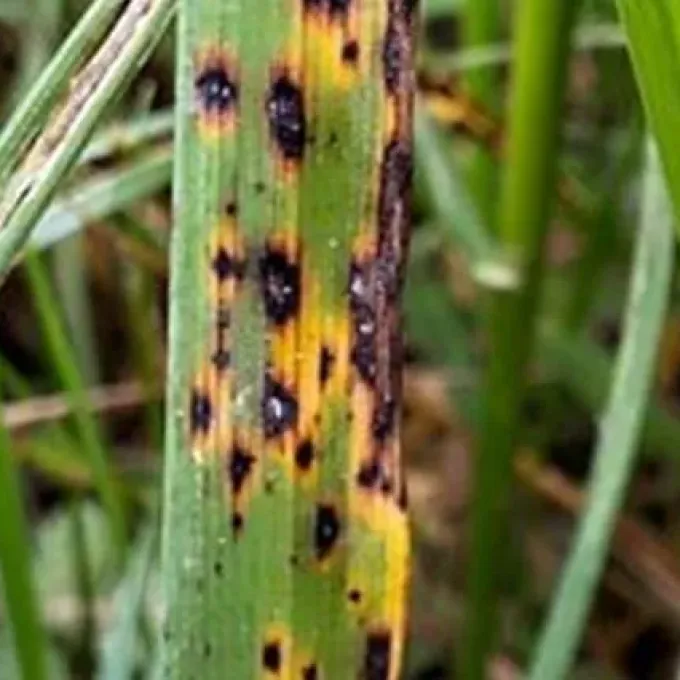
The disease is characterized by small, oval-shaped brown spots that gradually enlarge. Over time, these spots develop a dark, olive-colored velvety layer, which is the mass of fungal spores.
Lesions are often surrounded by a chlorotic halo, indicating the plant's stress response to the fungal metabolites. Leaves eventually yellow and desiccate, starting from the lower levels of the plant.
- Development of a dark olive, velvety layer on leaf lesions.
- Elongated, brown necrotic spots on the foliage.
- Premature drying of the leaf blade.
- Blackening of glumes and ears during severe, late-season infections.
- Presence of small lesions on leaf sheaths.
Lesions may coalesce to form large necrotic areas, which can be mistaken for chemical burns or other diseases. The distinct texture of the sporulation is the key identifying feature.
In advanced cases, the entire plant may appear scorched, with the flag leaf showing significant necrosis, which directly impacts the grain development process in the head.
Control measures
Effective control starts with crop rotation, ensuring barley is not grown in the same field for at least 2-3 years. This helps break the life cycle of the pathogen by removing its host.
Deep plowing and the thorough burial of post-harvest crop residues are essential. Decomposing the straw deep in the soil eliminates the primary source of the fungus for the following season.
The use of resistant barley varieties is the most sustainable management strategy. Additionally, planting certified, fungicide-treated seeds prevents the introduction of the pathogen via the seed lot.
Fungicide applications are recommended when disease thresholds are met and environmental conditions favor rapid spread. Systemic fungicides in the triazole or strobilurin classes are effective in managing the disease.
Proper nutrient management, especially balanced potassium fertilization, helps improve the plant's natural resistance to fungal infections, enhancing overall crop health and resilience against pathogens.
Causes diseases · 1
Discussion
No discussions yet — be the first.