
Barley stripe
Helminthosporium gramineum
Description
How to identify
Barley stripe is caused by the fungus Pyrenophora graminea (the anamorph is Helminthosporium gramineum). It is a seed-borne pathogen that belongs to the Ascomycota phylum.
The fungus survives as dormant mycelium within the seed tissues (embryo and pericarp). When the seed germinates, the fungus grows into the developing seedling, colonizing the tissues systematically.
Development is favored by cool and moist environmental conditions during the early growth stages of barley. The optimal temperature for seedling infection ranges from 10°C to 15°C.
The pathogen completes its life cycle by producing conidia on the leaves and leaf sheaths, which then spread to the barley spikes during the flowering stage.
Infected seeds become the primary source of inoculum for the next season, ensuring the persistence of the disease in the field if management strategies are not implemented.
What it damages
The disease causes significant damage by restricting plant growth and reducing the photosynthetic capacity of the leaves due to extensive stripe-like lesions.
Infected plants are often stunted and fail to produce fully developed ears. In severe cases, the spike remains trapped within the leaf sheath or produces shriveled, empty grains.
The yield loss is substantial, often leading to a sharp decrease in both the quantity and the quality of the harvested grain, making it unsuitable for seed use.
Premature senescence of the foliage limits the duration of grain filling, resulting in light-weight kernels and a reduction in the overall seed germination rate.
Epidemics can result in yield losses exceeding 30-50% in untreated crops, posing a serious economic threat to barley production globally.
Signs of infestation
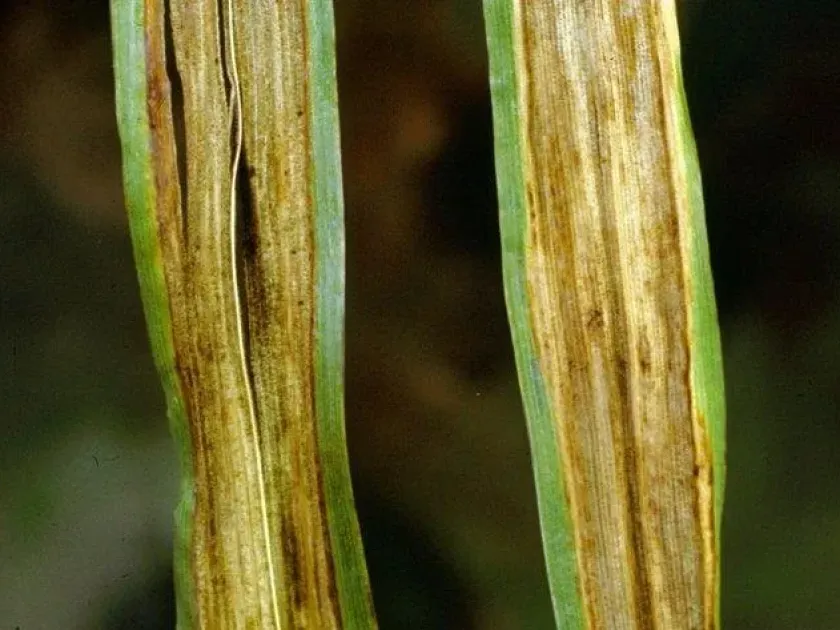
Initial symptoms typically appear during the tillering stage as yellowish, elongated streaks running parallel to the leaf veins.
As the disease progresses, these stripes turn brown, and the leaf tissue begins to split longitudinally, giving the leaves a shredded or ragged appearance.
Under high humidity, a grayish-olive velvety layer of fungal conidiophores and conidia develops over the brown stripes, marking the active sporulation phase.
Infected culms are weakened and distorted, and the ears often exhibit discoloration and poor development, frequently appearing dark due to fungal growth.
Eventually, affected leaves turn necrotic, wither, and die prematurely, causing the entire plant to collapse or become highly unproductive.
Control measures
The primary control measure is the use of high-quality, certified, and disease-free seed to prevent the introduction of the pathogen into new fields.
Seed treatment with effective systemic fungicides is highly recommended to eliminate the seed-borne mycelium before planting and ensure healthy stand establishment.
Implementing a proper crop rotation system helps break the cycle of infection, preventing the accumulation of the fungus in the soil and crop residues.
Opting for early planting in warm, moist soil conditions can help seedlings outgrow the period of maximum susceptibility to the infection.
The deployment of resistant barley cultivars serves as a sustainable and long-term solution for managing barley stripe in agricultural production systems.
Causes diseases · 1
Discussion
No discussions yet — be the first.