
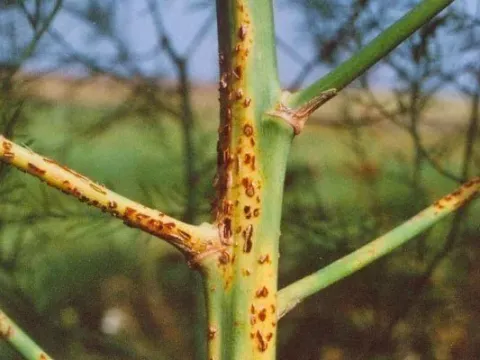
Asparagus rust
Puccinia asparagi
The causal agent of asparagus rust is the fungus Puccinia asparagi, a specialized pathogen belonging to the Basidiomycota division. It is an obligate biotroph, meaning it relies entirely on living asparagus host tissues to survive and reproduce.
What the section contains
Asparagus rust
The fungus completes a macrocyclic life cycle, involving five different spore stages. Infection typically initiates in the spring from aeciospores, progresses through the urediniospores stage, and concludes with the formation of teliospores for overwintering.
Teliospores are the primary survival structures that allow the pathogen to endure winter conditions on plant debris left in the field. When spring temperatures and humidity levels rise, these spores germinate to begin a new infection cycle.
Dissemination of the rust is primarily driven by wind, which can carry spores over long distances. Secondary infection cycles occur rapidly during the summer whenever environmental conditions are favorable for fungal growth.
Optimal development of the disease requires the presence of free moisture, such as dew, rain, or high humidity. In these conditions, spores germinate and penetrate the succulent stems of the asparagus plants.
The disease affects Asparagus officinalis, causing significant reductions in both yield and plant longevity. The infection disrupts photosynthesis by damaging the fern-like foliage of the plant.
As the disease progresses, early defoliation of the plant occurs. This loss of foliage prevents the plant from accumulating sufficient carbohydrates in the crown and root system for the upcoming season.
Stunted growth is a common outcome, leading to smaller, thinner spears in subsequent harvests. Severely infected plants are often unable to withstand cold winter temperatures, leading to significant die-back.
In high-pressure years, asparagus rust can lead to yield losses exceeding 50%. Continuous neglect of field hygiene can force farmers to abandon profitable stands due to the cumulative loss of plant health.
Secondary pathogens often exploit the stressed state of the plants, which increases the susceptibility of the asparagus patch to further fungal and bacterial degradation over time.
Initial signs in the spring manifest as small, pale-green lesions on the stems. These eventually develop into raised, orange, oval-shaped structures known as aecia.
During the summer months, the infection transitions into the uredinial stage, characterized by reddish-brown pustules that erupt through the epidermis, releasing mass quantities of spores.
By late summer or autumn, the pustules darken to a deep brown or black color, signaling the production of teliospores. At this stage, the plant often appears severely burned or rusty.
The impact on the foliage is dramatic, causing leaves to turn yellow, shrivel, and drop prematurely. Entire ferns may die back long before the natural end of the growing season.
- Pale-green spots on developing shoots.
- Orange blisters (aecia) in the spring.
- Reddish-brown, powdery pustules on the ferns.
- Black, hardened pustules (telia) in late season.
- Premature yellowing and defoliation of the ferns.
Effective management begins with strict field sanitation. Removing and destroying all infected fern residues after the harvest season significantly reduces the amount of overwintering inoculum.
Proper site selection and spacing are critical. Planting asparagus in well-drained, sunny locations with good airflow helps reduce the leaf wetness duration necessary for spore germination.
Utilizing resistant or tolerant cultivars is the most sustainable approach to long-term control of asparagus rust, as it reduces the dependence on chemical intervention.
Fungicide applications are recommended when the disease threshold is reached or when environmental conditions are highly conducive to the spread of the pathogen.
Regular scouting of the fields is essential for detecting the first signs of rust. Prompt intervention at the early onset of symptoms can prevent a minor infection from escalating into a major outbreak.