
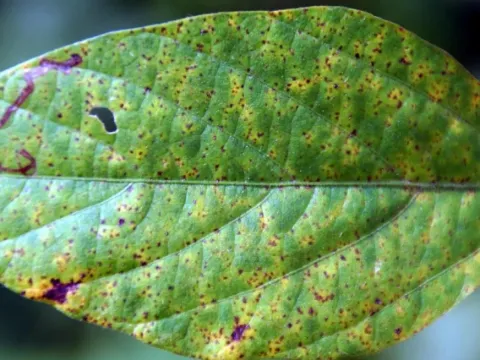
Asian soybean rust
Phakopsora pachyrhizi
The causative agent of the disease is the obligate biotroph fungus Phakopsora pachyrhizi, belonging to the Basidiomycota division. It is recognized as one of the most destructive pathogens affecting legumes globally.
What the section contains
Asian soybean rust
The fungus reproduces asexually through urediniospores, which can be dispersed by wind over long distances. High humidity and leaf wetness are essential for the germination and penetration of the pathogen into plant tissue.
Its lifecycle consists of an infection stage, an incubation period resulting in pustule formation, and an active sporulation phase. In the absence of host plants, the fungus can persist on alternative weed hosts.
Infection typically initiates in the lower canopy of soybean plants, where the microclimate is favorable for spore germination. From there, it spreads rapidly throughout the upper leaves and stems as the inoculum increases.
Diagnosis relies on identifying the characteristic uredinia—small structures filled with spores—found primarily on the underside of infected leaves.
While soybeans are the primary host, the pathogen is capable of infecting over 30 different leguminous species, including peas, beans, and lupines.
The disease causes significant damage by inducing premature leaf senescence and defoliation, which effectively halts the plant's photosynthetic processes.
Reduction in leaf surface area leads to severe yield losses due to poor seed filling, shriveled grains, and a significant decrease in the thousand-kernel weight.
Under epidemic conditions, yield losses can range from 30% to 80%, depending on the timing of the initial infection relative to the crop's development stages.
Infected plants exhibit stunted growth and an increased susceptibility to secondary pathogens, which compromises both the quantity and quality of the final harvest.
Asian soybean rust is most destructive during the flowering and pod-filling stages, when the dense canopy creates a humid microenvironment conducive to fungal spread.
The optimal temperature for spore germination ranges from 20°C to 25°C, although the fungus can remain active at temperatures as low as 10°C.
A persistent period of leaf wetness, typically lasting between 6 and 12 hours due to dew, fog, or rainfall, is required for the infection process to initiate.
In warmer climates, the pathogen may survive year-round on volunteer soybean plants or other perennial legumes, maintaining a constant source of inoculum.
Spore dissemination peaks during periods of frequent rainfall and moderate temperatures, which assist in both the release and transport of the pathogen.
The first symptoms appear as small chlorotic specks on the lower leaf surface, which gradually darken and evolve into angular lesions.
The hallmark sign of the disease is the development of pustules (uredinia) that break through the leaf epidermis to release powdery masses of spores.
- Yellowing (chlorosis) of the tissue surrounding the pustules.
- Premature leaf yellowing and shedding, beginning at the base of the plant.
- Tan to reddish-brown dust on the underside of leaves.
As the disease progresses, leaves may become entirely necrotic and drop, leading to exposed stems and severe stress on the developing pods.
The color of the pustules can shift from pale beige to dark brown, reflecting the age and the reproductive status of the fungal colony.
Management heavily relies on the application of systemic fungicides, specifically triazoles, strobilurins, and carboxamides, when early symptoms are detected.
Cultural practices, including the use of resistant soybean cultivars and effective weed control to remove alternate hosts, are critical for reducing disease pressure.
Integrated pest management (IPM) strategies, including monitoring fields with spore traps, allow farmers to time their fungicide applications accurately.
Avoiding high planting densities and optimizing nitrogen management can help improve air circulation and plant vigor, making the crop less hospitable to the fungus.
Continuous monitoring and regional collaboration to track spore migration are essential components in minimizing the economic impact of the disease.