
Asian bean rust
Phakopsora meibomiae
Description
How to identify
The causative agent of the disease is a microscopic parasitic fungus Phakopsora meibomiae, belonging to the division Basidiomycota (basidiomycetes) and the order Pucciniales. It is an obligate parasite that requires living plant tissue to complete its life cycle.
Systematically, this species is closely related to the more aggressive pathogen Phakopsora pachyrhizi, which causes soybean rust. The fungus primarily affects the vegetative organs of plants, causing premature leaf drop and the depletion of nutritional reserves.
The fungus mycelium develops within the host tissues, rupturing the epidermis to form fruiting structures known as uredinia. These structures produce single-celled spores (urediniospores) that are wind-dispersed over significant distances.
To identify the pathogen in laboratory settings, microscopic examination of the pustules is performed. Urediniospores have a characteristic shape and color, which helps distinguish this species from other rust fungi that affect legume crops.
In addition to urediniospores, teliospores can form during the life cycle, providing the fungus with a mechanism to survive adverse conditions, although asexual sporulation remains the primary mode of spread during the growing season.
What it damages
The primary host for this pathogen is common bean (Phaseolus vulgaris), as well as a wide range of other legume species, including members of the genera Vigna and Desmodium.
The disease causes serious damage to agriculture in tropical and subtropical regions. Damage to the leaves reduces the photosynthetic surface area, which leads to a sharp decrease in pod weight and a decline in the market quality of the harvest.
In cases of intense infection, total defoliation of the plants can occur before seed formation begins. This leads to underdeveloped pods, pod splitting, and a loss of seed productivity, which in severe cases can reach 80-100%.
The pathogen also weakens the general resistance of legumes to secondary infections and pests. Infected plants become less competitive and handle environmental stressors, such as drought or nutrient deficiencies, much more poorly.
The economic significance of Phakopsora meibomiae is driven not only by direct crop losses but also by the high costs of fungicide applications required to control epidemics.
When it appears
The development of the disease is closely linked to a warm, humid climate. The optimal temperature range for spore germination and infection is between +18°C and +28°C under conditions of high relative humidity.
The infection process requires the presence of free water (dew or rainfall) on the leaf surface for several hours. The latent period from the moment of infection to the appearance of initial symptoms usually ranges from 7 to 14 days.
Spore dissemination is facilitated by air currents. Under favorable weather conditions, the disease can spread very rapidly across large planting areas, establishing secondary infection foci.
In regions with a temperate climate, the survival of the pathogen is limited, but in zones with mild winters, it can persist on crop residues or alternative hosts throughout the entire year.
The greatest risk of infection occurs during the flowering and pod-filling stages, when plants are most vulnerable and weather conditions often promote moisture accumulation in the lower canopy.
Signs of infestation
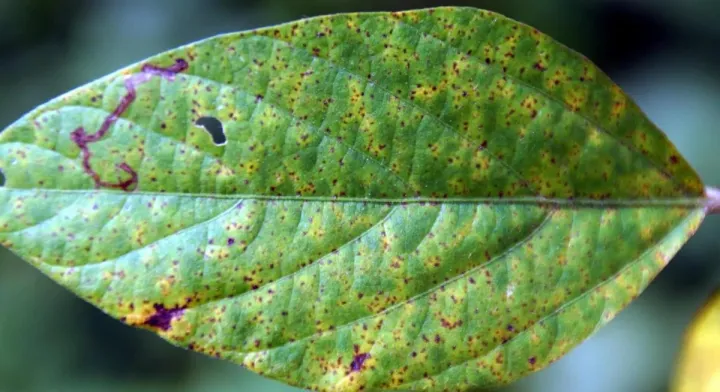
The first signs of infection appear on the undersides of leaves as small chlorotic spots, which gradually increase in size over time.
Soon, the epidermis ruptures at the site of the spots, forming pustules known as uredinia. These appear as small bumps, ranging in color from tan to reddish-brown, containing a mass of fungal spores.
As the disease progresses, pustules can appear not only on the leaves but also on petioles, stems, and even the pods themselves. Affected leaves turn yellow, wither, and drop prematurely.
A characteristic sign of rust is a "rusty" dusting on clothing or tools that come into contact with infected plants due to the abundance of released spores.
Severe infection manifests as a continuous layer of sporulation covering the leaf surface, giving the plant a scorched, browned appearance.
Control measures
The primary control method is the use of resistant bean cultivars, provided they are available for the specific growing region.
Effective preventive measures include crop rotation, excluding legume crops for at least 2-3 years, and the destruction of crop residues immediately after harvest.
Chemical protection involves the use of systemic fungicides from the triazole and strobilurin groups. Applications should begin at the first sign of disease or when weather conditions become favorable for fungal development.
- Optimizing plant density to improve air circulation and reduce canopy humidity.
- Timely weeding of non-crop hosts that may act as infection reservoirs.
- Utilizing high-quality, disease-free seed material.
- Regular field monitoring for early detection of primary infection centers.
In integrated pest management systems, it is crucial to combine agrotechnical practices with targeted fungicide application to minimize the pesticide load on the agroecosystem.
Causes diseases · 1
Discussion
No discussions yet — be the first.