
Halo spot of barley
Pseudoseptoria donacis
Description
Symptoms
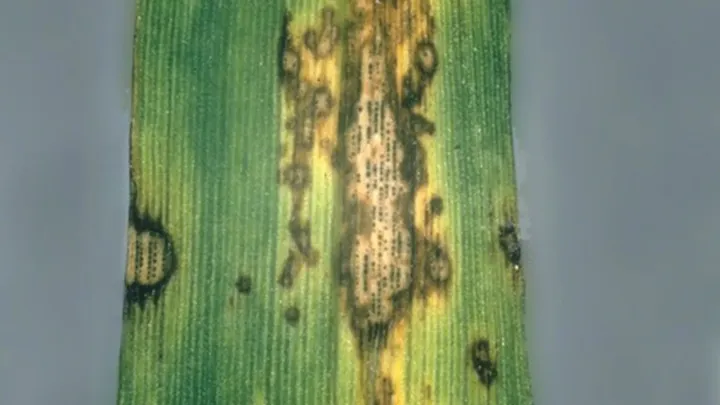
Initial symptoms manifest as small, oblong or rounded spots that gradually expand across the leaf surface.
A distinctive characteristic of this disease is the presence of a dark border surrounding the lesions, within which pycnidia develop.
Infection typically begins on lower leaves and progresses upward, leading to premature yellowing and necrosis of the foliage.
Upon close inspection, tiny black dots (pycnidia) are visible on the lesions, serving as a definitive indicator of the pathogen's presence.
Severe infestations result in chlorosis and reduced photosynthetic surface area, which significantly stunts plant growth and development.
Pathogen
The causal agent of halo spot is the fungus Pseudoseptoria donacis (syn. Selenophoma donacis), which belongs to the class of deuteromycetes.
This pathogen specifically infects various cereal crops, including winter barley, rye, and winter wheat.
The fungus survives on infected crop residues and in the soil, and it can also overwinter on winter crops, acting as a primary source of inoculum.
The life cycle involves the formation of pycnidia, which release conidia under high humidity conditions, facilitating the spread of the infection.
Dissemination occurs primarily via rain splash and wind, moving fungal spores from crop debris to healthy leaves of young plants.
Conditions for development
The development of halo spot is highly favored by cool and damp weather conditions, often occurring during early spring or autumn seasons.
Optimal environmental requirements include high relative humidity (above 80%) which is necessary for spore germination and tissue colonization.
Frequent rainfall during tillering and stem elongation stages accelerates the spread of conidia throughout the field.
Dense crop stands, where air circulation is poor and moisture persists, create a microclimate conducive to rapid disease progression.
Poor crop rotation practices ensure the continuous presence of the pathogen in the field, leading to recurring infection cycles.
Why it matters
The economic impact of the disease is linked to the significant loss of photosynthetic leaf area, which limits grain filling.
Halo spot leads to a reduction in grain weight and lowers the quality of the harvest, including protein content and overall grain density.
Yield losses can reach 15-20% if the flag leaf is heavily infected during the critical stages of grain development.
Affected plants are physiologically weakened, making them more vulnerable to secondary pathogens and further environmental stressors.
Persistent infection lowers the overall vigor of the crop, negatively impacting its ability to survive winter conditions effectively.
Protection
The primary control measure is the implementation of a proper crop rotation program to eliminate the carry-over of the fungus.
Thorough soil incorporation of crop stubble is essential to destroy the habitat of Pseudoseptoria donacis and reduce primary inoculum.
Utilizing genetically resistant or tolerant varieties of barley is the most sustainable approach to managing the disease.
In cases of high disease pressure, systemic fungicides, particularly triazoles or strobilurins, should be applied during the growing season.
Early scouting and monitoring of crops allow for the timely application of fungicides before the disease reaches its peak potential.
Pathogens and affected parts
Affects crops · 3
Discussion
No discussions yet — be the first.