
Avocado pseudocercospora spot
Pseudocercospora purpurea
Description
How to identify
The causal agent of this disease is the fungus Pseudocercospora purpurea, which belongs to the kingdom Fungi and the phylum Ascomycota. It is a specialized pathogen that affects avocado trees.
The biological cycle involves the production of conidia, which are disseminated by wind, rain splashes, and irrigation water. The fungus survives in leaf litter and infected plant tissue.
High humidity and warm temperatures are the primary requirements for the development and spread of the pathogen. Tropical and subtropical climates provide the most favorable conditions for infection.
The fungus invades the host through stomata or mechanical injuries on the epidermis of leaves and fruit. Once inside, the mycelium grows intercellularly, causing tissue necrosis.
Accurate identification is essential, as the symptoms caused by Pseudocercospora purpurea can be confused with other fungal blights, leading to inappropriate treatment choices.
What it damages
The disease primarily impacts avocado (Persea americana). It attacks both foliage and fruit, significantly reducing the vigor of the tree and the market quality of the harvest.
Leaf infection leads to premature defoliation, which stresses the tree and reduces its capacity for photosynthesis. This is particularly harmful to young or recovering trees.
Infected fruits develop necrotic spots that crack the skin. These lesions ruin the appearance of the fruit, making them unsalable in premium markets.
The cracks in the fruit skin also act as entry points for secondary opportunistic pathogens, leading to fruit rot and significant post-harvest losses.
In humid regions, severe outbreaks can cause substantial yield losses, sometimes exceeding 50% if fungicides are not applied in time.
Signs of infestation
Early symptoms appear as small, angular spots on the leaves, which are typically purple-brown in color. As the spots age, they often develop a darker, more defined margin.
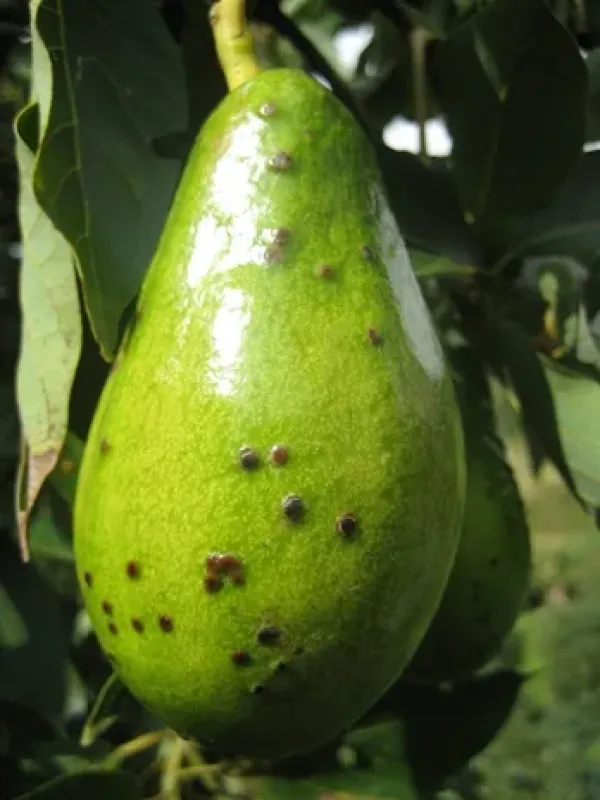
On the fruit, small circular brown spots appear. As the fruit matures, these spots expand, often becoming sunken necrotic craters that compromise the integrity of the peel.
The skin around the lesions becomes brittle and frequently ruptures. These ruptures are highly susceptible to secondary microbial colonization, resulting in deep fruit decay.
Under humid conditions, an olive-grey fungal growth can be observed on the surface of the lesions, representing the conidia of the fungus.
- Angular purple-brown spots on foliage.
- Premature yellowing and leaf drop.
- Sunken necrotic lesions on avocado skin.
- Rupturing of the fruit epidermis.
- Presence of fine olive-grey spore masses.
Control measures
Good orchard management, including pruning to improve air circulation and reduce humidity within the canopy, is the first line of defense against the pathogen.
Strict sanitation is vital; all fallen leaves and infected fruits must be collected and removed from the orchard to eliminate the primary source of inoculum for the next season.
Copper-based fungicides are the standard chemical treatment for controlling the spread of the fungus. Applications should be timed during the flowering and fruit development stages.
Integrated pest management (IPM) is necessary to reduce damage from insects, as their feeding activity creates openings for the fungus to penetrate the fruit.
Selecting resistant avocado varieties and ensuring proper tree spacing can significantly decrease the disease pressure in commercial production sites.
Causes diseases · 1
Discussion
No discussions yet — be the first.