
Physoderma brown spot
Physoderma maydis
Description
How to identify
The causal agent is the obligate parasite Physoderma maydis, a member of the kingdom Protista (phylum Chytridiomycota). It survives in soil and crop debris as dormant sporangia.
The life cycle relies on motile zoospores, which require free water to swim and infect the susceptible tissues of the corn plant during favorable environmental conditions.
The pathogen preferentially attacks young, rapidly growing plant tissues, specifically invading the whorl, leaf sheaths, and internodes of the corn plant.
Prolonged periods of high moisture, such as heavy rains followed by warm temperatures, are critical for the mass germination of zoospores and secondary infection cycles.
Sporangia of the fungus are remarkably resistant to harsh environmental conditions, allowing the pathogen to persist in agricultural soils for several years without a host.
What it damages
Physoderma brown spot primarily affects maize, causing a reduction in leaf surface area available for photosynthesis due to extensive spotting and necrosis.
Infection of the stalk nodes leads to weakened mechanical strength, which frequently causes plants to lodge or break, complicating the mechanical harvesting process.
Reduced translocation of nutrients to the ears results in poor grain filling and a significant reduction in overall yield quantity and grain quality.
The weakened tissue caused by the fungus creates an entry point for secondary stalk rot pathogens, leading to further decay and potential harvest losses.
While the disease is often localized, in years with high summer rainfall, the economic impact on susceptible hybrids can be severe and widespread across fields.
Signs of infestation
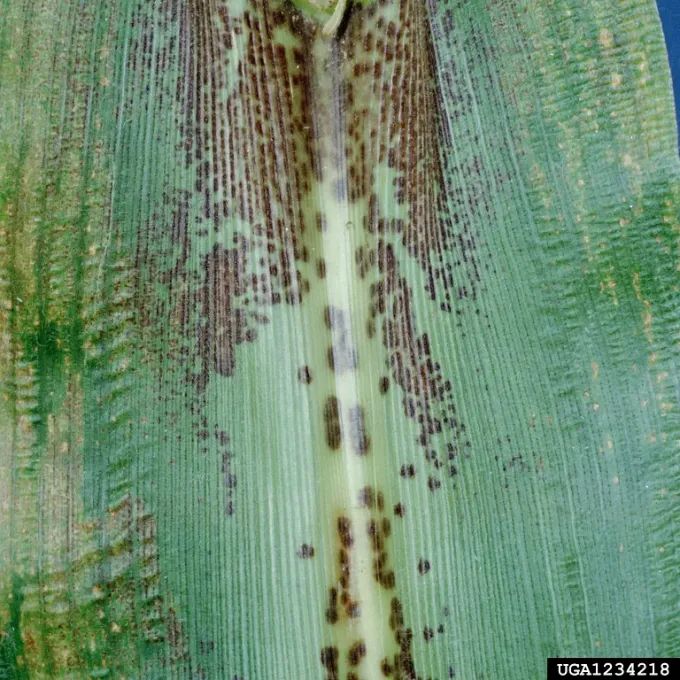
Early symptoms appear as tiny yellowish or brown spots on the leaves, which are often arranged in parallel bands or clusters following the leaf veins.
As the infection progresses, these spots darken significantly, turning reddish-brown or black, and may rupture the epidermis to release sporangia.
Lesions on the leaf sheaths and stalks are typically larger, darker, and more irregular in shape compared to the uniform spots found on the leaf blades.
Severely infected leaves may wither, turn yellow, and die prematurely, particularly on the lower portions of the plant where humidity remains higher.
Dissection of the stalk may reveal dark, necrotic tissue internally, signifying structural damage that predisposes the corn plants to lodging under wind pressure.
Control measures
Crop rotation remains the most effective management strategy, utilizing a two-to-three-year gap between corn crops to deplete the inoculum density in the soil.
Deep tillage helps to bury infected crop residues, which reduces the amount of pathogen material available on the soil surface to produce motile zoospores.
Planting resistant or tolerant corn hybrids is the primary method for mitigating economic loss in areas where the disease is historically problematic.
Field drainage management is essential to prevent water accumulation, as standing water is a prerequisite for the motility of zoospores and the infection cycle.
Sanitation practices, including the removal or burning of heavily infected debris, can help lower the baseline level of the pathogen for the following planting season.
Causes diseases · 1
Discussion
No discussions yet — be the first.