

Description
Symptoms
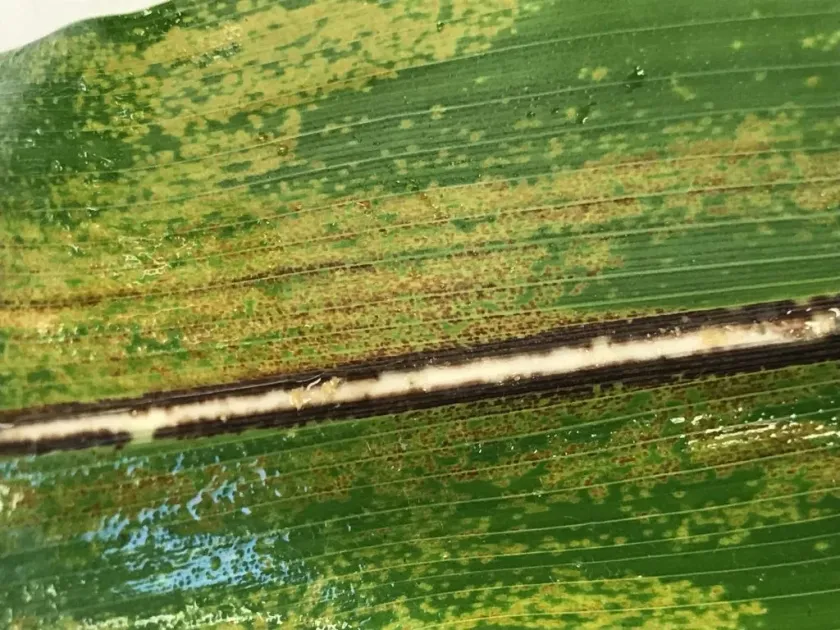
Initial symptoms of brown spot appear on leaves, leaf sheaths, and stalks as small, numerous yellow or brown spots. These spots are frequently arranged in distinct bands or rows along the leaf veins.
As the disease progresses, the lesions turn dark brown or nearly black and become slightly sunken. In cases of severe infection, these spots coalesce, leading to extensive tissue necrosis and leaf blighting.
On leaf sheaths and stalks, the pathogen may form larger, darker lesions filled with masses of fungal spores. Heavy infection of the stalks can cause the plants to become brittle and prone to lodging.
The disease can cause significant yellowing and premature drying of the leaves, which disrupts the photosynthetic process and limits the plant's ability to fill the ear properly.
- Small yellow or brown spots appearing in rows.
- Dark brown or black necrotic lesions on leaves.
- Large sporulating lesions on leaf sheaths.
- Premature leaf senescence and stalk breakage.
Pathogen
The causative agent of brown spot of corn is the fungus-like organism Physoderma maydis (formerly known as Physoderma zeae-maydis). It is an obligate parasite classified within the division Chytridiomycota.
The life cycle of this pathogen relies heavily on resting sporangia. These structures are remarkably durable and can survive in the soil and on crop debris for several years, waiting for favorable conditions.
Under moist conditions, sporangia release motile zoospores. These zoospores require free water to swim and locate the whorls of corn plants, where they attach themselves to the leaf tissue to initiate infection.
Once inside the plant tissue, the pathogen colonizes the cells and produces new sporangia. These are released when the plant tissue ruptures, spreading the infection to neighboring plants during the growing season.
This pathogen is highly host-specific, primarily affecting corn. Its survival depends on the presence of susceptible corn tissue and the availability of sufficient moisture in the environment.
Conditions for development
Environmental conditions are the primary drivers of brown spot development. The disease thrives in warm, wet weather where rainfall frequently collects in the leaf whorls.
The optimal temperature range for the germination of zoospores and subsequent infection of corn plants is between 23 and 30 degrees Celsius. High humidity is essential for the pathogen's spread.
High-density planting can exacerbate the problem by creating a microclimate that retains moisture longer, preventing the leaves from drying out and facilitating zoospore movement.
Heavy rains accompanied by wind are the primary mechanism for the dispersal of zoospores from infected crop debris to healthy, susceptible tissue in the field.
Fields with a history of continuous corn cropping are at the highest risk, as the soil reservoir of resting sporangia builds up over successive seasons.
Why it matters
The primary impact of brown spot is the reduction in photosynthetic leaf area, which directly decreases grain yield and weight. Severely infected plants struggle to produce full, healthy ears.
Stalk infection weakens the structural integrity of the corn, leading to lodging. This makes harvesting difficult and results in significant grain loss in the field due to dropped ears or downed plants.
Plants weakened by Physoderma maydis are often more susceptible to secondary infections by other stalk rots and opportunistic pathogens, further compounding the losses.
In seasons with excessive rainfall, the economic impact can be severe, leading to lower grain quality, poor test weights, and reduced marketability of the crop.
The damage is most noticeable in high-moisture environments, where the pathogen can spread rapidly through the canopy, causing widespread leaf necrosis.
Protection
Crop rotation is the most effective management strategy. Planting non-host crops for at least two years significantly reduces the population of resting sporangia in the soil.
Tillage practices that incorporate crop residues into the soil promote the decomposition of infected material, thereby limiting the survival of the pathogen until the next corn crop.
Selecting corn hybrids with known resistance or tolerance to brown spot is a crucial preventative measure, especially in regions prone to high humidity and heavy rainfall.
Adjusting planting density to improve airflow through the canopy helps reduce the duration of leaf wetness, creating an environment less favorable for pathogen infection.
Maintaining balanced soil fertility helps plants maintain vigor and improves their overall ability to withstand stress and infection, even under moderate disease pressure.
In brief
1
Affects crops
Biology
Pathogens and affected parts
Affected plant parts
whole plant
Content graph
Affects crops · 1
Content graph
Connections · Brown spot of corn
Most often together:
Marketplace
Products · 1
Community
Discussion
No discussions yet — be the first.