
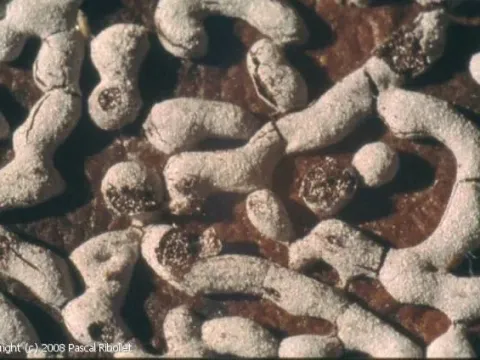
Physarum plumbeum
Physarum plumbeum
Physarum plumbeum belongs to the kingdom Protista, division Myxomycota. This slime mold is not a true pathogen that feeds on living plant tissues, but it adopts a parasitic lifestyle by using the aerial parts of plants as a substrate for its growth and development.
What the section contains
Physarum plumbeum
The life cycle of this myxomycete includes a mobile plasmodium stage, which moves slowly across the soil surface and plant stems. During its development, the plasmodium transforms into fruiting bodies called sporangia, which often exhibit a characteristic lead-gray or bluish hue.
Visually, the sporangia appear as a dense, powdery coating covering the leaf blades. Unlike fungal infections, Physarum does not penetrate deep into the plant tissues, but its mass presence significantly reduces the intensity of photosynthesis.
This organism prefers damp and shaded conditions, which is why it is often found in dense plantings or areas with excessive moisture. The population growth depends directly on the presence of organic debris in the soil and high atmospheric humidity.
A biological feature of Physarum is its ability to enter a dormant state during unfavorable dry periods. Spores remain viable in the soil for a long time, waiting for favorable conditions to germinate.
The primary targets for Physarum plumbeum are turfgrass, ornamental plants, and occasionally low-growing vegetable crops. The most significant damage is observed on dense, poorly aerated lawns where a specific microclimate is created.
Despite the lack of active destruction of plant cell walls, the layer of slime and subsequent sporangia physically blocks the stomata. This leads to impaired gas exchange and suppresses the overall vigor of the turf stand.
Under heavy infestation, plants may turn yellow and lose their aesthetic appeal. In conditions of high humidity, secondary bacterial infections can develop under the slime mold layer, potentially causing serious harm to plant health.
From an agrotechnical perspective, Physarum plumbeum serves as a marker for overwatering and poor air circulation. Its presence indicates a need to adjust watering schedules and perform soil aeration procedures.
Significant economic damage is mainly observed on ornamental lawns where the grayish coating ruins the visual appearance of the site. In agriculture, massive infestation of crops is less common and tends to be localized.
The first sign of infestation is the appearance of a thick, frothy slime on plant leaves and stems, which gradually thickens. As the sporangia mature, this mass acquires its characteristic gray, bluish, or metallic color.
Visually, the affected areas resemble accumulations of fine ash or dust, which are easily wiped off by mechanical action. Unlike powdery mildew, the coating of Physarum has a more pronounced sporangial structure.
Under close inspection, the sporangia look like tiny, tightly packed spheres. They can cover large areas of the leaf blade, creating a solid protective layer that hinders normal plant growth.
The intense development of the process is accompanied by a specific earthy odor characteristic of many myxomycetes. During morning hours, when humidity is at its peak, the coating becomes noticeably wetter and more visible.
If the coating is scraped away, the underlying leaf tissue is found to be practically undamaged, which is a key differential diagnostic sign. This distinguishes Physarum from true fungal diseases that cause necrosis and spotting.
The primary control strategy is based on modifying environmental conditions. It is necessary to optimize the irrigation schedule to eliminate moisture stagnation on the soil surface and the aerial parts of plants.
Regular lawn aeration helps reduce humidity in the root zone and improves air circulation. This creates an unfavorable environment for the active reproduction and migration of the Physarum plasmodium.
An effective technique is mowing the affected grass and removing organic debris from the site. Regular trimming helps remove sporangia, preventing further spread of spores across the territory.
In cases of massive outbreaks, the use of broad-spectrum fungicides is permissible, though their application is often unnecessary. Usually, mechanical removal of the coating and improved agrotechniques are sufficient to stop the life cycle.
It is important to monitor the overall condition of the drainage system on the site. Waterlogging and high soil acidity provoke outbreaks of many slime mold species, making liming a potential indirect control measure.