
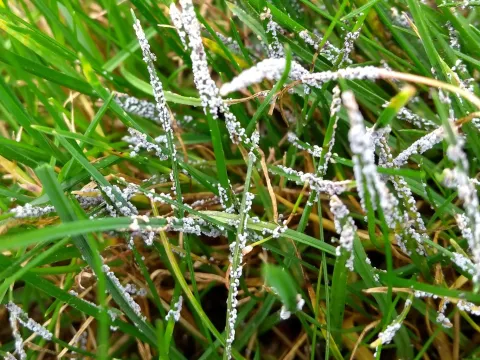
Physarum cinereum
Physarum cinereum
Physarum cinereum is a species of myxomycete, commonly known as a slime mold. It is not a true fungus but a protist that belongs to the kingdom Amoebozoa.
What the section contains
Physarum cinereum
The organism exists in a motile, multinucleate stage called a plasmodium. It travels across surfaces, engulfing bacteria, yeast, and decaying organic matter as food.
Its life cycle involves transforming from a vegetative plasmodium into stationary reproductive structures called sporangia, which release spores into the environment.
These organisms are highly adaptable and thrive by sensing moisture gradients and nutritional cues, allowing them to colonize new areas rapidly.
Identification is based on the morphological characteristics of the sporocarps, which typically appear as gray or ash-colored clusters upon maturation.
The primary concern regarding Physarum cinereum is its effect on turfgrass, ornamental lawns, and occasionally landscape plantings in high-moisture areas.
The plasmodium grows over the foliage of the grass, physically smothering the leaves and blocking the light necessary for photosynthesis.
While it is not a parasitic pathogen that extracts nutrients directly from plant cells, the prolonged coverage results in leaf yellowing, tissue death, and overall decline.
Aesthetic degradation is the most common impact, as the gray, dusty mats of slime mold make the lawn appear unsightly and neglected.
Severe infestations in golf courses can disrupt the smoothness and performance of the turf, leading to significant maintenance interventions.
Physarum activity is closely linked to weather conditions, peaking during periods of high humidity, frequent rainfall, or heavy dew accumulation.
The organism is most active in warm, damp weather conditions, typically during the mid-to-late summer months or early autumn seasons.
As the environment dries out, the plasmodium halts its movement and converts into dormant spores, which are resistant to desiccation and heat.
Dispersal is facilitated by rain splashing, wind, or mechanical equipment (mowers, trimmers), which can transport spores or plasmodial fragments.
When environmental moisture drops, the mold often disappears on its own, leaving behind only the powdery spore remnants that are easily removed.
The first sign is the appearance of gray, ash-colored, or white patches of slime that seem to coat the grass blades without causing immediate rot.
Upon closer inspection, the patches may feel slimy or wet, and they can be easily rubbed off, leaving behind a fine, dark, dusty residue on the fingers.
These patches often form irregular circular or patchy patterns across the lawn surface, expanding rapidly during wet nights.
- Ash-gray, powdery coating on grass leaves.
- Rapid expansion during humid, overcast weather.
- Absence of structural damage to the leaf tissue itself upon mold removal.
If left undisturbed, the slime turns into dry, crusty spore masses that persist until physical disturbance breaks them down.
Management of Physarum cinereum focuses on cultural practices rather than chemical eradication, as it is not a true fungus and ignores standard fungicides.
Improving lawn aeration and drainage is crucial to eliminate the water-logged conditions that allow the slime mold to thrive.
Avoid evening irrigation; watering should be done early in the morning so that the grass foliage can dry quickly during the day.
Mechanical removal is the most effective immediate control: use a leaf rake or a strong stream of water to break up the patches and increase air circulation.
Regular mowing and de-thatching help remove decaying organic matter, which reduces the potential food source for the plasmodial stage.