
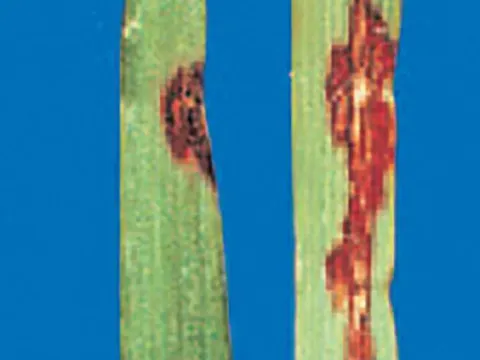
Phaeosphaeria leaf spot
Phaeosphaeria avenaria
Phaeosphaeria leaf spot, caused by the fungus Phaeosphaeria avenaria (with Stagonospora avenae as its anamorph), is a widespread fungal disease affecting oat crops globally. It is classified within the Dothideomycetes class.
What the section contains
Phaeosphaeria leaf spot
The fungus overwinters in infested crop residues, primarily as pseudothecia and pycnidia, which serve as the primary source of inoculum when favorable weather returns in the spring.
During the growing season, the fungus spreads via pycnidiospores produced in pycnidia, which are splashed by rain or wind-dispersed to healthy plant tissues.
This pathogen requires high humidity or frequent rainfall to successfully germinate and infect the leaves and stems of host plants, leading to disease outbreaks.
Microscopic examination of pycnidia is often required for precise identification, as symptoms can be easily confused with other leaf-spotting diseases of small grains.
Oats (Avena sativa) are the primary host of Phaeosphaeria avenaria, though the fungus can occasionally infect other cereal grasses, depending on local conditions.
The primary damage occurs on the foliage, where the fungus causes necrotic lesions, significantly reducing the surface area available for photosynthesis.
When infection reaches the upper canopy, especially the flag leaf, grain filling is severely compromised, resulting in low test weights and reduced total yields.
In addition to yield loss, the infection can degrade the quality of the grain, potentially impacting its suitability for milling or seed production.
Chronic infestations in fields with poor residue management can lead to cumulative economic losses over multiple growing seasons.
Disease development typically begins in the early vegetative stages, as the fungus spreads from lower leaves, which are in closest contact with infected debris.
The most critical periods for infection are during the stem elongation and heading phases, provided that rainfall and moderate temperatures occur.
Cool to moderate temperatures (around 18–22°C) combined with high humidity create the ideal environment for the fungus to multiply rapidly across the field.
By the time the grain reaches maturity, the fungus shifts its focus to saprophytic growth on dead straw, preparing the necessary structures for overwintering.
Monitoring fields during wet spells in the spring and early summer is essential for assessing the risk of severe disease development.
Initial symptoms present as small, brown-to-dark-brown spots on the leaf blades, which often enlarge into irregular, elongated shapes surrounded by a chlorotic halo.
The characteristic feature of this disease is the appearance of small, dark pycnidia in the center of mature lesions, which can be observed with a magnifying glass.
As the infection progresses, lesions may coalesce, leading to extensive necrosis, yellowing of the leaves, and premature senescence of the entire plant.
In severe cases, stem and leaf sheath lesions can weaken the structure of the plant, increasing the risk of lodging during adverse weather events.
- Small brown spots on leaves;
- Visible dark pycnidia in lesion centers;
- Necrosis and yellowing of the leaf surface;
- Lesions on leaf sheaths and stems;
- Reduced grain filling and stunted growth.
Crop rotation is the most effective cultural practice for managing this disease, as it allows for the natural decomposition of infected oat residues.
Tillage practices that incorporate crop debris deep into the soil can help reduce the amount of primary inoculum available to infect the next season's crop.
Selecting resistant or tolerant oat varieties is a key strategy for integrated disease management, especially in regions with a history of fungal outbreaks.
Fungicide applications, particularly those targeting the flag leaf, are effective in protecting the yield potential in high-pressure years or susceptible varieties.
Optimizing plant nutrition, specifically avoiding excessive nitrogen while ensuring adequate potassium, can help the plants better withstand pathogen stress.